In 2023, Seville adapted a 3,000-year-old underground water technique to cool a renovated amphitheatre; the system uses solar power, water and underground cooling
Rest of World News: In a bold move against soaring temperatures, Seville has innovatively revived the ancient qanat system, cooling air in an abandoned amphitheatre with a temperature drop from 104°F to 63°F using solar-powered technology.
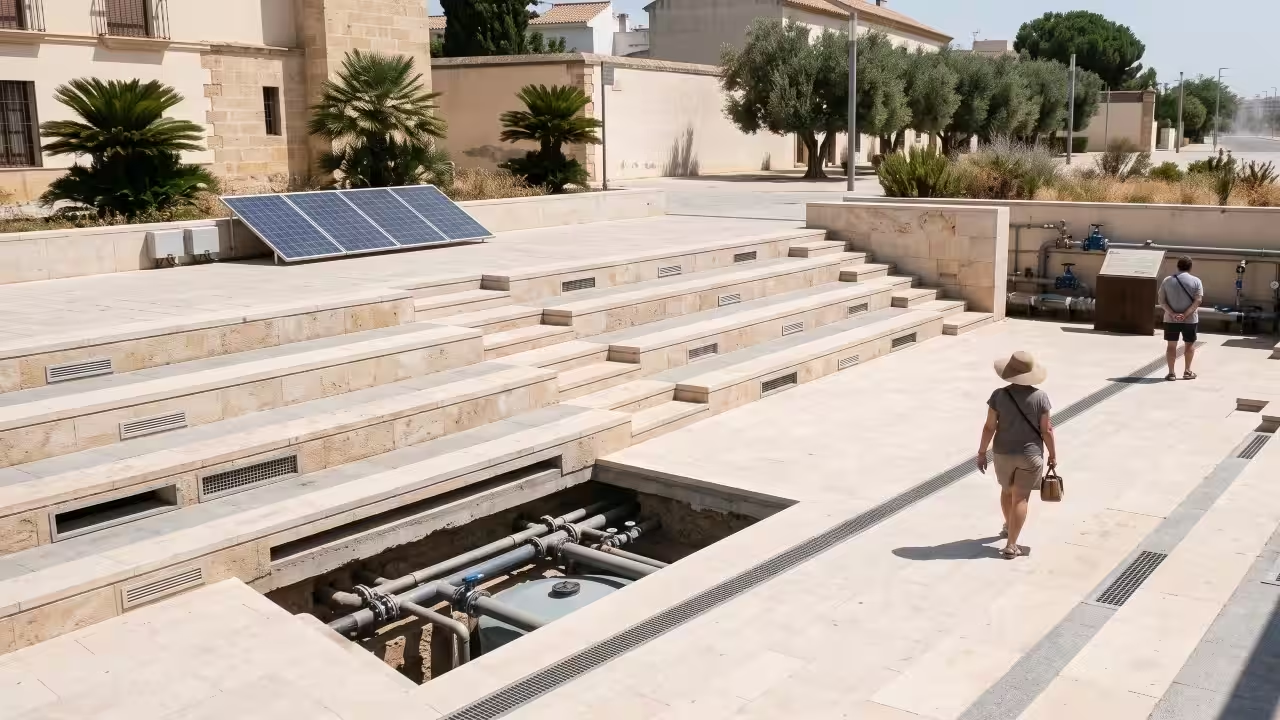
Seville regularly experiences extreme summer heat, with temperatures frequently approaching 40 degrees Celsius. The Andalusian capital frequently experiences temperatures close to 40 degrees Celsius, or roughly 104 degrees Fahrenheit. Officials there have formally begun naming and categorising heatwaves, just as meteorologists do with hurricanes. A group of engineers and researchers in Seville concluded that a method created thousands of years ago might help address a pressing issue in a climate that scientists predict will only become harsher.That method is the qanat, a network of subterranean tunnels that Persian farmers invented some 3,000 years ago to transport water through parched regions without losing it to evaporation. A project called CartujaQanat has adapted this ancient engineering for a public square and a renovated amphitheatre on a former Expo site on the Isla de la Cartuja. It uses solar power, buried pipes, and the earth's naturally stable temperature to draw cool air up from below ground while the surface bakes overhead.How Seville adapted an ancient irrigation method for coolingThe original Persian qanats relied on gravity and the depth of the tunnels. Persian engineers finally recognised that vertical shafts connected to these tunnels could carry both water and cooled air to the surface. Water went through tunnels that were excavated far enough below the surface to keep soil temperatures cool throughout the year. CartujaQanat reconstructs the same fundamental idea with contemporary materials and a closed water circuit. Water flows through rooftop solar panels and an outdoor aqueduct at night before cooling in underground tanks with stable ground temperatures and cooler night air. During the day, solar-powered pumps force the same water through pipes placed in front of fans, creating an air current that is released into the amphitheatre and plaza through tiny holes in the steps and floor. Engineers working on the project said that the system can lower ground and ambient temperatures at the site by as much as 10 degrees Celsius. The system uses the thermal stability of underground soil and water to cool air before releasing it into the occupied space.Why depth and darkness matter more than machineryUnlike a conventional air conditioner, the system relies on underground thermal storage, water circulation and solar-powered equipment rather than refrigerants and compressors. The site itself sits two metres underground, with a white ceiling that reflects heat and columns and vegetation around it to help keep the temperature down even when the active pumping system is not functioning. Related research on earth-air-water heat-exchanger systems has found that nighttime cooling can lower soil temperatures and help maintain cooler conditions into the next day. That is precisely why the project’s directors say it is fundamentally different from a domestic air conditioner: the entire process depends on solar electricity and the physical properties of soil and water, not refrigerants or compressors. The initiative required substantial investment and combined European urban-innovation funding with support from local institutions. The project combined European urban-innovation funding with support from local institutions.Other hot cities are now watching the project carefully as a modelSeville’s experiment addresses a combination of extreme heat and dense urban development that affects cities across the Mediterranean and other hot regions. Recently, Indian cities have increasingly named and recorded heatwaves, matching the institutional seriousness that Seville initially devoted to the problem. The CartujaQanat project demonstrates that some of the oldest engineering solutions humans developed for arid climates, refined with modern solar power and monitoring rather than replaced by them, may still have a meaningful role to play as summers grow hotter and city budgets for climate adaptation remain limited. The CartujaQanat project shows how underground water infrastructure, solar energy and thermal storage can be combined in a public space to reduce heat exposure without relying entirely on conventional air conditioning.Catch the latest World News and Live updates. Download the TOI app.
Topics in this story
Gathered from external sources. Rights to this text belong to whoever originally published it.