LPU Phagwara: A rape rumour sends an Indian university into turmoil and empties hostels
Police are trying to verify whether a female student was raped at Lovely Professional University (LPU).
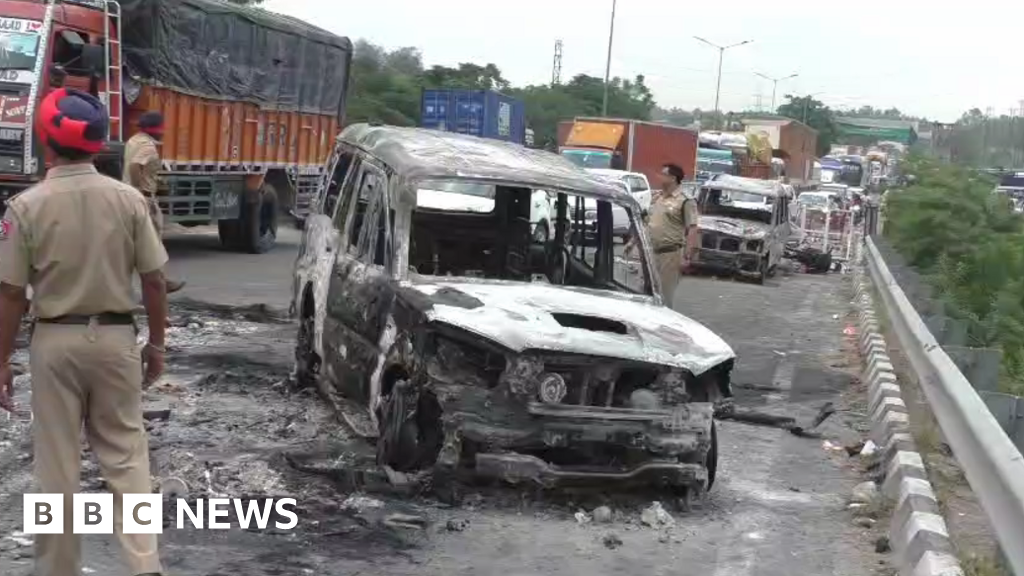
One of India's largest private universities has suspended classes after an unverified allegation that a female student was raped on campus set off protests that descended into violence.
Police say they have registered a case and are trying to verify whether last week's alleged rape at Lovely Professional University (LPU) did happen. The university has categorically denied the allegation.
Police say no student has come forward to say she was assaulted, investigators have yet to identify the alleged victim or the perpetrator, and CCTV footage examined so far has yielded no evidence of an attack.
But rumours on student WhatsApp groups led to unrest over the weekend at the sprawling 600-acre university in Punjab that draws students from India and abroad.
Founded in 2005 by a family whose business began with a small sweet shop, LPU has grown into a largely self-contained world of hostels and lecture halls, with thousands of young people living on campus.
Images and videos showed vehicles in flames, crowds filling a major highway and police wielding canes as unrest spilled beyond the university gates. Police vehicles were damaged, officers injured and parts of the campus was vandalised.
By Monday, the highway had reopened and the campus was calmer, but heavily policed.
University authorities described the claims circulating on social media as false and baseless, but it did little to reassure students with hostels emptying within hours. Key exams were postponed and students were allowed to go home.
Following demands from protesting students, police registered a rape case against "an unidentified person" and formed a seven-member special investigation team, or SIT, to investigate.
The unrest began in the early hours of 27 September, when word spread that a female student had been raped in or near one of the university's hostels a few days earlier.
The suspect was variously described - by students and in media reports - as a plumber, painter or construction worker. Some students said the assault had occurred on 23 September and accused the university of failing to act after being informed.
BBC Punjabi found that messages about the allegation had circulated through WhatsApp groups. As they travelled, crowds gathered.
Hundreds eventually spilled on to National Highway 44, a major route between Delhi and Punjab, blocking traffic for more than 15 hours. By Sunday evening, university property had been damaged, objects set alight and stones thrown at police vehicles. Videos showed police striking protesters with canes, although police later denied carrying out a baton-charge.
Behind the gates, students described a night of fear.
"We were sitting with knives and scissors," Arya, a student, told BBC Punjabi. Students had been told to lock themselves inside their rooms, she said, while people knocked on their doors. "We were just thinking that somehow this night would pass and we would get out of here."
Police later arrived and made them feel safer, she said. By the next day, she wanted to leave. "Our parents also want us to just get out of here."
Because that was among the protesters' central demands.
"The students have been demanding that an FIR [First Information Report] is to be registered, but the students could not provide us with any victim's name," senior police official Naveen Singla told the BBC.
Police nevertheless registered an FIR under India's rape law against an unidentified person. An FIR formally records an allegation for investigation; it does not establish that a crime occurred.
Singla said investigators had also begun examining CCTV footage. The preliminary search, he told the BBC, had so far shown no outsider entering a room.
"As of now, it can't be verified that rape has happened or not," he said.
But they are continuing to examine the footage.
"The campus is quite large, so we haven't been able to see all the cameras yet," Sinha told reporters on Monday. "We have initially checked the places that the students had mentioned, but we will get to the bottom of this."
It is difficult to say. What began with an allegation of rape quickly became a broader protest over security, the university's response and, eventually, the violence itself.
There was also growing uncertainty over who was on the campus. Some students insisted the demonstrations had begun peacefully and blamed outsiders for at least some of the violence. Others told BBC Punjabi of seeing masked or unfamiliar people inside the university.
"We were really scared," said Pawan, a student. "It became a complete battlefield."
Another student, Aniket Singh, said outsiders had entered a women's hostel and knocked on doors claiming to be police officers. Police have since confirmed that outsiders were among the crowds, but said they were still trying to establish who they were and what role they played.
Amid that confusion, the university's attempt to dispel the rape allegation produced a controversy of its own.
On Monday, LPU released a video of three women living in the hostel room that had been linked to the alleged assault. They said nothing had happened there and asked people to stop disturbing them.
The same students later alleged in another video that university officials had instructed them what to say, edited the recording and posted it without their consent. Those claims have not been independently verified. LPU has not commented on the students' allegations.
Another claim circulating during the protests sought to connect the alleged rape with the recent suicide of a female LPU student from Telangana state. Police say investigations into her death had already begun and there is no verified evidence linking the two cases.
For now, life on campus has been interrupted. Regular classes have been suspended for 10 days and exams postponed. Students have been asked to return home after consulting their parents or guardians.
Those who are staying have been advised to stay in their residences and avoid further unrest.
The Punjab State Women's Commission has also sought the FIR, details of the investigation and information about arrangements for students' safety.
The investigation now has two separate questions to answer: whether there is evidence of the assault that set the protests in motion? And who was responsible for the violence that followed?
Addressing the students on Monday, LPU's pro-chancellor Rashmi Mittal said she was hurt that despite the university's many channels for students to raise concerns, they had instead "believed the rumour that was spreading". She also alleged that outsiders had joined the unrest.
"I feel students can't do this," she said.
Additional reporting by Harmandeep Singh, BBC Punjabi
Follow BBC News India on Instagram , YouTube, X and Facebook .
Topics in this story
Gathered from external sources. Rights to this text belong to whoever originally published it.