In 1914, a Connecticut writer opened one of America’s first private songbird sanctuaries; her work helped shape a statewide bird-protection movement that still operates
Explore the rich history of Birdcraft Sanctuary in Connecticut, established in 1914 by conservationist Mabel Osgood Wright, and its ongoing impact on bird protection and conservation efforts in the state.
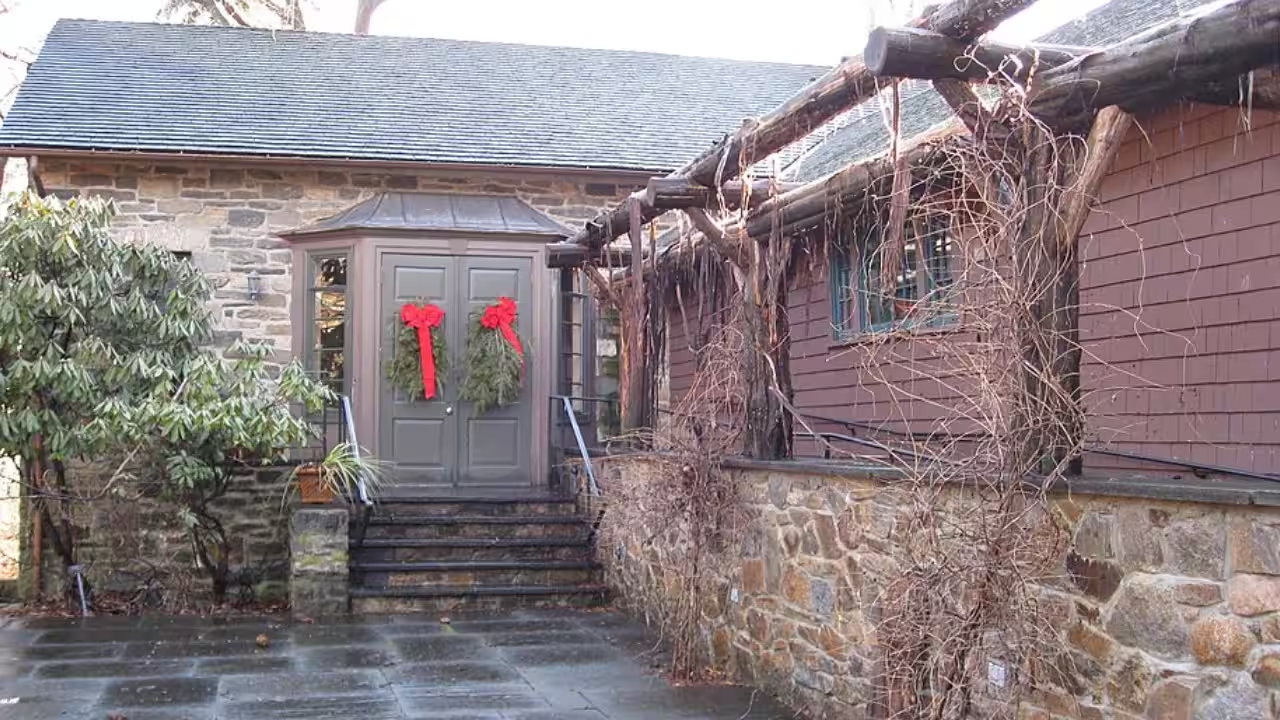
Birdcraft Sanctuary was founded in Fairfield, Connecticut, in 1914, and the Connecticut Audubon Society describes it as one of the first private songbird sanctuaries in the United States. It is a National Historic Landmark. Its creator was Mabel Osgood Wright, a writer and conservationist who had already spent years pressing for laws to protect birds. The sanctuary did not start the state's bird-protection effort so much as give it a home. Wright helped found the Connecticut Audubon Society in 1898, sixteen years earlier, and the society still operates. Its history page lists centers and sanctuaries across the state, along with an advocacy program in Hartford that has run since 1974.Wright helped found the Connecticut Audubon Society in January 1898The Connecticut Audubon Society's history page says a small group of women in Fairfield founded it in 1898, including Wright, Helen Glover, Theodora Wheeler and Harriet Glover. A profile of Wright, written by a later chair of the society's board and republished in 2023, puts the founding in January 1898 and says Wright served as president until 1924. Wright was also a prolific author. The profile counts 27 books, beginning with The Friendship of Nature in 1894. Her 1895 bird guide, Birdcraft, was reprinted nine times and served as the most popular bird guide until Roger Tory Peterson’s Field Guide to the Birds appeared in 1934. She joined the founding board of the National Association of Audubon Societies in 1905, though the Connecticut society stayed independent when that group became the National Audubon Society in 1940.Annie Burr Jennings funded a 10-acre former pasture that opened as Birdcraft in 1914Wright had earlier advocated for "songbird reservations" before she made one. After she and some friends watched a play about a feather hunter who became a bird conservationist, Jennings urged that Connecticut needed a sanctuary and that Wright should create it. Jennings's gift of 10 acres in 1914, the society's history page says, let Wright create Birdcraft Sanctuary. The land was a piece of former pasture within walking distance from the train station and near the Wright residence. It contained trees and berry bushes which were favorable for the birds. Workers erected a fence designed to keep away cats, created paths, planted shrubbery, constructed a cabin for a caretaker, and dredged a pond fed by springs. Wright planned the sanctuary as both a refuge for birds and a place where people could observe them.Nearly 1,000 visitors in the first month drove the birds away and led to a museumThe public reaction almost ruined the whole plan. According to the profile of Wright, nearly 1,000 visitors came in the first month, and the birds vanished. Instead of limiting access, however, the board came up with a different idea. Visitors would keep bringing dead birds and asking about them, so the caretaker, Frank Novak, who was also a taxidermist, would mount them. This resulted in the creation of a one-room museum with seasonal displays, this time funded by Jennings, the construction of which began in late November 1914 and which opened in March 1915. By July 1, 1915, the sanctuary had received 1,300 visitors, and 52 nests were recorded in its first year. It also followed the harsher management practices of its era: cats were not allowed, and predatory birds were removed as well.Bird-protection bills from 1907 to 1919 came out of the society Wright ledHer efforts transcended the fence line. According to the profile, the society she helped form backed legislation on hunting control in 1907, protection of birds and eggs from collectors in 1911, sandpipers in 1912 and the International Migratory Bird Treaty Act in 1918. It opposed a bounty on Bald Eagles in 1919. Once the bills were approved, Wright campaigned for their enforcement. Frank Chapman described Birdcraft in Bird-Lore as "an object lesson in conservation and museum methods." Birdcraft became a model for other projects. Bird-Craft also inspired the Theodore Roosevelt Memorial Sanctuary in Oyster Bay, after Roosevelt's widow visited while seeking a fitting memorial.The 1957 Interstate 95 route took nearly half the land, and landmark status came in 1993After Wright died in 1934, the sanctuary changed drastically. According to the Connecticut Audubon Society's profile of Wright, the construction of Interstate 95 in 1957 took nearly half of Birdcraft Sanctuary's land. The state initially offered $20,000 in compensation, and appeals failed because it did not recognize the property's value as a sanctuary. The final settlement was $42,000, which the profile says fell far short of covering the loss.However, even then, the place continued serving its purpose. Even so, the sanctuary kept serving its purpose: migrating birds still use the pond and dense vegetation between the highway and the railroad. It was designated a National Historic Landmark in 1993. According to the society's Birdcraft web page, more than 150 bird species have been recorded there, and it is a federally licensed bird banding station.The society now operates sanctuaries and a Hartford advocacy programAccording to its history page, the society opened the Center at Fairfield in 1971, the Coastal Center at Milford Point in 1995 and the Center at Pomfret in 2000, and it launched its Science in Nature program in 2012. Since 1974, its Hartford advocacy program has contributed to every major environmental initiative in Connecticut. This information makes a cautious interpretation of the legacy of the sanctuary justified. Birdcraft did not found the bird protection campaign in Connecticut, as it was established by the society back in 1898. However, it provided this campaign with its public location, a way of teaching people about birds, and a record of success, and it continues to work as an organization.You use AI every day. Now get your AI Quotient. Take the AIQ test.
Topics in this story
Gathered from external sources. Rights to this text belong to whoever originally published it.