In 2025, about a dozen Getty Villa workers stayed as the Palisades Fire reached the grounds, fighting spot fires and sealing galleries; the museum and ancient art survived untouched
In January 2025, Getty Villa employees bravely fought to save the museum's priceless Greek and Roman art from the devastating Palisades Fire, demonstrating the importance of preparation and emergency response in the face of natural disasters.
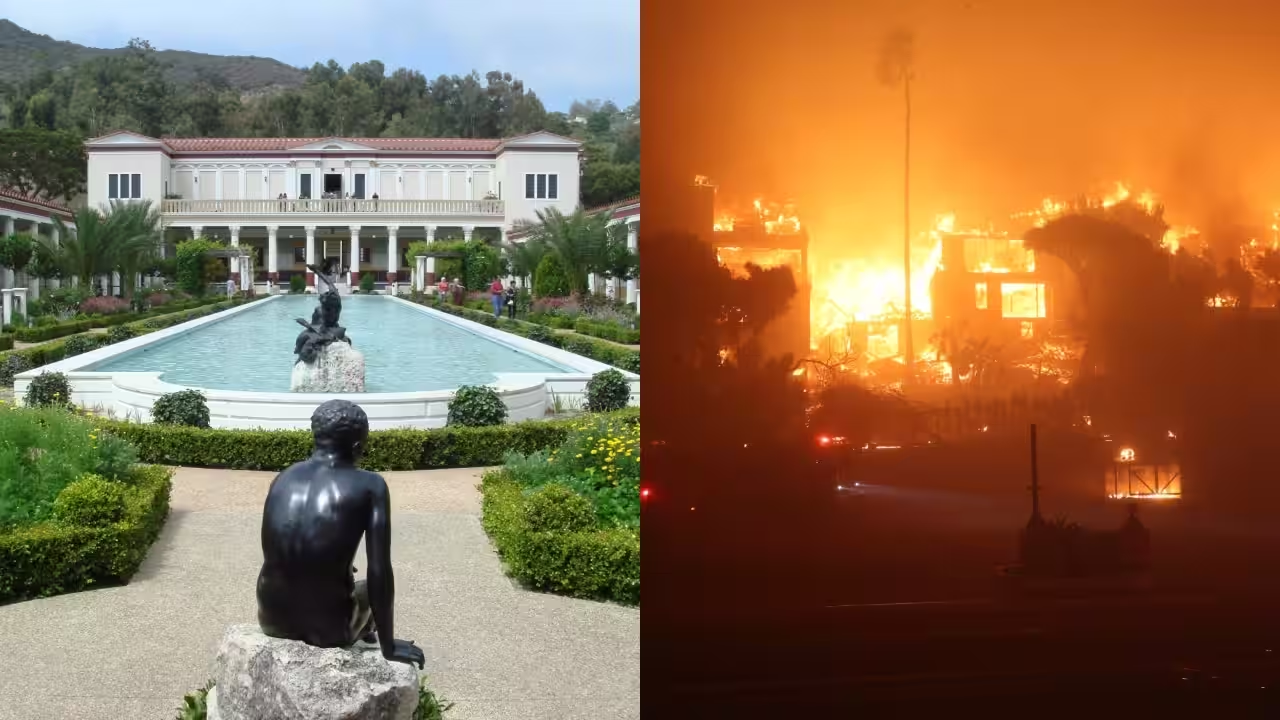
Museums are designed to last for centuries, but a single windy afternoon can still endanger a collection. Ancient ceramics, bronze and marble have survived graves, wars and earthquakes, and once they are lost, they cannot be restored. That was the risk facing the Getty Villa, a Pacific Palisades museum of Greek and Roman art, when a brush fire was reported about two miles away on January 7, 2025.It turned out that a combination of astute engineering and courageous individuals was the solution. According to Getty, every employee except about a dozen security and facilities volunteers went home. Those who stayed worked from the Villa's Emergency Operations Center, sealed the museum doors and put out small fires around the grounds while the main fire burnt nearby.When the smoke cleared, the buildings of the Villa were unharmed, and the art inside was undamaged, although the grounds did lose a considerable number of trees. This is not a call for ordinary people to stay put when told to evacuate. The Villa appears to have benefited from a detailed emergency plan, a purpose-built site and a direct line to fire authorities. Their experience offers lessons on preparation.A museum built for fireThe Villa had been built with fire in mind long before that January day. Getty says its walls are reinforced concrete beneath a tiled roof, and fire-rated doors can prevent smoke or flames from spreading to the rest of the site. A carbon-filtered air conditioner maintains a steady flow of pressure, which can be increased to keep out smoke and ash. In each room, detectors are set to an extremely low threshold to detect a fire at its earliest stage.The sprinklers are a surprise. They are kept absolutely dry to avoid accidental water damage and are only used as a last option. In case of loss of the main utility pressure, a backup water reservoir will serve the site. Emergency generators will operate the fire systems and lighting for weeks.Outside, the gardens had been constructed with fire in mind. The property is surrounded by oak trees, which absorb water effectively and burn more slowly than other plants; an irrigation system keeps the soil moist; and grounds staff clear low brush throughout the year, working beyond the distance the Los Angeles Fire Department requires.Timing also helped: the Villa was closed to the public on Tuesdays, so no visitors were on site when the fire arrived. Getty’s emergency preparedness specialist, Les Borsay, was testing the fire alarm system around 10 a.m. on Jan. 7 when a phone warning came in reporting a brush fire about two miles away. Within two hours, he said, it was already quite near. But buildings don’t put out a fire on a lawn, and that’s where the crew came in.Inside the long dayThe scale of the fire explains why the Villa could not count on outside help. CAL FIRE said the Palisades Fire began at 10:30 a.m. on Jan. 7, 2025, burned 23,448 acres before it was fully contained on Jan. 31, destroyed 6,845 structures, damaged 975 others and killed 12 civilians. As the fire spread, thousands of structures were in its path, and crews could not be committed to any one siteWithin the Villa the volunteers got themselves organised. The engineering manager monitored the humidity levels in the galleries and took action when alarms sounded, switching building systems to safeguard the collection and sealing the museum doors. The teams at the Villa and at the Getty Center in Brentwood checked security cameras for signs of flames, and the Center's personnel assisted in sending warnings when some radios at the Villa stopped working. Others patrolled in security vehicles, keeping watch on weak spots such as a parking area where cars would have been dangerous if they caught fire.Staff took turns during the day and into the night to step into the hot, smoky air and put out tiny flames with extinguishers, shovels or their boots. They put on N95 masks and goggles and were warned to return indoors after 20 to 30 minutes. Fires broke out in rosemary vines near the visitor car park, in plants above the Outdoor Classical Theatre, and immediately outside the front gate.“The difficulty was the wind; as soon as one fire was extinguished, another popped up behind them,” said security supervisor Carl Gordon. “My crew used at least 40 five-pound extinguishers.” None of them were firefighters. “I was at the Villa for 28 hours straight,” adds Borsay. Others stayed for 72 hours, sleeping in turns. Flames were near. The team dialled 911 to direct firemen to adjacent fires. Water was dropped by air on a slope near to the Ranch House, the first Getty museum, and firefighters were welcome to fill their vehicles from the Villa’s 50,000-gallon water tank.What other museums can learnUS Forest Service scientist Jack Cohen's research suggests that whether a home ignites during an extreme wildfire is largely determined by the house and its surroundings within about 100 feet, with flying embers and small surface fires among the main threats. That is consistent with the villa's practice of cutting brush early and keeping the soil damp. It also suggests why putting out small fires promptly can make a difference.The Getty team has been candid about what did not go so well. "The modest five- and 10-pound extinguishers we used were never intended for brush fires," Borsay told ABC7. Getty staff have since told other cultural institutions that water-based extinguishers work better than dry chemical ones in strong wind, and that staff should be sent home early.There was also the human side. Gordon said family members continued asking him why he had not left. After 30 years at the Villa, he said he felt a sense of responsibility for the institution. Security staff also handed out food, drink and torches to stranded neighbours nearby.About a dozen volunteers stayed at the Villa, but they did so under a plan, with training and with fire services close at hand. For everyone else, the official advice remains the same: when evacuation orders are issued, leave. Let preparation done ahead of time do the work.You use AI every day. Now get your AI Quotient. Take the AIQ test.
Topics in this story
Gathered from external sources. Rights to this text belong to whoever originally published it.