Wisconsin Rapids rejected a data centre plan for a former paper mill; the 1.2 million sq ft project now faces a year-long development freeze
Wisconsin Rapids, a city in the US state of Wisconsin, has rejected a proposal to transform a former paper mill site into a large data centre, ending
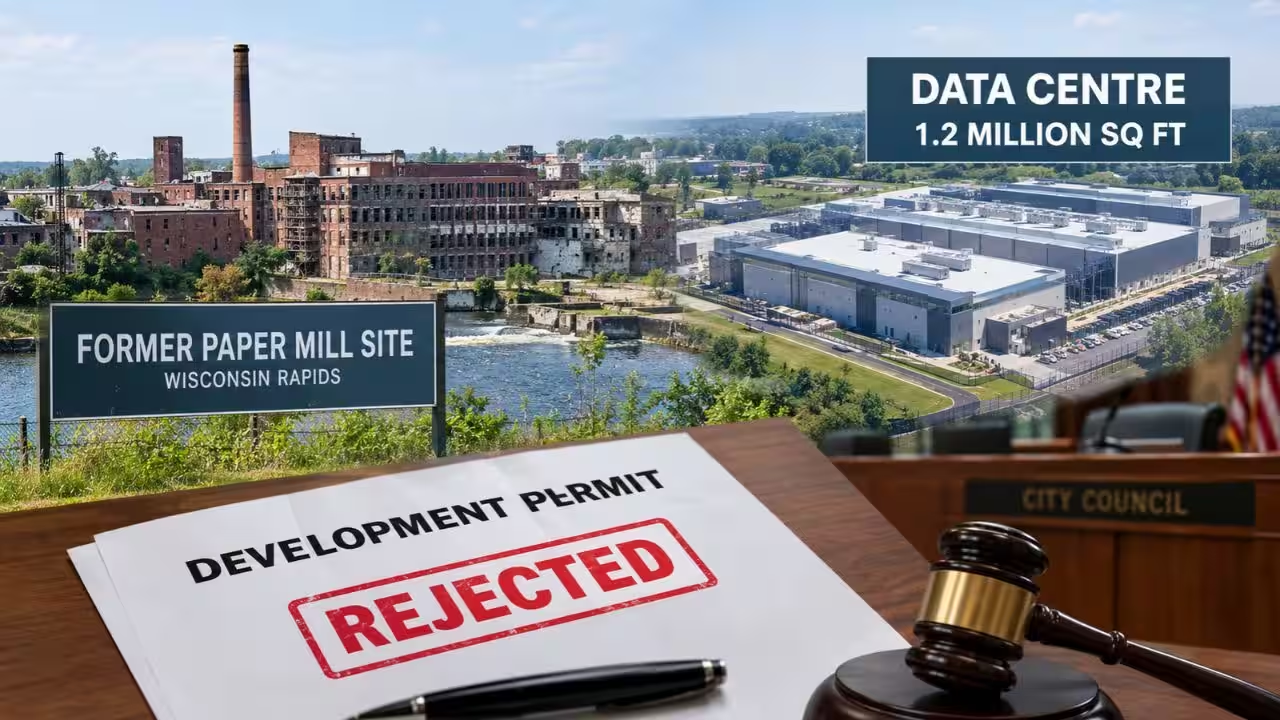
Wisconsin Rapids, a city in the US state of Wisconsin, has rejected a proposal to transform a former paper mill site into a large data centre, ending months of debate over the future of the property. On October 20, 2026, the city's Common Council voted unanimously against the development permit, following concerns about the application and opposition from local residents. The decision comes as the city implements a year-long moratorium on new data centre developments, giving officials time to review local rules before considering similar projects in the future.Wisconsin Rapids declined the former paper mill data centre planAccording to WXPR's report, the Common Council voted 7-0 to reject the conditional use permit for the proposed hyperscale data centre. The project was planned for the site of the former paper mill, which had been a major part of the city's economy for more than a century.The decision followed an earlier recommendation from the city's Planning Commission, which voted unanimously against the application in September. Concerns centred on missing information and whether the developer had provided sufficient details to demonstrate that the proposal met the city's requirements.As reported by Civic Media, the commission identified gaps relating to electrical utility approvals, staffing plans, construction traffic and building layouts. The developer disputed the findings, maintaining that it had responded to the city's questions.The Common Council's final decision meant the application could not proceed under the proposed permit. It also reflected the wider debate about how the city should manage large technology developments and assess their potential effects on the surrounding community.What was planned for the former paper mill siteThe proposal was submitted by PNK Group USA, which sought to redevelop approximately 209 acres of the former mill property at 950 Fourth Avenue North. According to Civic Media, the planned campus would cover around 1.2 million square feet, combining the renovation of an existing building with the construction of four additional buildings.The development was intended to accommodate large-scale computing operations, including those associated with artificial intelligence. The proposed facility was expected to require approximately 150 megawatts of electricity, making power supply an important consideration in the planning process.The location was attractive to developers because of the infrastructure already available at the industrial property. Wisconsin Public Radio explained that the former mill had connections to electricity, roads, railways and other essential networks.However, the site's industrial history did not guarantee approval for a new development. The application still had to satisfy the city's planning requirements, while residents and officials sought greater clarity about the proposed facility and its potential long-term effects.The former paper mill became available for redevelopmentThe site has a long history in Wisconsin Rapids, where the paper industry shaped local employment and community identity. The mill opened in 1894 and became one of Wisconsin's largest paper-making operations.According to WPR, the facility specialised in glossy magazine paper during its later years. However, declining demand for that product contributed to its closure in 2020, during the COVID-19 pandemic. The shutdown left nearly 1,000 people without jobs, marking a significant economic change for the city.Attempts to restart the mill or find a buyer were unsuccessful, and the industrial buildings were demolished in 2025. The cleared property subsequently became a potential site for redevelopment.WPR reported that a data centre proposal first emerged in December 2025. Interest in the site grew partly because of its existing electrical capabilities and its previous industrial use.Although the property offered an opportunity to attract new investment, its future became a source of disagreement. Some residents wanted a development that would create employment while addressing local priorities, rather than automatically accepting a large data centre as the next use for the land.Concerns raised by residents about the projectOpposition to the proposal developed over several months. According to WXPR, members of South Wood County Neighbors for Responsible Development organised against the development, attending meetings and working to prevent the project from moving forward.Residents raised concerns about noise and the potential effects of increased electricity demand on local energy costs. Questions also arose about the project's environmental implications and whether the information supplied by the developer was sufficient to assess its impact.The group formed in April 2026, and its campaign continued through public meetings and discussions with local officials. Marissa Johnson, a member of the organisation, told WXPR that opposing the proposal had become a sustained effort over the preceding 6 months.The developer also held meetings to explain the proposed facility and outline its potential benefits. Civic Media reported that PNK Group promoted the possibility of new jobs and investment, alongside a proposed $5.7 million community benefits plan.That plan included funding for public waterfront access, emergency response services, workforce training and river protection.How will the year-long development freeze affect future proposalsThe rejection of the permit comes alongside a separate decision to pause new data centre development. WXPR reported that Wisconsin Rapids introduced a one-year moratorium on October 9, 2026, with the option of extending it to 18 months.The restriction prevents new data centre proposals from proceeding while the moratorium remains in effect. City officials intend to use the period to review existing ordinances and determine whether additional rules are needed to assess future applications.Mayor Matt Zacher told WXPR that he was not opposed to all data centres but believed the city needed to take its time to ensure that developments were planned properly. He warned that a poorly designed facility could affect the community for decades.You use AI every day. Now get your AI Quotient. Take the AIQ test.
Topics in this story
Gathered from external sources. Rights to this text belong to whoever originally published it.