Jordan attacks militants in Syria tied to last week’s church attack, state media says
AMMAN, Jordan — The Jordanian air force carried out strikes against groups in Syria in retaliation for Friday’s attack on a Greek Orthodox Church in Karak that killed nine people, Jordanian state media reported Monday.
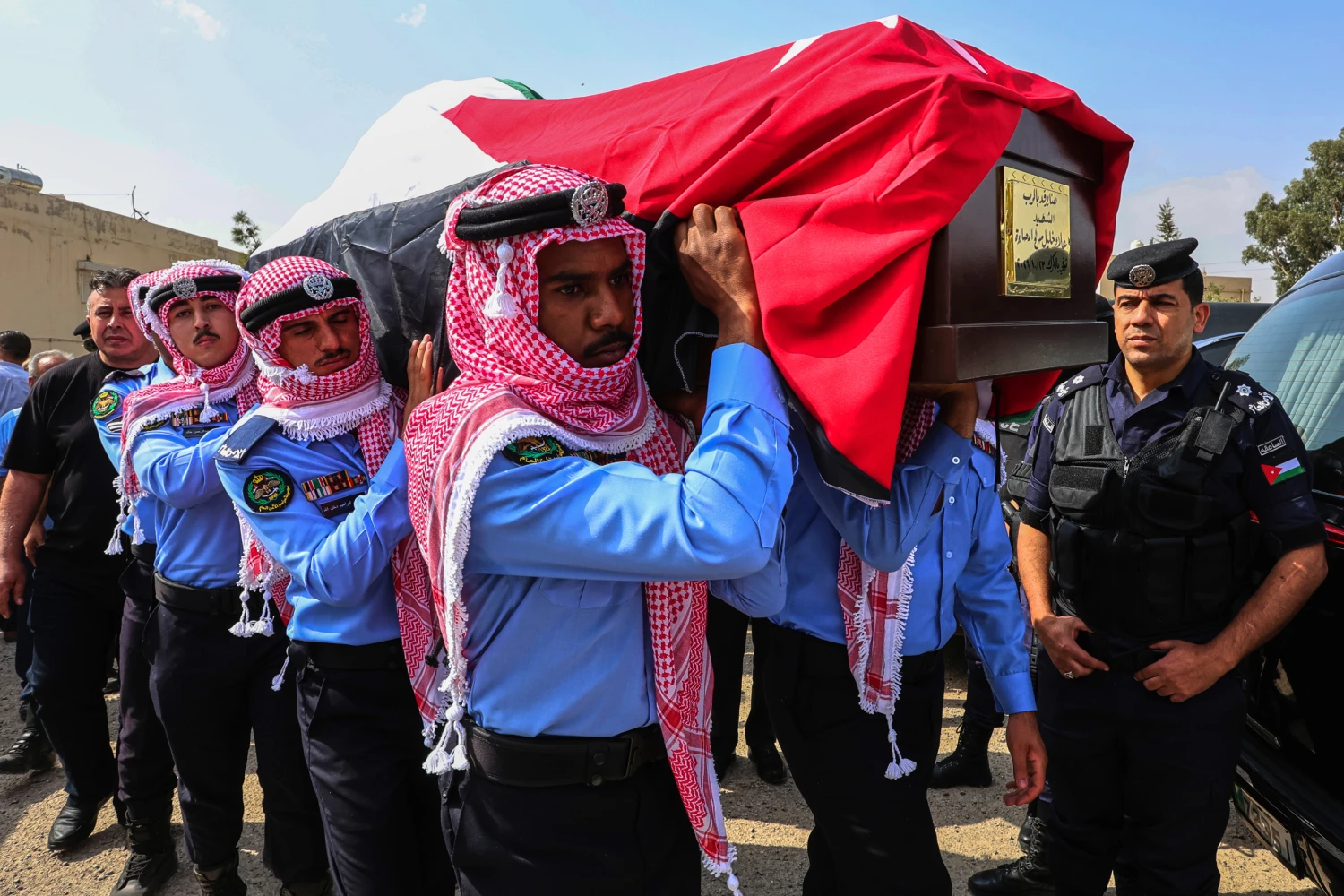
AMMAN, Jordan — The Jordanian air force carried out strikes against groups in Syria in retaliation for Friday’s attack on a Greek Orthodox Church in Karak that killed nine people, Jordanian state media reported Monday. It said the operation “resulted in the killing and wounding of many members of these terrorist groups and the destruction of a number of their vehicles.” It did not specify who the groups were or the precise location of the strikes. Syrian state TV said there were reports of civilian casualties following Jordanian airstrikes south of the village of al-Masmiyah in the southern province of Daraa. Earlier Monday, Jordanian authorities arrested three men for last week’s attack, which also wounded more than two dozen people. The arrests followed a dawn shootout, and all three men were wounded, officials said. The attack struck the Greek Orthodox Church during a funeral in Karak, about 90 kilometers (55 miles) south of the capital, Amman, on Friday. Karak is home to a minority Christian population. The attack shocked the nation, and Jordan declared three days of mourning for the victims. No group immediately claimed responsibility for the attack; the attackers’ motive remained unknown. Later Monday, the Public Security Directorate identified the three arrested men as brothers Hazzah Zaidan Mohammad and Mishal Zaidan Mohammad, and their brother-in-law Ahmad Sami Hussein. All three are Jordanian; they were taken into custody in Karak, south of Amman. The agency’s chief described the gunmen as “takfiri,” a term used for Sunni militants, but said they were not tied to any organized group. “They only represent themselves,” Maj. Gen. Obaidallah Abd Rabbo Al-Maayta told a news conference. He also said a large cache of munitions was found in the abandoned house where Jordanian forces apprehended the men. Jordan’s Interior Minister Mazen Al-Faraya said the attack by the three was the result of “a terroristic, extremist way of thinking.” “If this way of thinking is not resolved, we will see incidents like this again,” he told reporters. Jordan’s King Abdullah II had ordered authorities to respond with “an iron fist” against what he called the outlaws of Islam and anyone attempting to undermine the unity of the Jordanian people. “We vowed the terrorists would not escape punishment, and no proponent of dark ideologies that divide Jordanians will be tolerated,” he said in a statement on Monday. Relatives of the victims said the arrests brought them some relief. “Despite the profound and immense tragedy, what happened today has eased our grief — and the grief of the Jordanian people — not just for us, the families of the martyrs,” Khaled al-Borqan, himself a survivor of the attack and a relative of three of the people killed, told Al-Mamlaka. “Despite the sadness and pain, the news brought us joy,” Fares Halaseh, an uncle of one of the victims and a survivor of the attack, told the TV station. But the pain remains, he added. “We will not forget this agony for years to come.”
Topics in this story
Gathered from external sources. Rights to this text belong to whoever originally published it.