I Know Sun Damage Is Bad—but When Did It Become a Moral Failing?
Wear your sunscreen and mind your business.
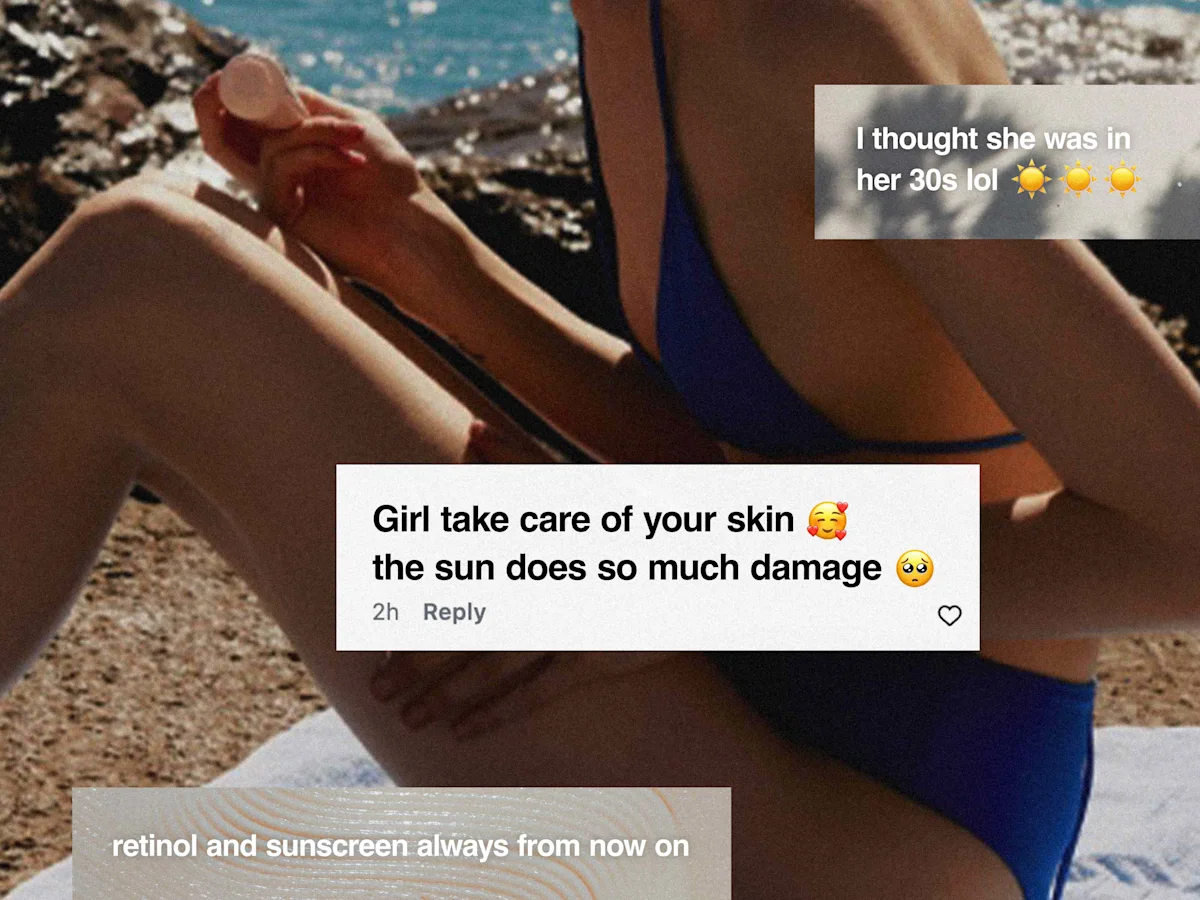
Sun damage is often a target for cruel comments on social media, with skin-related remarks being made with full names and profile pictures, unlike comments about body shape or size.
Sun damage is a complex process influenced by genetics, lifestyle choices, and other factors, with discoloration often making a face appear older, not just wrinkles or creases.
Shame and humiliation are not effective strategies for encouraging sun protection, as they can lead to internalizing negative messages about appearance and aging.
It's a common talking point amongst millennials that younger generations wouldn't survive the anonymous brutality of the internet of yore. But as someone who was both there back then and is currently wedged deep in our modern social media age, I have to say—every day there is a TikTok comment that quite literally gives me pause with its staggering casual cruelty. The target is often a woman (of course), and the comment is almost always about her appearance, but there's a strange pattern you'll notice after a while. Leave a cutting remark about body shape or size, and you'll be brigaded (rightfully) with dozens of replies setting you straight. Skin, though? Particularly when it comes to signs of sun damage or the look of premature aging, there's no need to go anon—that "I'm bored, let's put on sunscreen" comment is made with a full name, profile picture, and a school tagged in their bio. The body positivity movement has made major strides in the past 20 years, but somewhere along the way, we left skin out of the equation. Sun damage is a particularly prime target, maybe because of the (much needed) mainstreaming of information around SPF and safe sun . There's a perceived culpability, a "you-did-this-to-yourself- yikes" undercurrent that seems to grant license to lob the meanest shit imaginable at unsuspecting posters, couched in smug morality. All sorts of lifestyle choices are apparent in our appearance—why does this one feel like such fair game?
The human brain has a remarkable ability to subconsciously track patterns and draw conclusions, critical for our survival (great for evading predators and now making sweeping inferences in DeuxMoi comment sections). Those mechanisms naturally extend to appearance—ourselves and others—but there's more cultural and social work at play than we realize. When it comes to evaluating sun damage, we seem to think we can read someone's values off their face. Has this person consciously chosen to skip sunscreen out of an inability to delay gratification? Are they not smart or well-read enough to know about its dangers? Are they a MAHA-adjacent SPF eschewer, convinced the chemical compounds are the real danger here? Each assumption turns a physical characteristic into a character assessment, collapsing the distance between what someone looks like and who we decide they must be. It's part of the problem with the whole "Republican makeup" accusation. The problem isn't recognizing that aesthetic trends can carry cultural associations, because they very much do. It's more the certainty with which we attempt to reverse-engineer character from traits that may be only partially chosen—or not chosen at all. And unlike excessive eyeliner, sun damage isn't something you can wash off at the end of the day.
The reality is, we don't always know what we're looking at. Sun damage is not just pigmentation or wrinkles, explains Dr. Shereene Idriss, board-certified dermatologist and founder of Idriss Dermatology in New York City . It's a complex process that manifests differently based on a number of factors, including genetics. "Some people age faster or appear more weathered because of genetics, despite taking proper precautions around sun exposure because aging is never one variable," she shares. Interestingly, Dr. Idriss also notes discoloration is oftentimes what makes a face read as older, rather than the stereotypical idea of wrinkles and creases—which is likely what spurs those nasty "you look 50" comments on a video of someone clearly sitting at a classroom desk wearing Brandy Melville. She also adds that not all brown spots, of any shade, automatically equal sun damage. She lists freckles and melasma as two examples—though UV exposure can exacerbate both of them, they're also influenced by genetics and hormones. Of course, her medical training and practice experience compel her to add in an important bottom line: While genetics are an undeniable factor in the look of aging, it's lifestyle choices that ultimately play a bigger role. Daily sunscreen should be an absolute nonnegotiable.
But let's go ahead and take the least charitable scenario anyway. Say the commenters are right: Someone spent decades skipping SPF, absolutely roasting in the sun, and personally accumulating the damage now visible on their face. They did, in some meaningful sense, "do it to themselves." When did that become permission to humiliate them for it? The most obvious analogy is pointing out someone's body weight in either extreme direction, a full-on social taboo by now (as it should be). Weight, too, is routinely—and often reductively—understood as the visible consequence of personal choices. Yet we've largely arrived at the understanding that whatever combination of biology, circumstance, and behavior got someone there, their body is not an open invitation for commentary. Why hasn't skin been afforded the same grace? Is there something reassuring about believing that we've made the "right" choices when someone else seemingly hasn't?
Shame is rarely an effective strategy no matter how you serve it up. In fact, according to Dr. Rachel Goldman, New York-based psychologist and author of When Life Happens , it can propel people in the exact opposite direction. "We live in a culture that tells us that if we just make the 'right' choices, use the right products, eat the right way, exercise enough, we can control how we look and how we age," she explains. " We can educate people about the risks of UV exposure, using sunscreen vs. not using sunscreen, without turning it into a judgment about their character." Critically, she adds, health education and shame are two very different things. The cruel remarks are difficult to not internalize, and can feel especially personal when it's about your appearance. "If someone is constantly being told that they look bad, made bad choices, or should be ashamed of their appearance, eventually those external messages can become part of their own internal dialogue," she says.
There is some comfort in this perception of control, too. If someone else's visible aging can be neatly traced back to a series of wrong choices, then perhaps our own can be staved off indefinitely by making all the right ones. The faces in our phone become an FYP of cautionary tales, proof that the rules work, and that we're following them correctly. The rules, too, haven't always been this neatly spelled out. The people getting dragged for visible photodamage in 2026 didn't necessarily spend their entire lives in a culture where daily SPF 50 was a rote part of daily life.
We spent decades actively valorizing tanning—and still do to some extent, as evidenced by the alarming rise of Melanotan —and now we're laughing at the women whose skin bears the evidence of pursuing the beauty standard we handed them. Yesterday's beauty standards have been conveniently recast as today's personal failing. Hindsight makes for one hell of a high horse.
Topics in this story
Gathered from external sources. Rights to this text belong to whoever originally published it.