Head teacher evacuated 900 children minutes before Nepal floods hit
Rajendra Dawadi leapt into action after receiving warnings over waters heading towards his school.
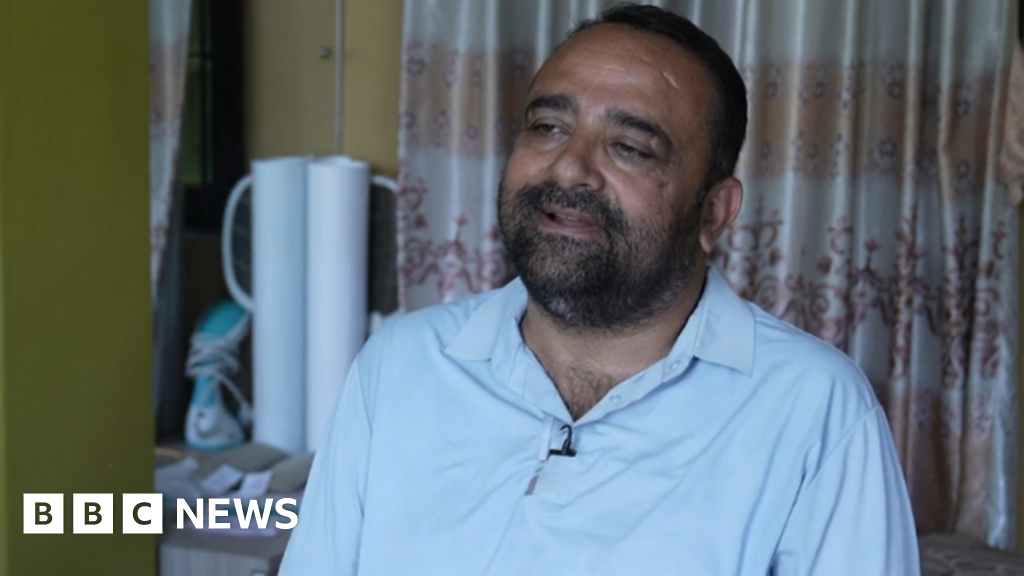
A headteacher has told how he saved 900 pupils' lives from the Nepal floods - by quickly evacuating them just 10 minutes before the waters hit.
Rajendra Dawadi, who is in charge of Tribhuvan Trishuli Secondary School in Nuwakot, told the BBC he had received four calls at 09:10 local time (03:25 GMT) warning about the disaster, which has now claimed at least 794 lives.
He quickly decided to evacuate, telling the children to run to higher ground and ordering buses full of students to turn around to flee the area.
Dawadi said: "If we didn't make a quick decision, if it was 10 minutes later, we all - including the students and me - wouldn't be able to speak to you today."
What we know about deadly Nepal-Tibet floods
The warnings had come from four different people in the space of minutes and helped him evaluate the impending danger.
"A parent came and told me that 'a big flood was coming, I am here to take my daughter, I will take her'," he added.
"Parents don't rush without a strong reason, so it was confirmed that I shouldn't waste a second to evacuate the children.
"I decided I shouldn't delay any more. Even if the flood was not coming, it was just a matter of a single day's classes.
"I feel proud that we saved so many lives."
The floods - which decimated parts of Nepal on Wednesday and have left at least 2,426 people missing - saw the school building buried under mud and debris.
Dawadi said the waters arrived so quickly that a hostel building about 100m (328ft) from the river was engulfed immediately.
At first, many students did not realise how serious the situation was.
Pupil Yunisha Amatya, 16, said she scrambled to safety with her friends just before the flood hit.
"I along with my friends survived by just 10 seconds only," she told the BBC.
"Just before the flood came, we were in the class studying. Teachers had gathered in one place and initially had no idea what had happened. After five minutes teachers came and informed us about the flood and asked us to go home."
She said one student fainted after hearing about the disaster, but many initially underestimated the danger and waited for classmates who were in a maths lesson.
Yunisha and her friends scrambled uphill through an escape route behind the school.
"I could not walk fast, and my friends helped me to climb uphill. We tried our best to be in the safer zones then. We escaped through a narrow ladder from backside of the school. Within no time, the bazaar was swept away in front of my eyes," she says, referring to the local market around the school.
"If there was no grip in my shoes I would have fallen and students and other people were jostling each other to reach the safer area while escaping. The people who choose to escape from another route are apparently swept away."
Students and teachers initially moved a few hundred metres uphill to safety before making their way to a neighbouring village.
With roads cut off and transport disrupted, many remained stranded for two nights before rescue efforts reached them.
The principal and Yunisha, who both live across the river from the school, were eventually airlifted back to their home village.
Meanwhile parents were desperately trying to contact their children and relatives.
Yunisha's mother, Sabina Kumari Shrestha, says she repeatedly tried to call both her daughter and husband, but neither could be reached.
Her husband, Yubaraj Amatya, immediately headed towards the school.
"Soon after the flood news spread, I tried my daughter's number, but she was not reachable, then I was afraid," he said.
"Within a few minutes I rushed toward my daughter's school and Trishuli Bazar was all swept by the flood, then I thought my daughter was no more. I was so horrified, stopped my scooter, there was flooding but I could not think of returning without my daughter."
For nearly an hour, he had no idea whether she was alive and kept calling her without success. Then the phone finally connected and Yunisha answered.
"Finally, my daughter received my call and I couldn't stop myself, broke out... two relatives that were with me also cried and hugged me," he said.
Yunisha appears tearful as she recalls that moment.
"After I had reached the top of the hill, I received a call from my father. He was tearful and I could not speak a word then," she said.
Back home, her family waited anxiously for her return.
"Even my younger daughter couldn't sleep. But I felt so good to see her after three days (Friday), I am so happy and relieved," her mother said.
Yunisha says she is now thinking about what comes next.
"Now I am worried about my further studies," she said.
"If I had to change my school, I would have to miss my old friends and will face difficulties to make new friends. I am sad about my further studies."
Head teacher Dawadi says better warning systems, including sirens and evacuation alerts, could have helped residents respond sooner.
But he believes his decision to act immediately prevented a catastrophe.
"Had I decided to close the school after the period, nothing might be left, only the bell would be ringing at 9:30."
Topics in this story
Gathered from external sources. Rights to this text belong to whoever originally published it.