Why Northern Ireland was the 'perfect place' for The Death of Robin Hood
The Death of Robin Hood, which stars Hugh Jackman and Jodie Comer, was filmed entirely in Northern Ireland.
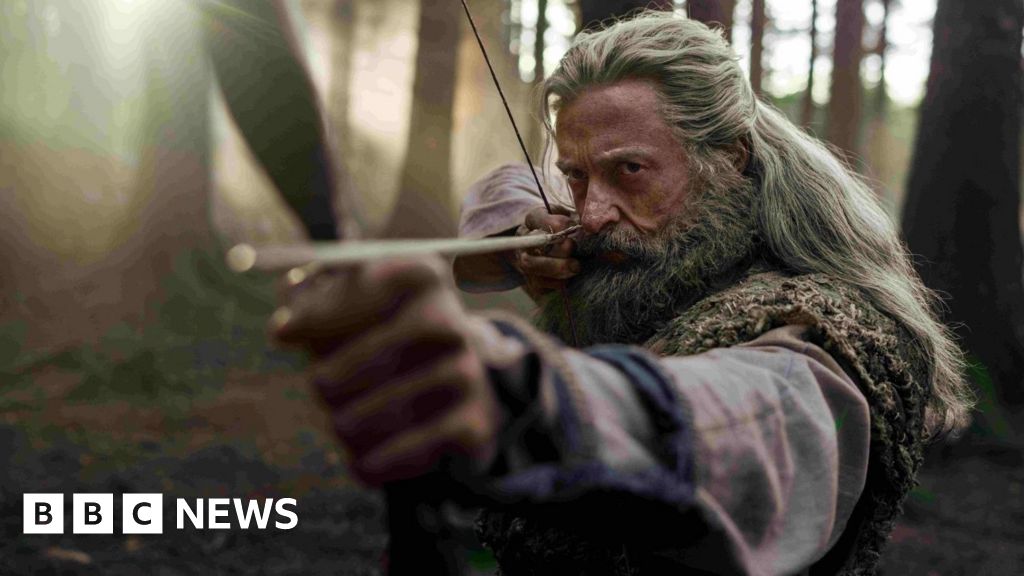
It is a centuries old legend of stealing from the rich to give to the poor, freshly adapted for the big screen, filmed entirely in Northern Ireland.
The Death of Robin Hood is based on a 17th Century ballad of the outlaw, starring Hugh Jackman as the reflective, battle-weary titular character at the end of his life. It presents a darker, less family-friendly version of the medieval hero.
A Belfast actress, who played a small role in the film, told BBC News NI about sharing the screen with A-listers and why Northern Ireland was now "the perfect place" to make a film.
Tabitha Smyth, from the east of the city, was cast as Sarah in her first role in a major studio feature film.
"The film's set in England, but Northern Ireland is just like the perfect place to film for everyone at the minute - you can get from a beach to a city centre, to a forest park, all within 20 minutes of each other," Smyth said.
"It's like a dream for a production like this, where it is set hundreds of years ago, hence why Game of Thrones and stuff like How to Train Your Dragon etc have all been filmed in the north."
Filming spanned across a wide range of picturesque parts of the country including Silent Valley, Glenarm and Murlough Bay.
Production was also based at Belfast Harbour Studios, whilst the film's post-production process was completed at the company Yellow Moon in Holywood.
The film has a small cast but some big names - Jodie Comer, Bill Skarsgård and Noah Jupe.
Smyth said it was "very daunting", but Comer and Jackman were "so down to earth"
"Obviously going into a film like that when you haven't been in a film before and then you're just like on set with like Jodie Comer and Hugh Jackman," she said.
"It was pretty much every scene or every part I was doing they were in there as well, which was kind of mad."
Strangford and Bushmills were also among the locations to provide a dramatic backdrop for the film.
"There were times where mad storms were happening, when they were filming, like it was kind of crazy, rain, hail and snow," Smyth said.
The actor said filming in Northern Ireland brought an authenticity to the film.
"We were filming a scene and it was absolutely freezing, like on the edge of a cliff. There was a fire lit and the wind was mad, but it just adds to it because it would have looked look like that," she said.
Northern Ireland is also popular with the crews, she added.
"The people are all really sound, the food's good, the craic is good and people are really drawn to it at the minute in producing work here," she said.
"Game of Thrones has a really big part to play in that for sure."
Andrew Reid, chief content officer at Northern Ireland Screen, told BBC News NI that productions like this have become a "regular occurrence" in Northern Ireland.
He said there had been a particular rise in the number of indigenous productions – that is, productions written, directed and produced in Northern Ireland.
Like Smyth, he believes Northern Ireland lends itself perfectly to film-making.
"We are a small but very compact region, it's easy to get around," Reid said.
"We can be up a mountain in the morning, and in a studio in the afternoon. There's a really good selection of diverse locations."
However, Reid said Northern Ireland had other star qualities for film-makers.
"We have a fantastic ecosystem that has been built up over decades," he said. "We have fantastic people.
"We also have a very strong training remit within our productions that we're building up those crews."
Reid added that the region's "state-of-the-art facilities" were also a major draw.
So how long until Northern Ireland can call itself a major player in European film?
According to Reid, the talent, facilities and landscape of the area mean it might be sooner than some expect.
"We're starting to see the beginning of it already."
The Death of Robin Hood was released in the UK on 2 September.
Opening of NI's largest virtual studio makes filming 'the impossible possible'
Topics in this story
Gathered from external sources. Rights to this text belong to whoever originally published it.