The Tibet-Nepal flood is a warning against defying nature
The catastrophe that began high in the mighty Himalayas on the Tibet-Nepal border is a warning from the world’s youngest, tallest and most volatile mountain range about the dangerous illusion that humans can engineer nature into submission.
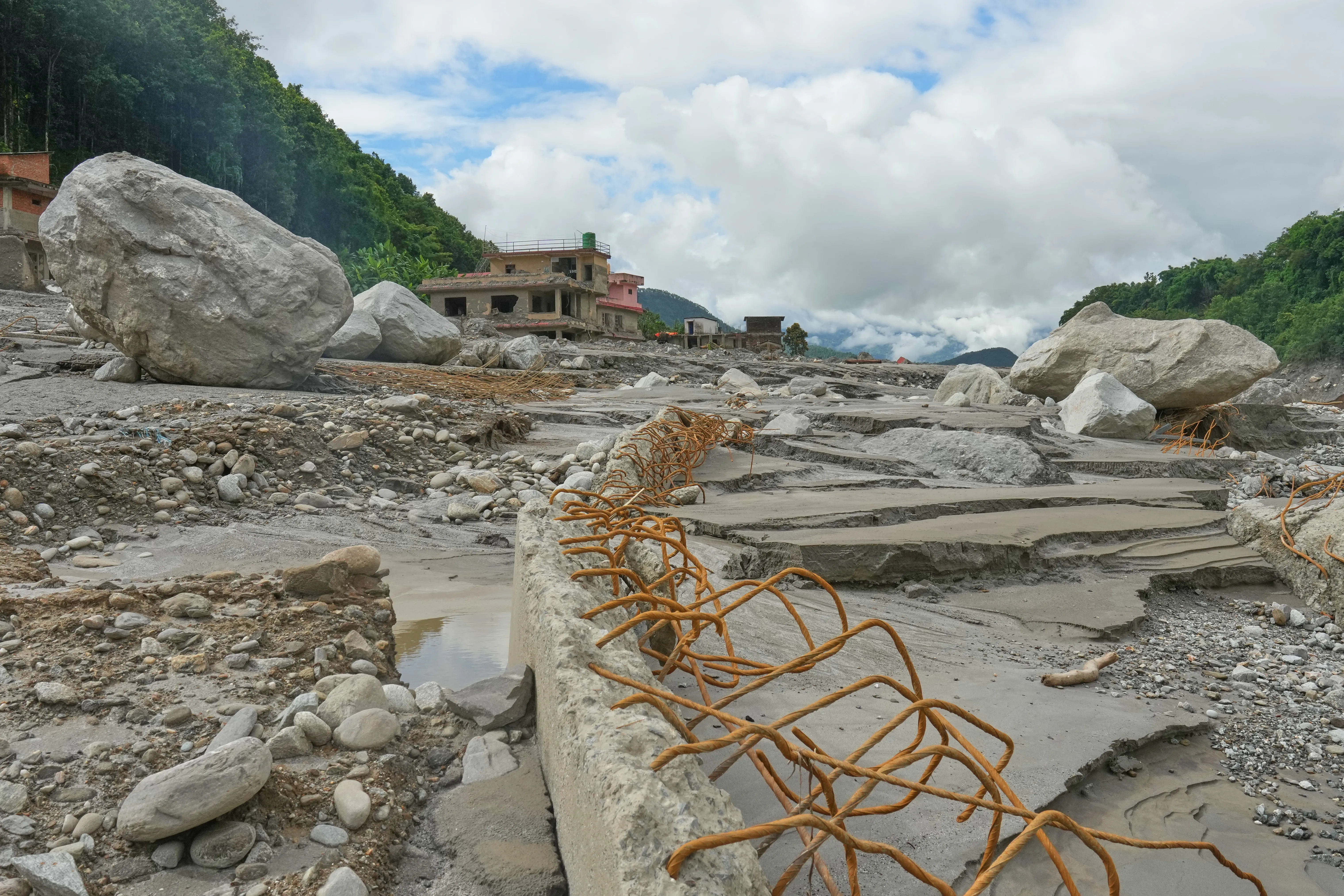
Humanity is altering natural ecosystems more rapidly than it is developing an adequate scientific understanding of the consequences. Those alterations are contributing to climate change, which in turn is amplifying the damage to ecosystems. The Nepal-Tibet flood disaster is a stark reminder that humanity must stop trying to bend nature to its will.
The catastrophe that began high in the mighty Himalayas on the Tibet-Nepal border is a warning from the world’s youngest, tallest and most volatile mountain range about the dangerous illusion that humans can engineer nature into submission.
An immense ice-and-rock avalanche sheared off a glacier situated directly along the crest of the international boundary on the Nepalese side, plunged into the China-controlled Tibetan upper basin, and unleashed a devastating torrent that ripped through transboundary rivers, wrecking upstream Chinese infrastructure and leaving a vast trail of death and destruction downstream in Nepal.
The disaster exemplified how human interventions can magnify nature’s fury. Nepal bore no responsibility for the catastrophic flash floods, yet it faced their main brunt. Extensive infrastructure-centered alterations to the upstream river corridor and mountain landscape in the Tibetan border region compounded the downstream effects through physical, structural and operational vulnerabilities.
The tragedy’s central lesson is best summed up by the 1970s American television advertising slogan that became a pop-culture catchphrase: “It’s not nice to fool Mother Nature.”
In the name of development, countries have long sought to redirect river flows, flatten mountains, tame weather and conquer landscapes. Such engineering has undeniably brought energy, water and prosperity. But when it disregards the fundamental logic of natural systems, manageable risks potentially turn into calamitous ones.
The Tibet-Nepal disaster offers the latest illustration of why respecting nature has become an imperative for humanity’s future .
Yet much of the analysis of this disaster in U.S. and international media has focused on climate change while obscuring how human alteration of ecosystems is itself increasing natural hazards and accelerating global warming. Climate change should not become a catch-all explanation that deflects attention from the broader ecological and environmental damage caused by human activity. Climate change is one consequence of these wider human impacts.
The unstable Himalayas are a living geological laboratory. Large-scale construction and river engineering there can significantly compound risk.
Pounded by the slow-motion collision of the Indian and Eurasian tectonic plates, the Himalayas remain among the most seismically active and structurally fragile regions on Earth. Their rocks continue to fracture and rise; glaciers expand and retreat; and monsoon rains and freeze-thaw cycles constantly weaken steep valley walls. In such an environment, landslides, cryospheric collapses and flash floods are anything but rare.
The latest catastrophe underscores that inherent instability. But what followed the initial act of nature was shaped as much by human construction as by natural processes.
Natural floodplains, gravel bars and meandering channels act as hydraulic shock absorbers, dissipating energy by allowing water to spread laterally . When they are replaced with concrete embankments, retaining walls, highways, diversion structures and narrowed channels, the river system loses its natural flood buffer. Water is forced into tighter corridors from Tibet, accelerating its speed and increasing its destructive power in Nepal, as a 2022 scientific study had forewarned .
That is exactly how the flood tragedy appears to have unfolded, with extensive embankments, border facilities, highways, intake works and riverbank engineering creating artificial bottlenecks in the upper Tibetan valley. Instead of allowing the floodwaters and debris to disperse naturally, these structures funneled the liquid-rock-mud mass through a narrow gorge, dramatically increasing its velocity before it surged downstream into Nepal’s river basins.
This resulted in devastating consequences. Loose sediment and debris from upstream construction sites were swept into the deluge , creating a dense, hyper-concentrated slurry that smashed bridges, roads, buildings and hydropower infrastructure with enormous kinetic force. Temporary debris dams formed behind bridges and culverts before bursting, releasing secondary flood pulses that were even more destructive than the original surge, as another peer-reviewed study had foreseen.
The tragedy fits into a much broader global pattern. Modern states increasingly pursue projects that seek to reshape natural systems.
China has become the world’s most ambitious practitioner of this approach — from its environmentally damaging Three Gorges Dam and gigantic South-to-North Water Diversion Project to massive weather-modification programs and the colossal super-dam now rising on Tibet’s Yarlung Tsangpo, the world’s highest-altitude major river . Such projects reflect a seductive belief that nature can be bent to the Chinese will.
Complex ecosystems, however, rarely behave like human-made machines. Natural systems function through intricate networks of feedback and balance. Every significant human intervention can alter interconnected natural processes whose cumulative effects may emerge years later or even in places far removed from where the original construction occurred.
The Tibet-Nepal disaster is a strong expression of a universal truth: disrupting one component of a tightly connected natural system creates cascading consequences throughout the whole.
Humanity has entered an age in which its engineering capacity has become extraordinary, but so too has its ability to magnify natural hazards. It is thus imperative for humanity to understand its safe operating space .
Respecting Mother Nature does not mean abandoning development or rejecting engineering. It means recognizing that human ingenuity must work with natural processes rather than against them.
The sustainable path is stewardship, not mastery, of nature. It includes protecting floodplains instead of endlessly constricting rivers, preserving biodiversity instead of simplifying ecosystems, and designing infrastructure that accommodates natural flows rather than reengineering them.
We can keep trying to bend nature to human ambition and greed, or learn to live within nature’s design. The Himalayas have delivered their verdict with clarity.
Brahma Chellaney is the author of nine books, including the award-winning “ Water: Asia’s New Battleground. “
Topics in this story
Gathered from external sources. Rights to this text belong to whoever originally published it.