Missouri labourer turned his 20-acre property into a landscape of hand-painted signs; decades later, more than 100 of his works found a home in museums
A stretch of land in Fulton, Missouri, gradually became covered with hand-painted messages, biblical references and pointed observations about American
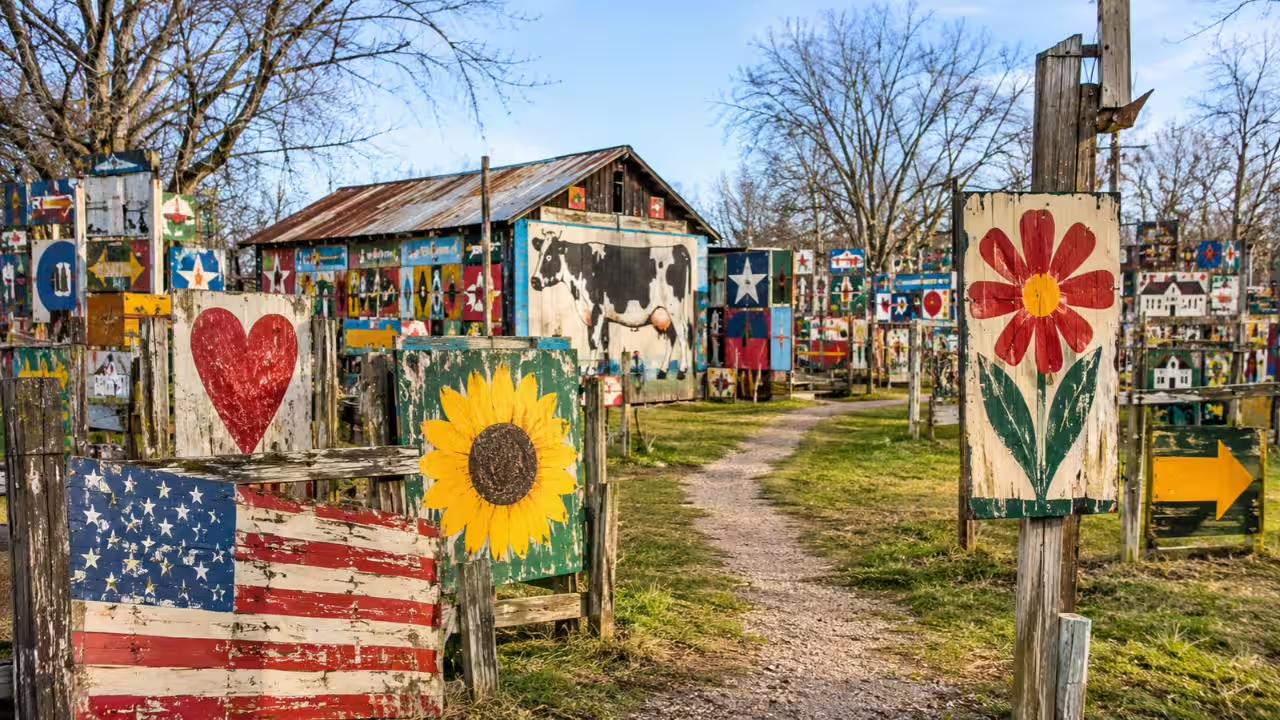
A stretch of land in Fulton, Missouri, gradually became covered with hand-painted messages, biblical references and pointed observations about American life. Its owner, Jesse Howard, was not a trained artist or someone who made his living through art. He earned money through manual work and odd jobs, spending much of his life in the small Missouri town. Yet, from the 1950s onwards, his property took on a very different character. Signs appeared across fences, buildings and the yard, each carrying words he wanted passers-by to read. Howard called the place Sorehead Hill. What began as a personal undertaking eventually attracted attention from art institutions far beyond his neighbourhood.The Missouri man behind the growing collectionHoward was born in 1885 in Shamrock, Missouri. He was one of ten children and had a twin sister. His early years included periods of travelling around the American West before he eventually settled in Fulton, where he spent most of his adult life.His working life was largely made up of practical jobs and physical labour. There was little in his background to suggest that his name would eventually become associated with an unusual body of American folk art. He did not follow a conventional artistic career. Instead, his creative output developed on the property where he lived.During the 1950s, Howard began placing painted objects around his roughly 20-acre site. Some featured biblical imagery, while others included model aeroplanes carrying patriotic messages. His displays attracted criticism from people living nearby, and his creations were repeatedly vandalised.How neighbourhood disputes shaped his growing collection of signsThe disagreements with neighbours became part of the story of the site. As objects disappeared or were damaged, Howard responded by producing more work. He also began making signs that communicated his frustrations and views about events around him.The messages covered several subjects. Biblical passages and religious interpretations appeared alongside references to local and national politicians. Some signs directly addressed people accused of stealing or damaging his creations. Howard's writing was often forceful, with statements extending across multiple lines.His approach to making the signs was distinctive. He used carefully arranged lettering, usually in black or red paint, against whitewashed wooden or metal surfaces. The capital letters were laid out in ruled lines, giving the boards a recognisable appearance. Some messages were lengthy enough to fill several lines, turning ordinary sections of the property into displays of his personal commentary.Over time, the signs spread across the fence, house, yard and surrounding outbuildings. The collection eventually numbered in the hundreds. Howard continued adding to it even as disagreements with neighbours persisted.The artist who brought Sorehead Hill to wider attentionAlthough the property was not universally welcomed by the surrounding community, Howard's work began attracting interest outside Fulton. A significant moment came in 1968, when artist Gregg Blasdel featured him in an essay titled The Grass-Roots Artist, published in Art in America.His signs subsequently appeared in exhibitions at the Walker Art Center in Minneapolis and the Philadelphia College of Art. The displays introduced his work to audiences who might otherwise never have encountered Sorehead Hill. The attention was a departure from the response Howard had received locally. His property had grown out of personal expression and neighbourhood disputes, but the objects were increasingly being considered as part of a wider American folk and outsider art tradition.How museums preserved Howard's signsIn the 1970s, the Kansas City Art Institute acquired a substantial collection of Howard's works. The institution later took responsibility for looking after the signs following his death in 1983.Preserving the collection became important because the objects had originally been made for an outdoor setting. They were part of a changing property, exposed to the elements and, at times, vandalism. Their removal into institutional collections allowed many examples of Howard's work to survive beyond the life of Sorehead Hill.A further transfer took place in 2016. The Kansas City Art Institute worked with Kohler Foundation, Inc., to move 187 objects from its collection to the John Michael Kohler Arts Center. The material included 80 signs, six sculptures and more than 50 archival documents. These objects were added to 12 Howard signs already held by the Arts Center.Two more signs entered the institution's collection in 2017, expanding its holdings of the Missouri artist's work.The lasting legacy of Howard's unconventional artHoward's signs were not created as a single exhibition or according to a planned artistic programme. They accumulated over several decades, reflecting the subjects that occupied his attention at different points in his life. Religion, patriotism, politics and disputes with people around him all found their way onto the boards.The property itself was central to how the work developed. Its fences and buildings provided space for the messages, while the repeated destruction and replacement of signs contributed to the site's constantly changing appearance.Sorehead Hill no longer exists in the same form as the landscape Howard created, but a substantial part of its visual record survives through museum collections. The objects now held by the John Michael Kohler Arts Center and other institutions offer a way to examine the work of a man who spent much of his life outside the recognised art establishment.You use AI every day. Now get your AI Quotient. Take the AIQ test.
Topics in this story
Gathered from external sources. Rights to this text belong to whoever originally published it.