An 18-year-old solved a mathematical problem named after Chicken McNuggets and won €7,000 at a European science contest
An 18-year-old student from Poland has won €7,000 at a European science competition for developing a new method to solve a long-standing mathematical
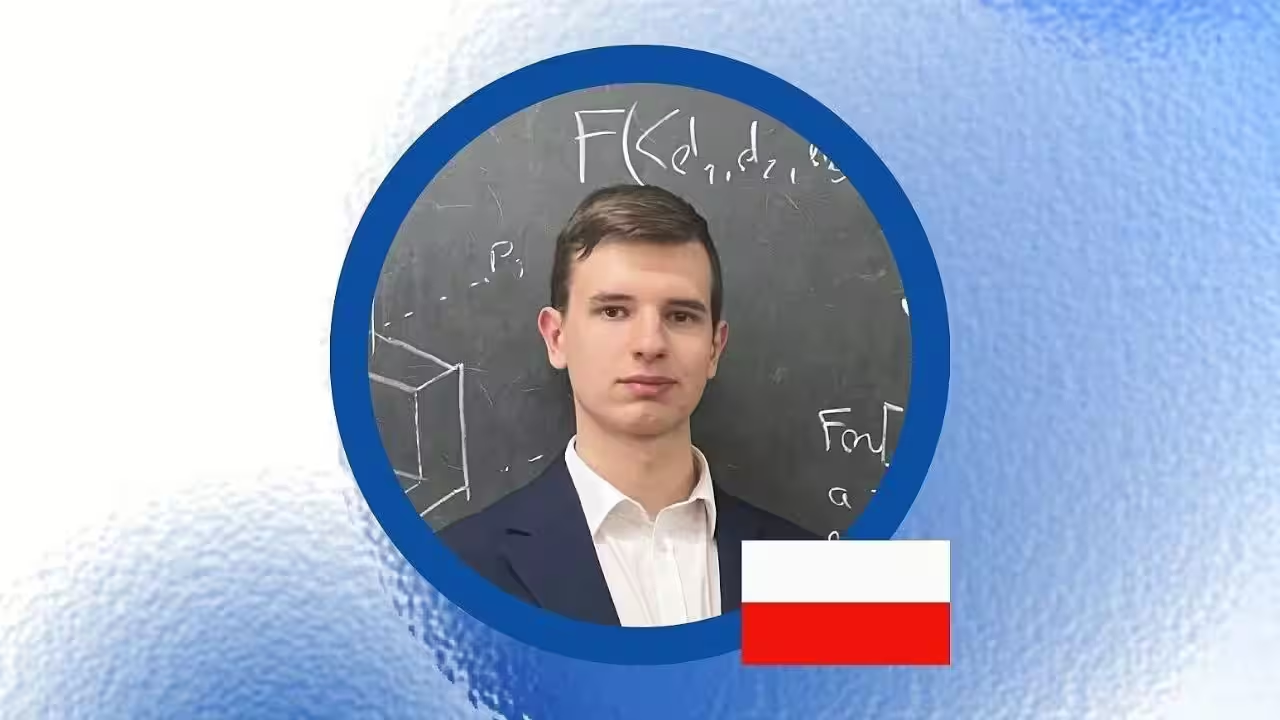
An 18-year-old student from Poland has won €7,000 at a European science competition for developing a new method to solve a long-standing mathematical problem named after McDonald’s Chicken McNuggets. Kazimierz Jakub Chomicz received one of four first prizes at the 2026 European Union Contest for Young Scientists, held at Kiel University in Germany. His research addresses a mathematical puzzle that has challenged researchers for decades, extending the methods available for tackling it to a case involving four different box sizes.How did an 18-year-old approach the Chicken McNugget problemThe problem, formally known as the Chicken McNugget problem, examines which quantities cannot be formed when items are sold in packages of fixed sizes. Although the name comes from chicken nuggets, the underlying mathematics has applications beyond food packaging.According to Kiel University, the puzzle concerns the largest quantity that cannot be obtained by combining packages of specified sizes. Mathematicians call this the Frobenius number, and finding it becomes increasingly difficult as the number of available package sizes increases.For example, if a product is available only in packages containing fixed numbers of items, some quantities may be impossible to make by combining those packages. The challenge is to identify the largest quantity that remains unattainable.The problem has attracted mathematical interest because a straightforward solution is available for 2 package sizes, while the situation becomes considerably more complicated when additional sizes are introduced.Chomicz's research focuses on extending the mathematical approach to 4 package sizes, addressing a part of the problem that has remained difficult to resolve.Why has this mathematical puzzle challenged researchersThe difficulty lies in determining which quantities can be formed from combinations of different package sizes without overlooking any possibilities.Kiel University explains that the Frobenius number can be calculated using a simple formula when there are two package sizes. For three sizes, however, there is no equivalent general formula, although mathematicians have developed a substantial body of results to address the problem.When four or more package sizes are involved, finding solutions becomes even more challenging. Existing approaches have struggled to provide results comparable to those available for the 3-size case.Chomicz's work addresses this gap by introducing a method for solving the problem for any four package sizes. According to the university, the approach directly extends the established results for three sizes and is the first method to achieve a comparable level of strength for four.What did the research achieveThe project, titled Chicken McNugget problem in embedding dimension four, was recognised at the 2026 European Union Contest for Young Scientists, known as EUCYS.In its report on the project, Kiel University described the method as a new approach to a problem that has remained largely out of reach for cases involving four or more package sizes.The research builds on earlier mathematical work rather than treating the problem as an entirely new question. By generalising results already established for three package sizes, it offers a way to address a more complicated version of the same challenge.This distinction matters because mathematical progress often depends on extending an existing result to situations where earlier techniques no longer work effectively. A method that applies to four package sizes provides researchers with a stronger framework for examining the problem.The university's description establishes the scope of the method, although it does not suggest that the broader Chicken McNugget problem has been completely solved for every possible number of package sizes.How did Chomicz win the European science competitionThe award was presented at EUCYS 2026, which brought together young researchers from across Europe and beyond to present projects spanning multiple scientific disciplines.According to Kiel University, 144 participants from 37 countries presented their work to an international panel of experts. The young researchers, aged between 14 and 20, had qualified through national science competitions before reaching the European stage.The competition took place at Kiel University from 22 to 27 September 2026. Participants presented projects they had developed themselves and answered questions from the jury during several rounds of interviews.Chomicz received one of four first prizes, each worth €7,000. The other winning entries covered research into cancer-related biology, medical technology and plant stress detection.What did the other winning projects investigateThe competition recognised projects that approached scientific challenges from very different directions.According to the European Commission's research and innovation department, one first prize went to Georgian researchers Nikoloz Tkebuchava, 17, and Lizi Chachua, 16, for their investigation of the structure and conservation of the FAM163A protein and its potential role in cancer.Canadian researcher Gurnoor Kaur, 17, received another first prize for Eigenpulse, a project aimed at eliminating demographic bias in pulse oximetry and remote photoplethysmography. These technologies are used to measure aspects of the body's physiological condition, making accuracy across different demographic groups an important research objective.The fourth first prize went to Italian teenagers Tommaso Vaninetti, 17, Abdoellah El Makkaoui, 16, and Frida Tirari, 16. Their PlantLeaf project uses a system to detect and analyse how plants react to stress.EUCYS has been organised annually since 1989, bringing together successful participants from national science competitions. The European Commission reported that the 2026 event attracted around 140 young scientists from nearly 40 countries. An international jury of 20 experts assessed the projects, with first, second and third prizes awarded alongside additional special awards.You use AI every day. Now get your AI Quotient. Take the AIQ test.
Topics in this story
Gathered from external sources. Rights to this text belong to whoever originally published it.