'Indie and punk music made me feel I was betraying my race'
Big Joanie's Stephanie Phillips sets out the history of black people and alternative music.
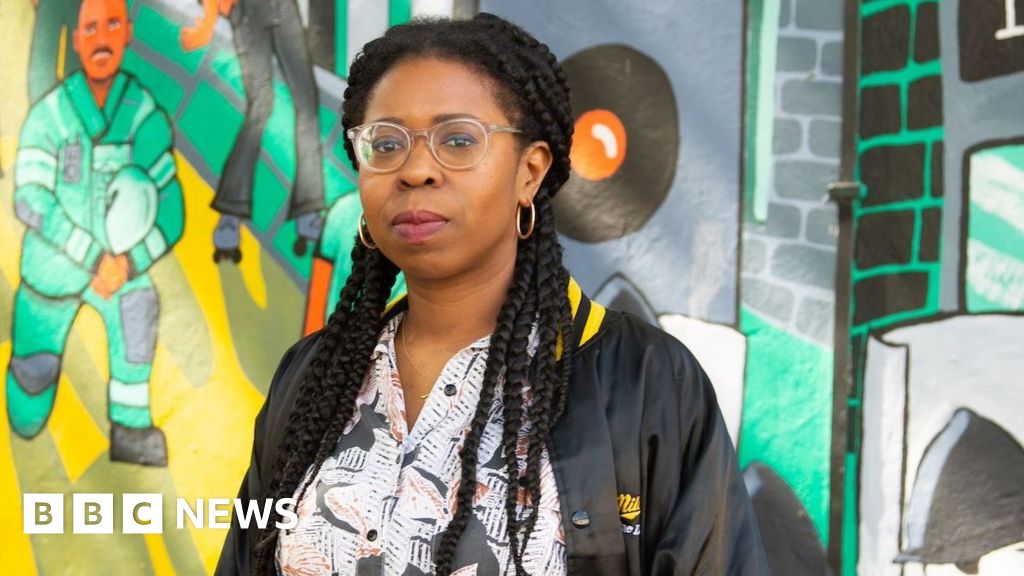
Growing up in Wolverhampton, Stephanie Phillips says she was initially pretty much into the same chart music as her friends.
But alongside TLC, Aaliyah and Destiny's Child, she developed a passion for rock, indie and punk.
"It was music that meant a lot to me as someone who was very shy and needed an outlet," she said. Yet she felt compelled to keep that passion hidden.
"There was always this idea that black people weren't really into alternative music, or punk," the musician, journalist and author told the BBC.
"When I first got into alternative music I felt like I was betraying my race, and had to keep my love of rock practically secret," she writes in her new book.
"There was a particular way that I was supposed to move through the world and being super into this genre was seen as something that wasn't for black people."
In We Were Here, the Big Joanie singer and guitarist charts the role of black artists in creating, shaping and transforming rock 'n' roll, punk and alternative music.
Phillips argues black artists never disappeared from the scene but were often forgotten, overlooked or deliberately excluded.
"There was this insinuation that we weren't really part of those histories," she said, "but when you look back, there was so much there."
She says the phrase "black weirdo" captures both how she felt and how others viewed her involvement in the punk scene.
The lead singer of ska and 2 Tone group The Selecter, Pauline Black, agrees.
The pair are set to take part in an event together as part of Black History Month, in Coventry.
"Although what I do still comes from the genre of black music, I was one of those weirdos in a way because I come from a folk background, and you can't get much whiter than that," said Black.
"Certainly when I was growing up if you weren't into Tamla, you weren't into soul - which I am, but didn't particularly want to do music like that - then nobody really understands.
"If you want to be a punk, and are black and a woman it's very difficult."
The book explores figures including Sister Rosetta Tharpe and Jimi Hendrix before moving through later genres, from heavy rock to pioneering punk acts such as Bad Brains and Pure Hell.
"We've always known that black people were essential to the creation of rock and roll," Phillips said.
"They're also essential to the creation and continuation of so many different genres that came off of that."
Tharpe, whose guitar work helped shape artists including Chuck Berry, Elvis Presley and Little Richard, was "pivotal" to the emergence of rock'n'roll, Phillips said.
Yet she was largely forgotten after her death in 1973 before being rediscovered decades later.
Phillips argues these histories were often overlooked as music journalism grew more influential.
Publications such as Rolling Stone helped define the archetypal rock star, she argues, often favouring white male artists while overlooking many groundbreaking black performers.
Segregation also shaped the music industry and charts until the mid-1960s.
"The threat of the colour line being breached was terrifying in America," she said. "It wasn't just in schools or public spaces, it was in culture too."
Pioneering black punk bands such as Bad Brains were frequently under-recognised despite their influence, Phillips said.
"They completely changed what hardcore could be. They had the technical proficiency to play harder, to play faster," she added.
"People think black people haven't been there. It's like, well, we probably have been, the question is whether it was documented properly."
After moving to London, Phillips became involved in the independent DIY punk scene, which she said was welcoming to women, non-binary and trans people.
But despite the city's diversity, there were still only a handful of black people involved.
"It still made me feel a bit of an outsider," she said.
In response she co-founded Big Joanie, describing the group as a black feminist punk band.
"It was exciting creating a space where black women could exist outside all those expectations," she said.
The book also examines how black artists within alternative music have faced hostile or distorted media coverage.
She points to Skunk Anansie's Skin, who was often portrayed through the lens of her appearance rather than her music.
"The only way they would speak about her is either that they found her scary or they couldn't take their eyes off her," she explained.
"They were seen as outsiders and their music wasn't really as well championed as other artists."
Bloc Party frontman Kele Okereke experienced similar treatment, including being outed by a music magazine.
Interviewing him for the book, Phillips said it was clear the experience had remained painful.
"The shyness and vulnerability of one of the few black men in the indie world was often being interpreted as hostility," she said.
Black recalled that a famous 1980 photograph of her alongside Debbie Harry, Poly Styrene of X-Ray Spex and other leading female artists, featured on the cover of New Music News magazine, was billed as representing "the women in rock".
"And I suppose they needed a couple of black women in there as well," she said.
"But it was interesting they couldn't put one woman on the cover.
"In those days their ethos was that if you put a black face on the cover, particularly if it's not a male black face, then you're not really going to sell many copies."
Even today, Phillips argues black artists were often forgotten, overlooked or deliberately excluded.
She cites Nova Twins, who took out a bank loan to record their debut album which received rave reviews but they still struggled to find a label, she said.
The issue is personal, she added, recalling the challenges of securing support for Big Joanie's early releases.
"You do have to work harder. It can be exhausting."
Now based in Birmingham, the author is taking part in a series of events discussing the issues raised in the book, including a conversation with The Selecter's lead singer at Warwick Arts Centre.
"I'm really interested to hear what makes Stephanie tick," said Black.
"She would have grown up a generation behind me, so her experience would have been different, but I don't think the industry had changed significantly by the time she formed Big Joanie.
"I think she's done an extraordinary job, both with her band and with the book.
"So it's 'up the weirdos', is what I say."
We Were Here: A History of Black People and Alternative Music by Stephanie Phillips is published by Faber .
She is in conversation with Pauline Black at Warwick Arts Centre on 15 October and appearing at Supersonic Festival in Birmingham on 18 November.
Follow BBC Wolverhampton & Black Country on BBC Sounds , Facebook , X and Instagram .
Tributes paid to influential soul singer Ray King
Godmother of rock and roll's city gig honoured
'We shouldn't need to face racist attacks in 2024'
Topics in this story
Gathered from external sources. Rights to this text belong to whoever originally published it.