Xi in Washington: China’s arrival as a superpower?
When Chinese President Xi Jinping and his wife, Peng Liyuan, arrived in Washington, President Donald Trump and Melania Trump personally received them at
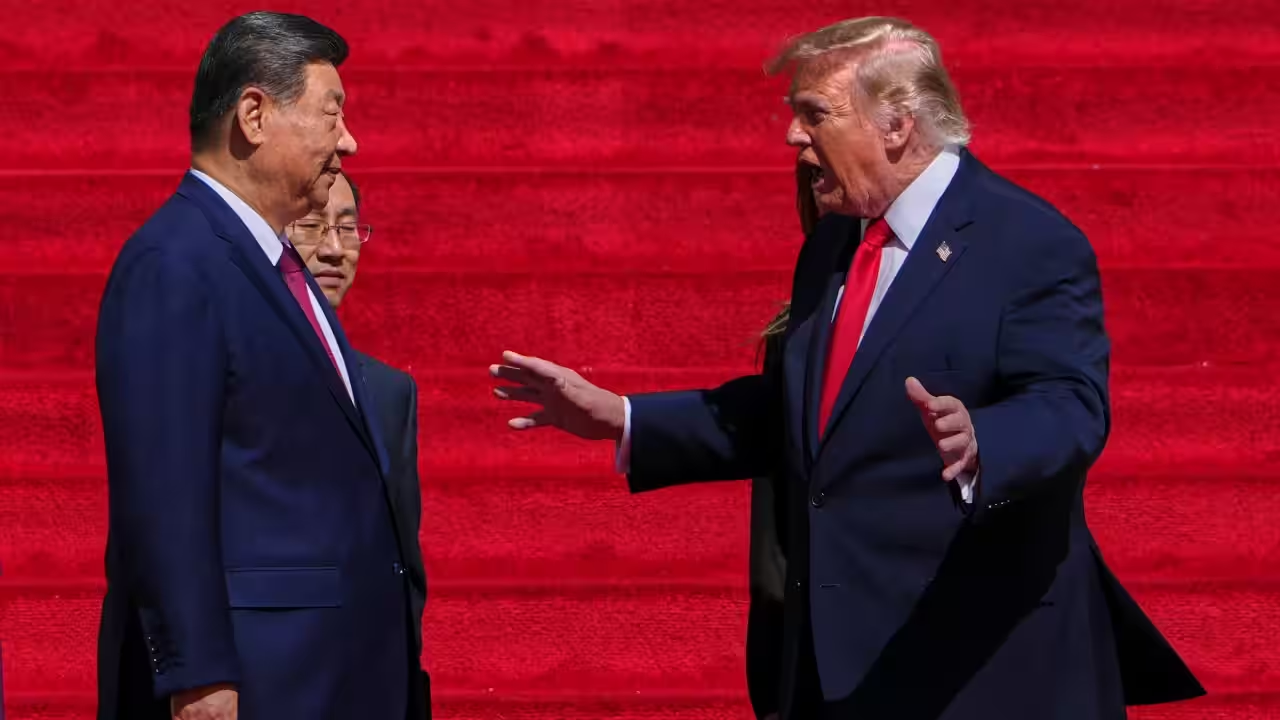
When Chinese President Xi Jinping and his wife, Peng Liyuan, arrived in Washington, President Donald Trump and Melania Trump personally received them at Joint Base Andrews — an unusual gesture in American presidential protocol.The red carpet, 21-gun salute and ceremonial warmth conveyed something beyond diplomatic courtesy: the changing weight of China in the international system.Even the presidential cars carried their own symbolism. Trump travelled in the high-tech American presidential limousine, while Xi used China’s domestically produced Hongqi limousine with similar features. These were more than two cars moving through Washington.They symbolised two countries possessing the industrial, engineering and technological capabilities to produce sophisticated systems of their own. It was a small but striking manifestation of comprehensive national power.Yet protocol was only the surface. The deeper significance of Xi’s visit lies in a larger question: is China’s rise changing not merely the global balance of power, but the very meaning of superpower status?China’s rise differs fundamentally from that of the Soviet Union, whose military power was never matched by comparable integration into the world economy. Even the US and Soviet economies themselves remained largely separate. By contrast, US–China goods trade reached about $415 billion in 2025, while China holds around $600 billion of US government debt — in effect, money borrowed by the US government from China.Yet China combines military power with economic scale, manufacturing depth, technology, global connectivity and an unparalleled domestic market. Twenty-first-century power increasingly extends beyond military and nuclear strength to strategic resources and supply chains, industrial scale, market power and the capacity to translate technology into mass production.Across these dimensions, China stands alone in possessing the breadth of capabilities to engage the United States simultaneously on multiple fronts, increasingly on near-equal terms.The warmth surrounding Xi’s visit also came against China’s growing importance in West Asia. Its relationships with Iran, Russia and the Gulf, combined with its position as a major energy consumer and trading power, have made Beijing increasingly relevant to managing the consequences of the Iran conflict and elsewhere in West Asia.The larger message was clear: Washington increasingly finds major global challenges difficult to address without Beijing.President Xi himself articulated this proposition in Washington: China-US cooperation, he said, “may not solve every problem in the world, but without such cooperation many global problems would be difficult to solve”.Two revolutions that redefined geopoliticsAround 2010, two technological revolutions began reshaping geopolitical power.The shale revolution transformed the United States from a major energy importer into a major producer and exporter, reducing a longstanding strategic vulnerability. Simultaneously, China consolidated its dominance in rare-earth processing, permanent magnets, and critical-mineral value chains, creating new global dependencies, including for the United States.America reduced its dependence on the world for energy; the world became increasingly dependent on China for critical materials and manufacturing inputs. China remained energy-dependent, but mitigated this vulnerability through domestic diversification and relationships with Russia, Iran, Central Asia and the Gulf.If oil defined twentieth-century geopolitics, rare-earth permanent magnets and critical minerals are increasingly defining the geopolitics of the twenty-first. While the US retains major advantages in frontier technologies, China combines its dominance across rare-earth magnets and critical-mineral value chains — essential to the emerging high-technology industrial economy — with manufacturing scale, engineering capabilities, supply-chain strength and market size. Technological power increasingly depends not only on invention, but on the capacity to produce and deploy technology at scale.Connectivity as powerChina’s domestic and global infrastructure capabilities add another dimension to its power. Its more than 50,000-km domestic high-speed rail network—the world’s largest—is complemented by expanding high-speed rail projects and extensive freight corridors across ASEAN, Central Asia and Europe, alongside Chinese-built ports and infrastructure worldwide. This ability to build and connect infrastructure across borders enables China to translate engineering and manufacturing strength into trade, economic integration and geopolitical influence.The Russia factorXi also arrived in Washington against the backdrop of China’s deepening relationship with Russia. Their strengths are substantially complementary: Russia brings enormous energy and commodity resources, military capabilities and defence technologies; China brings manufacturing capacity, markets, capital and increasingly sophisticated technologies. Their interests are not identical, but their growing cooperation adds another dimension to the changing strategic balance.Changing global perceptionsChina’s growing material power also coincides with changing international perceptions. Gallup’s 2026 assessment recorded median approval of Chinese leadership at 36 per cent, compared with 31 per cent for the United States, while US disapproval reached 48 per cent.Taiwan: The ultimate testTaiwan may provide the ultimate test of China’s changed status and the emerging power equation with the United States. Beijing’s message is unequivocal: trade, tariffs, technology and other geopolitical differences can be negotiated, but not Taiwan — China considers it an internal issue on which external interference is unacceptable.Xi conveyed this forcefully during President Trump’s visit to Beijing in May. Washington subsequently kept a proposed $14 billion arms package for Taiwan in abeyance. This time, in Washington, the message did not need to be stated as loudly; China’s growing comprehensive power and the changed strategic equation conveyed it silently.The emerging parity between the two powers will not necessarily be smooth. It may be increasingly contentious, with competition, negotiation and cooperation occurring simultaneously. But as the power gap narrows, neither can expect to deal with the other from a position of overwhelming superiority, potentially constraining unilateral actions and their wider global consequences. The emerging order may therefore be defined by two increasingly comparable powers managing a difficult relationship within a broader multipolar world.Message to IndiaDeepening US–China engagement could pave the way for India–US relations to reset more firmly on their own foundations of complementary strengths and shared interests, rather than primarily through the prism of Washington’s China strategy.But Xi’s visit carries a larger message for India: build comprehensive national power. There can be no truly equitable relationship between unequal partners in international relations. India’s ability to preserve strategic autonomy and engage major powers on increasingly equal terms will ultimately depend on the capabilities it builds at home.India must accelerate its transition from an economy disproportionately characterised by rent-seeking towards one driven by innovation, intellectual-property creation, advanced manufacturing and indigenous technology. Diplomacy must increasingly help secure critical minerals and rare earths, technology partnerships, investment and resilient strategic supply chains. At the same time, Corporate India must make geopolitical risk, technological dependencies and supply-chain resilience integral to corporate strategy.India needs strategic space and time to build these capabilities. Strategic autonomy cannot simply be proclaimed; it must be built on national power.(Dr. B. Bala Bhaskar is a former Diplomat who served in both the USA and China.)Disclaimer: Views expressed above are the author's own.
Topics in this story
Gathered from external sources. Rights to this text belong to whoever originally published it.