Third-generation Massachusetts farmer grows broccoli and sweet corn beneath 832 solar panels; his 2.2-acre agrivoltaic farm wins Farmer of the Year
On a stretch of farmland in Hadley, Massachusetts, broccoli, sweet corn and other crops have been grown beneath rows of solar panels.
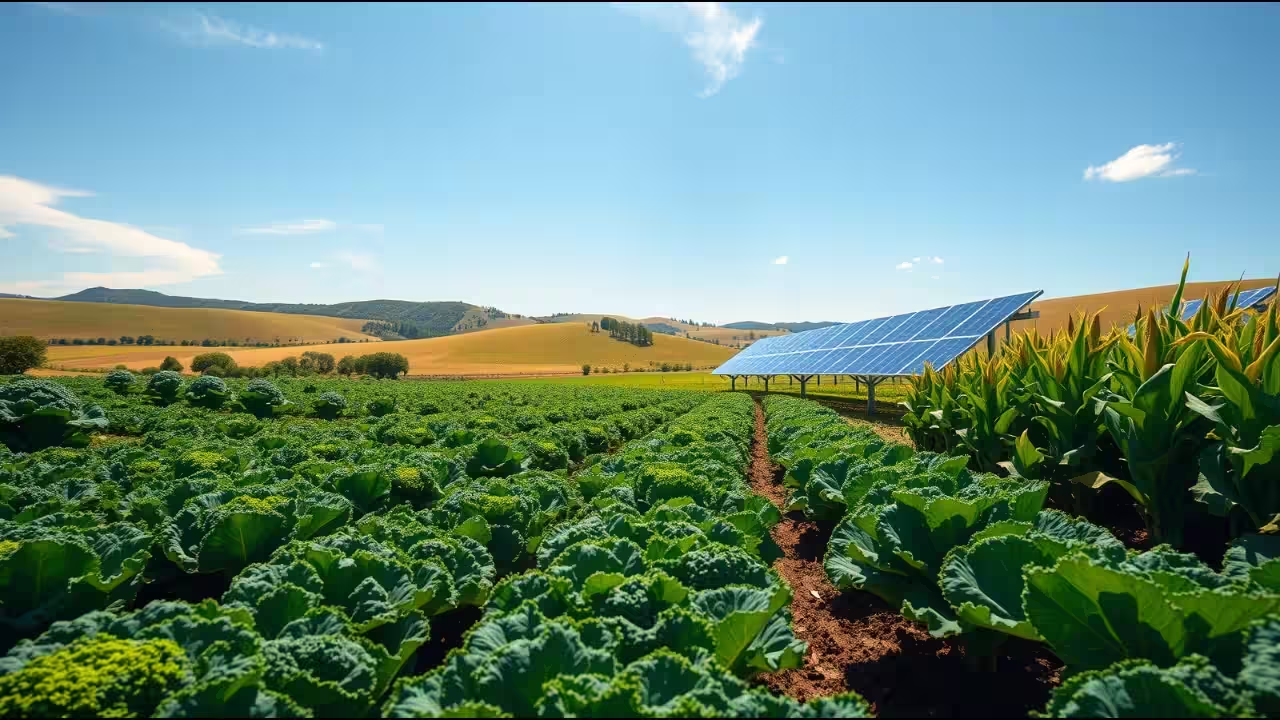
On a stretch of farmland in Hadley, Massachusetts, broccoli, sweet corn and other crops have been grown beneath rows of solar panels. Farmer Joe Czajkowski, whose family has farmed in the Pioneer Valley for three generations, hosts an 832-panel agrivoltaic array covering 2.2 acres of his more than 400-acre farm. The 445-kilowatt DC system was built by Hyperion Systems and completed in July 2023, although the array became operational in 2024. The North American Agrivoltaics Awards has named Czajkowski its 2026 Solar Farmer of the Year, with the awards ceremony scheduled for October 27 in Chicago. The awards say half the electricity generated by the array runs his farm operations, while the other half goes to 17 low-income households across western Massachusetts. The U.S. Department of Energy says the panels are mounted at a 10-foot elevation to allow enough sunlight to reach crops below. UMass research and project materials from Hyperion describe the tracking system and its changing clearance above the ground.Massachusetts agrivoltaics farm: how Czajkowski Farm in Hadley hosts 832 solar panels over croplandCzajkowski Farm covers more than 400 acres in the Pioneer Valley, and the 2.2-acre solar array occupies a small portion of that land. The project was developed through a partnership between Czajkowski and Hyperion Systems, a company specialising in dual-use solar. Hyperion's project information says the array has a capacity of 445 kilowatts DC and 375 kilowatts AC and consists of 832 modules mounted on single-axis trackers. The rows are spaced 26 feet from post to post, allowing farm equipment to operate between them. Czajkowski can continue using tractors and attachments for activities including subsoiling, tilling, harrowing, cultivating and spraying. The modules are 10 feet above the ground when horizontal, according to Hyperion. Because the system tracks the sun, the clearance changes as the panels tilt. The UMass research summary records a maximum tilt that brings the panels to about 7.75 feet above the ground. The array uses a north-south single-axis tracking system, with the modules following the sun from east to west. The UMass research records the system as completed in July 2023.The project was designed around the farm's existing agricultural operation. Czajkowski continues to prepare the soil, plant, cultivate and harvest crops beneath the array, while also using the land for a winter cover crop. The North American Agrivoltaics Awards says the project qualified for both the Massachusetts SMART Program's Low Income Community Solar standards and its Agricultural Solar Tariff Generation Unit standards. Half of the electricity generated goes toward the farm's operations, while the other half serves 17 low-income households in western Massachusetts.Crops under solar panels: broccoli and sweet corn grow beneath the arrayBroccoli was selected for a 2023 experiment examining how the agrivoltaic array affected the crop's growing conditions. The UMass research summary, titled Broccoli Production Under Agrivoltaic Solar Array in Hadley, MA, describes the work as first-year preliminary results. Researchers transplanted broccoli on August 18, 2023, and monitored three bed positions beneath the array: one under the leading panel, one between two panels and one near the back panel. They compared these positions with control plots. The study examined growing conditions and crop performance at the different positions beneath the array. The researchers found that the leading-panel position received less photosynthetically active radiation than the control, while the other two positions received similar light levels to the control. Air temperature, relative humidity and soil temperature were similar between the array and control areas. The researchers described the findings as a snapshot of how the panels modified the crop-level microclimate and said further time-series analysis was planned. One important detail is that the 2023 trial took place before the system was connected to the grid. The UMass report says the panels remained horizontal during that trial year, so those results describe the conditions during that specific experiment rather than the fully operational tracking configuration.The project has since expanded beyond broccoli. The 2026 North American Agrivoltaics Awards says Czajkowski has grown sweet corn, blueberries and shade tobacco beneath the panels and has also raised broiler chickens under the array. It says sweet corn grown beneath the panels is producing about 80% of the volume of open-field corn while maintaining matching quality. The awards page separately attributes the roughly 20% difference to fewer corn rows being planted rather than stunted growth. That result comes from this farm and should not be treated as a general yield figure for sweet corn grown under agrivoltaic systems elsewhere. The farm also supplies produce to institutional and retail customers, including UMass Amherst Dining Services, Springfield Public Schools, Trader Joe's and Whole Foods, according to Hyperion's project information. The North American Agrivoltaics Awards says an electric van charged from the array is used to transport produce to UMass Dining.Dual-use solar for farmers: how the array provides another source of farm incomeFor Czajkowski, reducing the farm's electricity costs was one reason he became interested in solar. American Farmland Trust reported that his average annual electricity bill was around $75,000 and that he became interested in solar as a way to decrease that cost. The organisation reported that, under the arrangement described in its November 2023 article, Czajkowski would receive a 17.5% discount on his monthly electricity bills as a subscriber, equivalent to about $13,125 a year based on the $75,000 annual bill. American Farmland Trust also reported that the parcel used for the project had previously grown almost exclusively onions and had experienced degraded soil. Czajkowski wanted to make the land more viable, while the agrivoltaic project provided another use for the acreage alongside continued agricultural production. The Department of Energy quoted him saying he receives payments for the electricity while also getting a discount on his electric bill. The exact lease-payment amount has not been publicly disclosed in the cited accounts. The percentage discount has been reported differently in different accounts. American Farmland Trust's November 2023 article described a 17.5% discount for the subscriber arrangement, while later reporting has cited a figure of about 15%. The reports do not explain the difference between the two figures.Czajkowski told the Department of Energy that the solar income could provide another layer of financial security as he gets older. He also discussed additional agrivoltaic projects as a way of helping keep the farm viable for the next generation. The Hadley project is part of a wider expansion of agrivoltaics in the United States. The National Renewable Energy Laboratory identified 566 U.S. agrivoltaic projects as of August 2024, with more than 10 gigawatts of combined capacity. The figure comes from research published when the laboratory was still known as the National Renewable Energy Laboratory (NREL), now the National Laboratory of the Rockies. The U.S. Department of Energy's Solar Futures Study projected that solar could require about 5.7 million acres of land by 2035, equivalent to roughly 0.3% of the contiguous United States. DOE has highlighted agrivoltaics as one approach to combining solar generation with continued agricultural use of land. Its research and funding programmes have also examined how solar installations can coexist with crops and livestock.You use AI every day. Now get your AI Quotient. Take the AIQ test.
Topics in this story
Gathered from external sources. Rights to this text belong to whoever originally published it.