In 1990, cheetah expert Laurie Marker sold her possessions to begin fieldwork in Namibia; her research base now helps protect about 158,000 acres of cheetah country
Rest of World News: Discover how Laurie Marker sold her possessions to create the Cheetah Conservation Fund in Namibia, safeguarding 158,000 acres of cheetah habitat while fostering coexistence with local farmers.
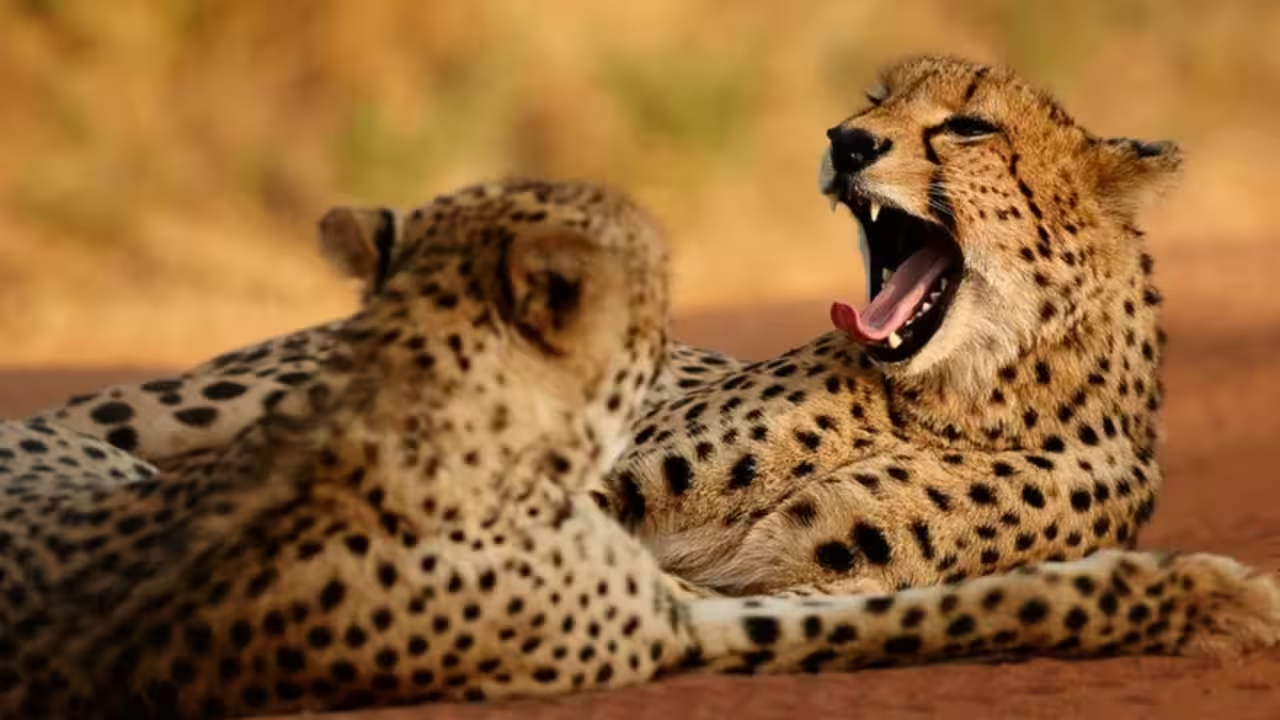
In 1990, American zoologist Laurie Marker made a decision that reshaped her career and eventually led to one of the world’s best-known cheetah conservation organisations. Marker founded the Cheetah Conservation Fund (CCF) that year, selling her possessions to purchase an old Land Rover for her upcoming fieldwork. She then transferred her research to Namibia, where she permanently relocated in 1991. Following her relocation, she began building a conservation programme around the survival of wild cheetahs outside conventional protected areas.In 1977, Marker first travelled to what was then South West Africa while researching whether a captive-born cheetah could learn to hunt in the wild. Marker studied Khayam’s behaviour after taking the animal from Wildlife Safari in Oregon to Namibia. This experience helped her to see another challenge that would become central to her career: wild cheetahs were being killed by livestock farmers who regarded them as threats to their animals.A conservation organisation that started from a research projectThough the CCF was established in 1990, Laurie Marker’s ultimate relocation to Namibia came in 1991. To start her field operations, she began working directly out of a local farmhouse, taking her research and conservation efforts into the farming areas where many of the country’s free-ranging cheetahs lived.As Namibia’s cheetahs often occupied private farmland, their survival was connected directly to livestock production. CCF therefore started interacting with the farmers to understand why cheetahs were being killed and to work on methods that could reduce livestock risk without resorting to lethal predator control.A peer-reviewed review of cheetah conservation programmes describes the organisation’s work in Namibia as an example of conservation outside protected areas. Moreover, it emphasises reducing conflict between cheetahs and livestock farmers.Science became the foundation of the programmeMarker’s work was not simply limited to fieldwork. During the 1980s she worked with scientists from the Smithsonian Institution and National Cancer Institute on the species’ genetic characteristics and reproductive biology. Those studies indicated unusually low genetic diversity and poor sperm quality in cheetahs, findings that helped scientists understand some of the species’ biological vulnerabilities.According to the foundation, its Namibian cheetah population study began in 1990 and used tissue and scat samples to identify individual animals and investigate population structure. The organisation has reportedly accumulated hundreds of tissue samples and more than 1,000 scat samples, creating a long-term record for ongoing and subsequent research.As cheetahs are wide-ranging predators, conserving them requires more than just protecting isolated animals. Consequently, CCF’s research included population monitoring, genetics, ecology and studies of how the species interact with farms and other lands. One such practical response to livestock conflict was suggested in 1994, when the organisation began its livestock guarding dog programme. The organisation now breeds and places Anatolian dogs and Kangal dogs with farmers, using their presence around livestock herds to deter predators and reduce attack risks. This programme demonstrates how the organisation sought to provide practical measures that could address the same concerns that had once driven much of the conflict, instead of treating farmers as an obstacle to their conservation.The small-scale operation that began with a farmhouse and an old Land Rover eventually grew into the Cheetah Conservation Fund’s International Research and Education Centre in Namibia. The place is now a multidisciplinary facility which incorporates research, veterinary work, genetics, education and model-farm activities.Today, theCheetah Conservation Fund’sInternational Research and Education Centre operates a 142,483-acre private wildlife reserve. To expand its protection footprint, the organization integrates this model facility with an additional 15,517 acres of adjacent community conservancy lands. Managed cooperatively, this joint framework fulfills the headline's scope by putting roughly 158,000 total acres of cheetah country under structural protection. The purpose of the Namibian operation was not simply to create a large fenced refuge and remove cheetahs from human-dominated landscapes. Instead, the foundation made it a point to focus on farmland, where maintaining viable predator populations depends on reducing conflict and finding ways for livestock production and wildlife to coexist.Catch the latest World News and Live updates. Download the TOI app.
Topics in this story
Gathered from external sources. Rights to this text belong to whoever originally published it.