In 1984, a meteorite crushed the back of a Georgia woman’s steel mailbox and knocked it over; the battered mailbox later sold at auction for $83,000
US News: A rural mailbox in Georgia, hit by a meteorite in 1984, sold for $82,750 at auction, highlighting the unusual intersection of everyday objects and astronomical phenomena.
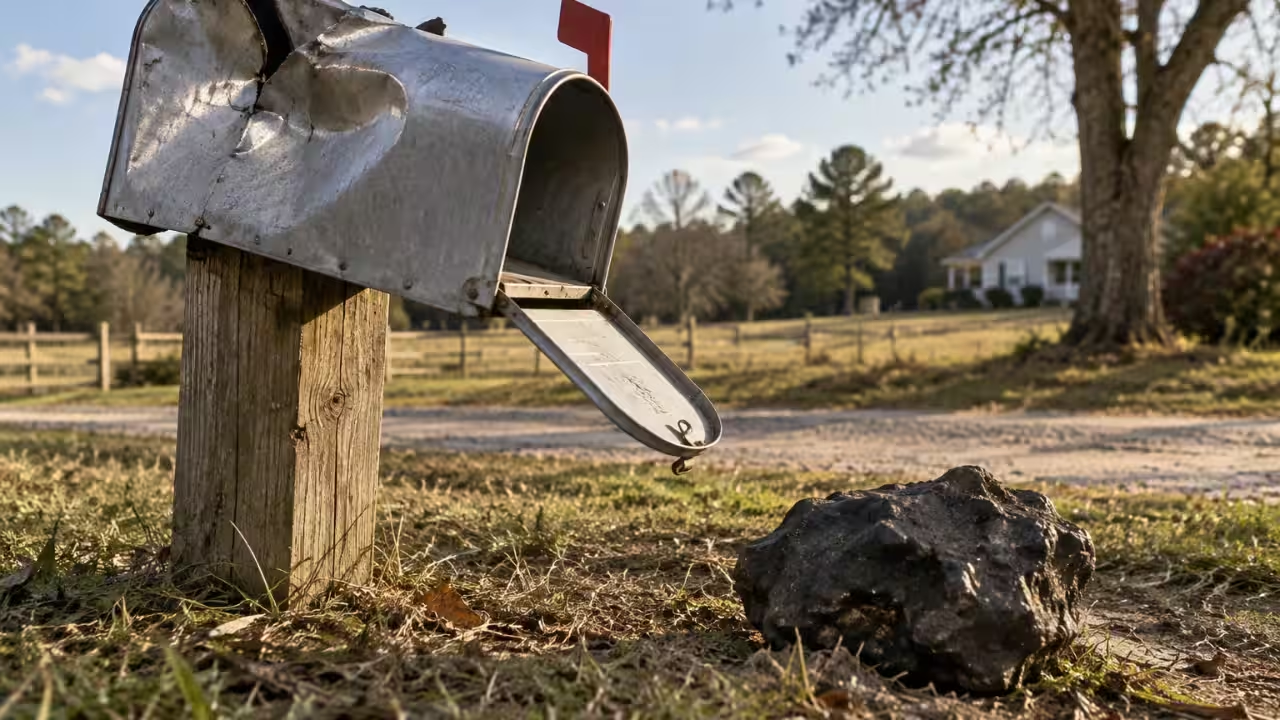
A rural mailbox in Claxton, Georgia, was struck by a meteorite on December 10, 1984. The impact damaged the metal box and tore it from its wooden post, and left behind an object that would eventually become a curiosity in the world of meteorite collecting. In 2007, the battered mailbox was sold at a Bonhams auction for $82,750, including the buyer’s premium.The night a space rock hit the mailboxThe event occurred in the evening in Claxton, where the meteorite came down in Evans County. The Arizona State University Buseck Center for Meteorite Studies identifies the object as the Claxton meteorite, an L6 ordinary chondrite. Its account says witnesses heard a whistling sound followed by a crash and a thud as the rock fell. The meteorite was later estimated to have weighed about three pounds, with roughly 1,455 grams recovered. It struck the metal mailbox that belonged to Carutha Barnard and left a depression in the surrounding ground.The ASU meteorite center notes that the mailbox was later acquired by meteorite collector and tektite expert Hal Povenmire. A staged photograph from the period shows Barnard alongside Povenmire and the damaged mailbox, although the archive notes that the photograph was staged and that the mailbox had actually been torn from its post during the impact.From rural mailbox to collector’s objectThe mailbox might have remained a local curiosity if the meteorite itself had not been recognized and preserved, but its connection to a documented extraterrestrial impact made the battered steel box rather unusual. The Claxton meteorite is significant because scientists were able to document the fall and recover pieces of the object. The ASU archive records that the stone was covered by a thin black fusion crust, which is a surface formed as the meteorite heated while passing through Earth’s atmosphere.The mailbox therefore became physical evidence of the event; its dents and damage were linked to a documented meteorite fall. The object had become something far removed from its original purpose by the time it reached auction, and was no longer being valued as a mailbox but as an artifact deeply associated with a rare astronomical event.The $82,750 auction surpriseThe mailbox was offered at Bonhams in 2007 during an auction devoted to meteorites and related material. The sale included far more scientifically significant rocks, including pieces of famous meteorites, but the damaged Georgia mailbox became one of the unexpected highlights. The Associated Press reported that the mailbox sold for $82,750, including a 20% buyer’s premium. A small piece of the Claxton meteorite itself, weighing less than an ounce, sold separately for $7,700. The Smithsonian also highlighted the mailbox after the auction and described it as a battered metal box from Georgia that had been struck by a falling meteorite in 1984. Its final bid was reported as $82,750.The price tells us something unusual about meteorite collecting: sometimes the object connected to a meteorite can become nearly as interesting to collectors as the rock itself. The Claxton mailbox’s value came later, from the story attached to its damaged metal surface. A meteorite had crossed the atmosphere, struck the ground, and hit a household object that most tend to overlook. That accident transformed a rural mailbox into a documented piece of meteorite history, and decades later, into an auction item worth tens of thousands of dollars.Catch the latest World News and Live updates. Download the TOI app.
Topics in this story
Gathered from external sources. Rights to this text belong to whoever originally published it.