A Mississippi couple received $13,172 from State Farm after a tree fell on their home, but lost their fight for a $95,896 insurance payout after an appeals court rejected their expert evidence
A fallen tree can leave a homeowner facing more than a damaged roof.
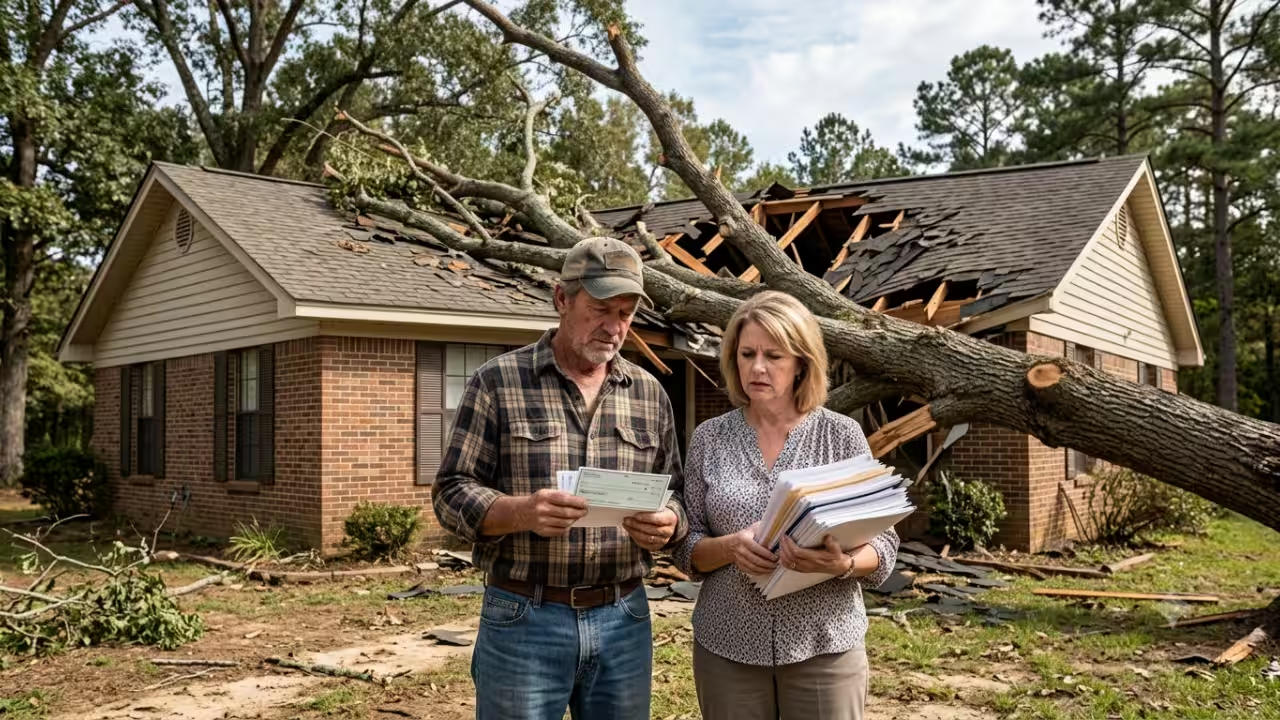
A fallen tree can leave a homeowner facing more than a damaged roof. Repairs may extend to surrounding concrete, a swimming pool and parts of a building that were already showing signs of wear. For Dustin and Amanda Cain of Mississippi, the disagreement over what their insurer should cover became a legal dispute that ended with an appeals court ruling in favour of State Farm. The couple argued that the tree had caused substantially more damage than the insurer initially accepted. But their attempt to establish the full extent of the loss ran into a problem with the expert evidence they presented. On October 16, 2026, the US Court of Appeals for the Fifth Circuit upheld the dismissal of their claims.State Farm homeowners’ insurance dispute over tree damage and repair costsThe US Court of Appeals for the Fifth Circuit reported that the incident occurred on August 27, 2022, when a tree fell on the Cains’ home. The couple held a homeowners’ insurance policy with State Farm, which inspected the property and concluded that the impact had punctured the roof. The insurer attributed other problems around the house to longer-term issues, including temperature-related expansion and contraction, deferred maintenance and settlement.Those distinctions mattered because State Farm did not consider the additional damage to be covered by the policy. It initially paid the Cains $10,042.90.The couple disputed the insurer’s assessment and sought independent advice. Reportedly, an engineer’s report and a contractor’s estimate put the cost of the damage to their home, swimming pool and concrete at $95,896.07. The figure was far above the amount State Farm had paid, setting up a disagreement over both the cause of the damage and the repairs the insurer was obliged to fund.State Farm reviewed the earlier inspection, examined the property again and revised its estimate. It then paid a further $3,130.08.Expert report raised questions about who was responsible for its findingsOn June 6, 2024, the Cains filed a lawsuit against State Farm. They sought $134,994.54, covering their breach-of-contract allegations and claims involving the insurer’s handling of the matter, along with consequential damages, legal fees, court costs and interest.Their case depended in part on demonstrating that the tree had caused the disputed damage. To support that argument, they designated Sean Fee of Forensic Building Science (FBS) as their expert witness. Fee’s report, submitted on 6 December 2024, recommended repairs but did not include a breakdown of their costs.There was a problem with the way the report had been prepared. Fee had worked on it with Jim Irmiter, a colleague at the same company, and the document stated that both men had contributed to, reviewed and agreed with its contents. Yet the Cains had formally named Fee alone as their expert.The expert evidence dispute ended with a victory for State FarmThe Cains later submitted another document, this time setting out repair costs of $149,325.66. The estimate was also jointly prepared by Fee and Irmiter, and it was filed on March 4, 2025, the deadline for completing discovery.State Farm challenged the additional estimate as well as Fee’s proposed testimony. Its position was that Fee could not simply present another person’s analysis as his own, particularly when Irmiter had not been designated as an expert witness. The insurer argued that the reports did not establish which conclusions Fee had personally reached or how he had arrived at them.The couple asked the district court to accept the later estimate despite its timing. Their lawyers explained that counsel had experienced a medical condition requiring surgeries and treatment between December 2024 and March 2025.That request did not resolve the separate issue surrounding the expert evidence. The US Court of Appeals for the Fifth Circuit reported that on July 24, 2025, the district court struck the proposed reports and Fee’s testimony. It found that the documents did not make clear who had performed the relevant work or developed the opinions. Without that distinction, the court concluded, the reliability of the analysis could not be properly assessed.The ruling left the Cains without the expert evidence they needed to support their account of the damage. The district court consequently granted summary judgment to State Farm and dismissed the lawsuit with prejudice, meaning the claims could not simply be brought again as a new case.The Fifth Circuit upheld the exclusion of the jointly prepared reportsThe Cains challenged the decision before the Fifth Circuit, arguing that a report did not become inadmissible merely because two people had worked on it. They maintained that Fee and Irmiter had both contributed to the documents and agreed with their conclusions, presenting a shared assessment rather than competing opinions.The appeals court did not rule that experts were prohibited from preparing reports together. Instead, it focused on the need to identify the work and opinions attributable to each person. A jointly prepared report may be acceptable, but the court must be able to determine what each designated expert actually intends to say and the reasoning supporting that testimony.In the Cains’ case, the report did not provide the necessary separation. Both Fee and Irmiter were named as contributors, but only Fee had been designated as an expert. The court therefore had no clear way to establish which parts of the analysis belonged to him.The Fifth Circuit upheld the ruling in State Farm’s favourThe Cains also argued that certain claims should survive independently, including allegations concerning delayed payment, punitive damages and actual cash value. The court rejected that position. Under Mississippi law, a bad-faith insurance claim requires an underlying breach of contract. Once the couple could no longer establish the necessary basis for their contract claim, their related allegations could not proceed on their own.The Fifth Circuit accordingly affirmed the district court’s judgment for State Farm. It did not need to decide whether the later estimate had been properly excluded as untimely or whether Fee’s proposed testimony would also have failed a separate assessment of scientific or technical reliability.The decision, issued on October 16, 2026, was marked as unpublished, meaning it was not designated for publication under the Fifth Circuit’s rules. For the Cains, the outcome was not a finding that every disputed condition at the property had been caused by long-term wear or maintenance problems. The appeal turned on whether the evidence they presented could be admitted and used to prove their case. With the expert reports excluded and no adequate alternative evidence of causation and damages, the insurer’s victory remained intact.You use AI every day. Now get your AI Quotient. Take the AIQ test.
Topics in this story
Gathered from external sources. Rights to this text belong to whoever originally published it.