In 2020, Brazil tested sugarcane bagasse ash in a highway resurfacing; a 2023 inspection found no visible defects in either section, while lab wheel tests showed 11% less deformation in the ash mixture
Brazil's recent study reveals that replacing mineral filler with sugarcane ash in asphalt can reduce rutting by 11%, showing promise for more sustainable road construction.
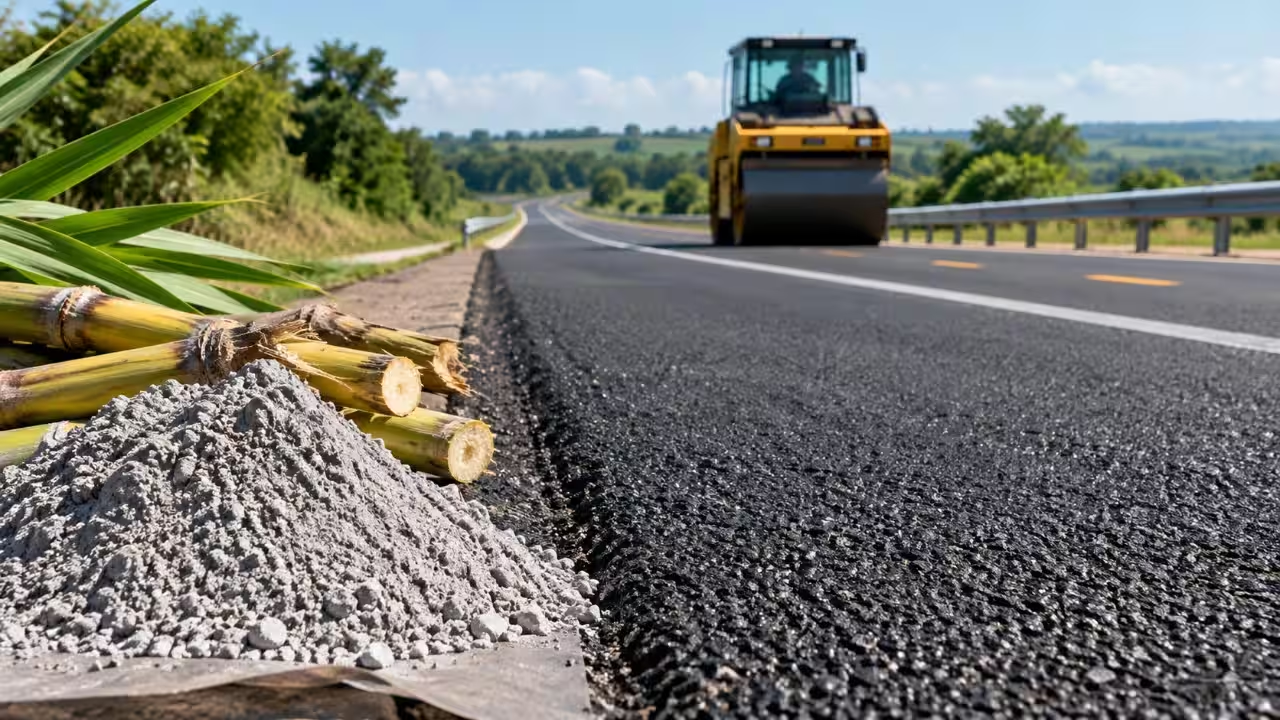
The surfaces of asphalt roads degrade in an irregular pattern depending on traffic. Vehicles with heavy loads repeatedly drive along the same small path, slowly forming grooves that are called ruts in the road surface. Road administrations pay lots of money to repair those areas, whereas engineers try to find suitable asphalt mixes that would not degrade in the first place. Sugarcane milling provides one of the possible ingredients. Mills burn bagasse, a byproduct of sugar juice production, into ash, which is disposed of somewhere.The 2024 Maringá studyVinicius Milhan Hipólito and Jesner Sereni Ildefonso studied the use of sugarcane bagasse ash in asphalt pavement in Functional and structural assessment of an experimental section gap graded modified with sugarcane bagasse ash, published in Scientific Reports on 8 August 2024. The study examined an experimental section of the BR-158 highway in Paraná, Brazil, constructed in September 2020. The reference mixture was a gap-graded asphalt with a rubber-modified binder and in the modified mixture, the ash made up 5% of the total mineral aggregates, replacing conventional filler. The researchers found that 5% was the maximum proportion that kept the mixture within the recommended grain-size range.The BR-158 test sectionThe experimental section was on the BR-158 highway in Paraná. The existing asphalt surface was milled and covered with a 10 cm layer of dense-graded mix and then a 3.5 cm layer of gap-graded mix. The first 60 metres received the ash mixture and the next 60 metres received the standard mixture under the toll company’s maintenance programme, so both sections carried the same traffic.Laboratory tests and the May 2023 inspectionSamples taken from the experimental lane were tested in the Hamburg Wheel Tracking Device, which rolls a loaded steel wheel across each sample under water. The test ran at 50 °C with a 705 N wheel load for 20,000 revolutions. The reference mixture deformed by 3.6 mm and the ash mixture by 3.2 mm, which is 11% less. Both mixtures stayed below the 4 mm threshold the authors used as an indicator of adequate properties.A second laboratory test, dynamic creep, also favoured the ash mixture. It showed 28% less deformation after 10,000 cycles and a flow number of 16,707 against 9,681 for the reference mixture, which is 73% higher. A road inspection in May 2023 found no visible surface defects on either section. Because the reference section was also free of defects, this shows the ash section held up under traffic but does not show that it outperformed the reference mixture.A 2026 laboratory study of ash in asphalt masticA separate team tested the same material in the binder. Prasad Bishetti and Aniket Kataware’s study, Valorization of Sugarcane Bagasse Ash for Sustainable Asphalt Mastics: Material Characterization and Performance Evaluation, appeared in the Journal of Transportation Engineering, Part B: Pavements in 2026. In this laboratory study of mastics, not a road test, the ash replaced granite filler at 0% to 25% by mass. The best results came at 15% to 20% replacement, where non-recoverable creep compliance, an indicator of rutting susceptibility, fell by 79% and fatigue life rose 1.18 times.What the evidence supports so farTaken together, these two studies support only a limited conclusion. Bagasse ash can replace part of the mineral filler without degrading performance, at least in the laboratory tests and on one heavily trafficked road during the first inspection period. Neither study shows that the ash prevents rutting over a pavement’s whole service life. The field test also covered only 120 metres, of which 60 used the ash mixture. The authors of the above-mentioned study concluded that partially replacing conventional filler with the ash is technically feasible in both laboratory and field settings. Further observation is needed before agencies adopt the ash as a filler in their pavements. The mastic study also replaced filler at much higher shares than the 5% of total aggregate used on the BR-158, so the two figures are not directly comparable.You use AI every day. Now get your AI Quotient. Take the AIQ test.
Topics in this story
Gathered from external sources. Rights to this text belong to whoever originally published it.