In 2026, activists spent 70 days perched in a 200-year-old Arizona tree to save it from a border wall; federal agents cleared the protest, and crews cut it down
A 200-year-old cottonwood tree known as the 'grandmother' in Arizona was cut down by federal agents as activists protested against the construction of a border wall. The protests highlight concerns about wildlife corridors and environmental impacts in the region.
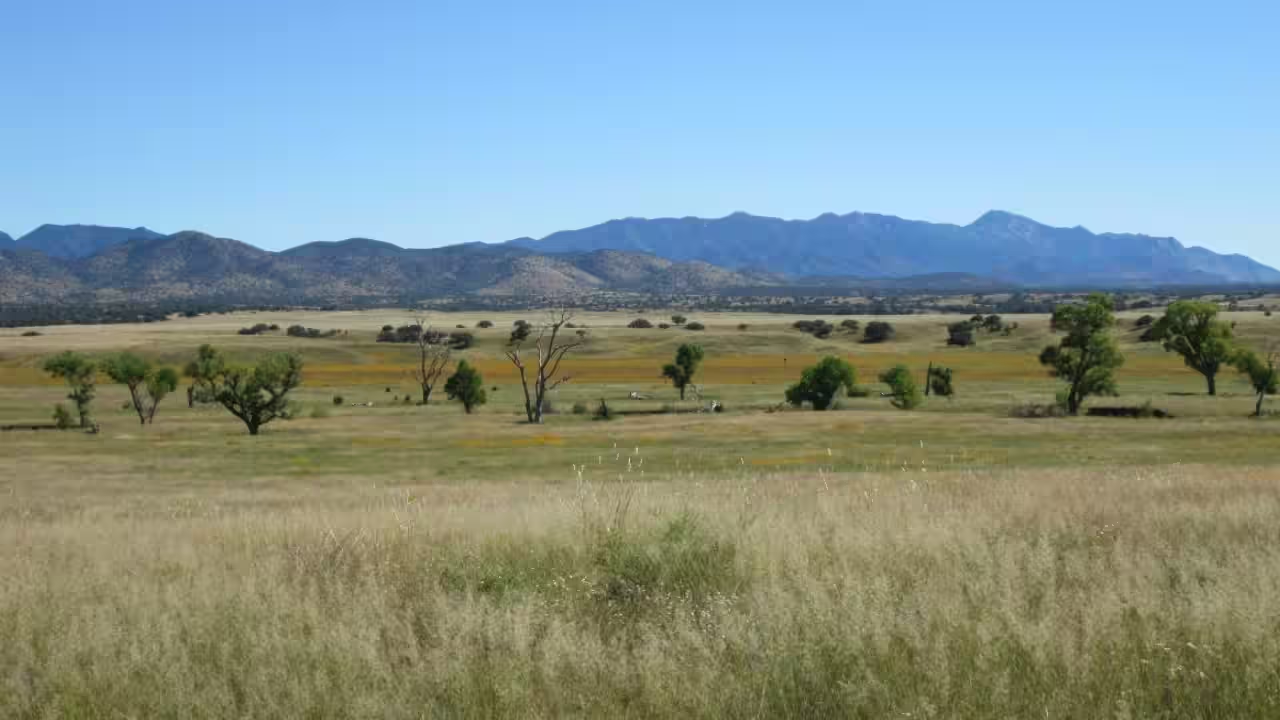
A 200-year-old cottonwood tree in Lochiel, Arizona, was cut down on 5 October 2026 after protesters occupied its branches for more than 70 days. The tree was locally known as the “grandmother” and became the focal point of protest against a project slated to run two 30-foot-high parallel walls through San Rafael Valley. According to The Guardian, more than 80 federal agents arrived at the private land that morning and removed the last person occupying the tree and prevented demonstrators from reaching it. An excavator was used by contractors from Fisher Sand & Gravel to push the cottonwood to the ground.Participants had taken turns occupying a platform high in the tree, while supporters gathered and prayed near the construction site. Even after the grandmother tree fell, the protest continued, driven by the efforts of demonstrators trying to delay the construction along the border. Prior to the destruction, another ancient cottonwood in the area was felled on 27 July earlier this year.The wildlife corridor at riskThe San Rafael Valley is a remote high-elevation grassland between the Patagonia and Huachuca mountains in southern Arizona. Its landscape forms a vital wildlife corridor bridging the habitats between the United States and Mexico, and is home to jaguars, ocelots, bears, beavers, and porcupines. The demonstration raises concern about constructing a wall through this landscape, which would hinder the movement of wildlife between the two countries.According to Russ McSpadden, an advocate with the Center for Biological Diversity, cottonwoods are the hallmark of riparian forests, dependent on underground water, and represent an endangered ecosystem found across Arizona and the southwestern United States. Their removal would not only affect the landscape’s appearance but also completely eliminate the trees from an ecological setting that is already under pressure.Another pressing concern brought about by the border infrastructure is water consumption. To construct the wall, water would be required to facilitate the preparation of concrete, and this would undoubtedly strain the local water supplies. To add more context, in 2008, US Border Patrol estimated that constructing a smaller wall nearby could require as much as 710,000 gallons of water per mile. The wall is being built using steel panels set into trenches containing reinforcing steel and concrete. By early October, contractors had completed the secondary barrier along part of the private property where the protesters camped. As of October 2026, 88 miles of secondary wall had already been completed nationally, with another 444 miles under construction, according to the Department of Homeland Security.Arrests and the continuing oppositionThe removal of tree sitters did not end the demonstrations, as protests continued with non-violent resistance. Earlier, on 7 August, a woman had attached herself to a cement truck so as to delay the work, and witnesses and videos cited by The Guardian indicated that she was sprayed with mace by the agents and removed from the cement truck.Afterwards, she was held in custody, according to information submitted by the authorities to her lawyers. The demonstration gained support from environmentalist Julia Butterfly Hill, who spent two years in the late 1990s in a California redwood, and condemned the act as horrifying. Speaking on the experience, Butterfly Hill told the Guardian, “She’s a hero of the highest order.”On October 8, the dispute made its way into Congress; Arizona congresswoman Adelita Grijalva said she intended to introduce legislation revoking the Department of Homeland Security's authority to waive any and all laws in border infrastructure. The proposal was a response to concerns over the powers used to advance construction, although it had not yet changed the work taking place in Lochiel.You use AI every day. Now get your AI Quotient. Take the AIQ test.
Topics in this story
Gathered from external sources. Rights to this text belong to whoever originally published it.