Jack London bought 1,400 acres of exhausted California farmland and planted 65,000 eucalyptus trees; his experimental Beauty Ranch is now a state park
US News: The California ranch where Jack London spent his final years was not simply a country retreat for a wealthy author but a testing ground. London bought.
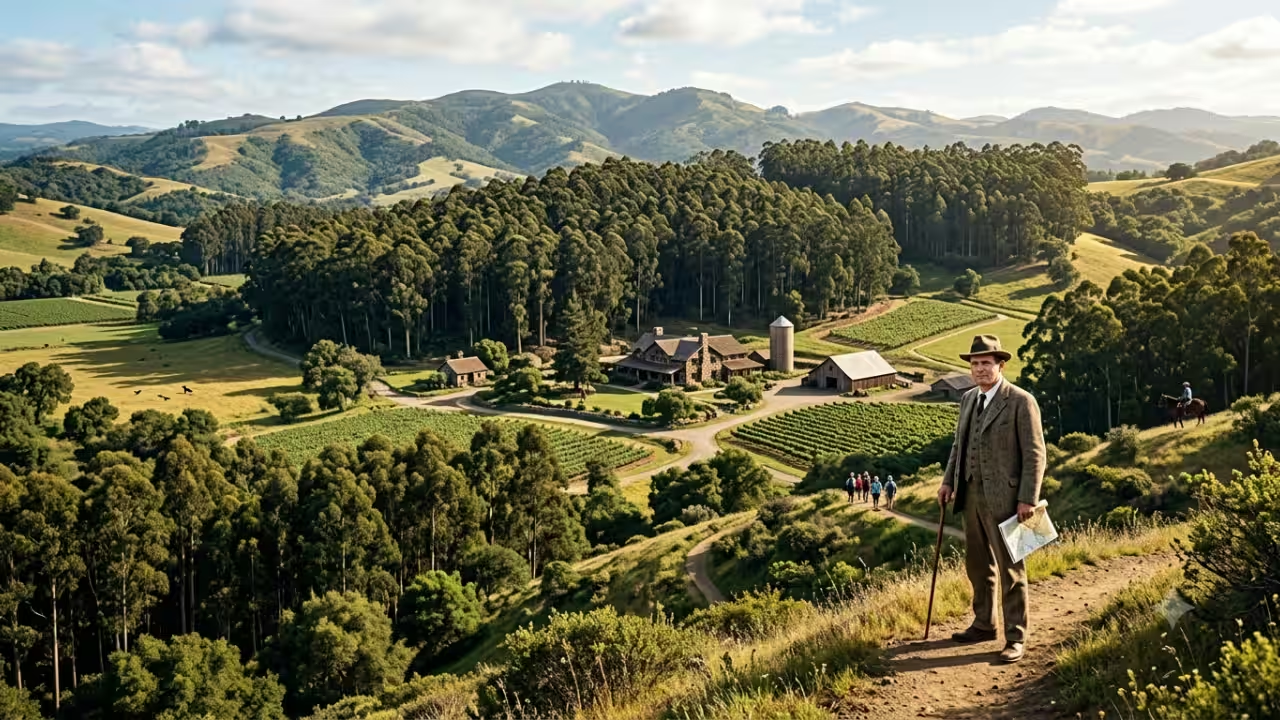
The California ranch where Jack London spent his final years was not simply a country retreat for a wealthy author but a testing ground. London bought the Hill Ranch on Sonoma Mountain in 1905 and soon found that the land had been worn down by intensive farming. The discovery pushed him towards agriculture, a subject he pursued with unusual seriousness. He studied farming manuals, explored scientific approaches to soil management and began putting ideas into practice across the property. As he purchased neighbouring parcels, the ranch grew to roughly 1,400 acres and took the name Beauty Ranch. London planted enormous numbers of trees, raised cattle, horses and pigs, experimented with crops and built systems designed to recycle materials produced on the farm.He even tested spineless cactus as cattle feed with Luther Burbank, the world’s leading horticulturist. Some schemes failed or produced unexpected results, but the aim remained the same: restore the land while making the ranch increasingly self-sufficient. Much of that story remains preserved today.Jack London’s first California ranch revealed badly depleted farmlandJack London arrived at Sonoma Mountain with money made from his writing and a clear intention to make the Valley of the Moon his permanent home. In June 1905, while living with Charmian at Wake Robin Lodge in Glen Ellen, he bought the 130-acre Hill Ranch for $7,000, as reported by Jack London Historic Park.He described the property as some of the most beautiful primitive land in California. Yet the impression changed when he began preparing part of it for hay. Clearing about 40 acres exposed a problem that would shape his approach to farming for years: the soil had been repeatedly cropped without enough being returned to it.The surrounding ranches had also struggled. London eventually acquired several adjoining properties from owners who had failed financially, turning what had been a collection of troubled farms into a single expanding estate.Jack London turned his ranch into a living agricultural experimentLondon approached the problem as he approached many other subjects in his life; by reading. Agricultural manuals and scientific works became part of his study, and farming gradually took up far more of his working day than might be expected of a novelist.He came to reject the idea that a farm should simply extract as much as possible from its fields. His own rule was to keep material on the property wherever possible. Crop residues, animal manure and plants grown specifically to improve the soil all had a role.Jack London quoted, "I am rebuilding worn-out hillside lands that were worked out and destroyed by our wasteful California pioneer farmers. I believe the soil is our one indestructible asset, and by green manures, nitrogen-gathering cover crops, animal manure, rotation of crops, proper tillage and draining, I am getting results which the Chinese have demonstrated for forty centuries."Green manure became particularly important. Cover crops could be grown and then worked back into the ground, adding organic matter and helping replenish nutrients. Crop rotation was used instead of repeatedly planting the same crop, while drainage and careful tillage were part of the effort to make better use of the land.London also experimented with terracing. He had encountered the practice while working as a war correspondent in Korea in 1904, and later applied the principle to his California property as a means of limiting the loss of soil from sloping ground.Beauty Ranch grew into a large-scale farming operation for LondonThe Hill Ranch did not remain a small farm. London continued buying neighbouring parcels, and by 1913 his holdings on Sonoma Mountain covered about 1,400 acres. The property became known as Beauty Ranch, and London sometimes referred to it as the Ranch of Good Intentions.There was plenty happening across those acres. Hay was grown, livestock were kept and thousands of trees were planted. London eventually put about 65,000 eucalyptus trees into the ground and continued looking for ways to make unproductive acreage useful again.By 1916, close to 50 people were employed on the ranch. Farming was no longer a side project for a successful author. It had become a substantial operation occupying much of his time and attention.London tested new ideas to make the ranch more self-sufficientLondon was interested in practical experiments, even when the results were mixed. He worked with horticulturist Luther Burbank on growing spineless cactus as a possible source of cattle feed. The plants could grow quickly under the right conditions, but irrigation was needed, and some of the cactus eventually developed spines again.A small patch of the experiment survives in the meadow at the historic park.The ranch also had its own system for dealing with feed and animal waste. London built what has been described as California's first concrete-block silo, using it to store silage made from shredded corn stalks. The silage went to the dairy cattle, while the pigs were fed corn.Italian stonemasons were brought in to construct a barn for the horses, as well as a manure pit where animal waste could be collected and turned into fertiliser. The intention was to make the farm less dependent on outside inputs and to return useful material to the soil.Fields that had been considered exhausted produced againSome of London's most striking results came from land that had previously been regarded as badly overworked. He reported record oat-hay yields from fields that had suffered under earlier farming practices.His approach was not based on a single technique. The farm combined rotations, cover crops, manure, composting, terracing, drainage and controlled use of grazing animals. In his view, restoring the soil was as important as producing a crop from it.That thinking can be seen in a line London wrote about the property: he wanted to leave the land better because he had lived and worked there. His methods were shaped partly by his reading of agricultural science and partly by practices he had encountered elsewhere, including the long-established farming traditions of China.Beauty Ranch after LondonLondon died in 1916, aged 40, but the agricultural landscape he had developed remained an important part of the property. His former ranch is now protected as Jack London State Historic Park, covering roughly the same 1,400 acres that had been assembled during his lifetime.The park contains buildings and landscapes associated with the Londons, including the remains of the ranch's agricultural operations. Visitors can still encounter parts of the working landscape that made Beauty Ranch more than a retreat for a famous writer.Its significance lies partly in that unusual combination. London came to Sonoma Mountain as a novelist with an interest in farming and ended up devoting enormous amounts of time to restoring worn soil, raising animals and testing ideas in the fields. The ranch became a long-running experiment in whether damaged farmland could be made productive again without simply repeating the practices that had exhausted it in the first place.More than a century later, the land is no longer a private working ranch. But the fields, buildings and surviving traces of London's experiments remain within the state park, preserving an unusual chapter of his life that took place far from the writing desk.Catch the latest World News and Live updates. Download the TOI app.
Topics in this story
Gathered from external sources. Rights to this text belong to whoever originally published it.