Ollie Letrell Cader disappeared from California’s Emerald Triangle in October 1981 | Dateline
Ollie Letrell Cader was last seen in California’s Emerald Triangle in 1981. He disappeared from Humboldt County, and his truck was later found in Mendocino County.
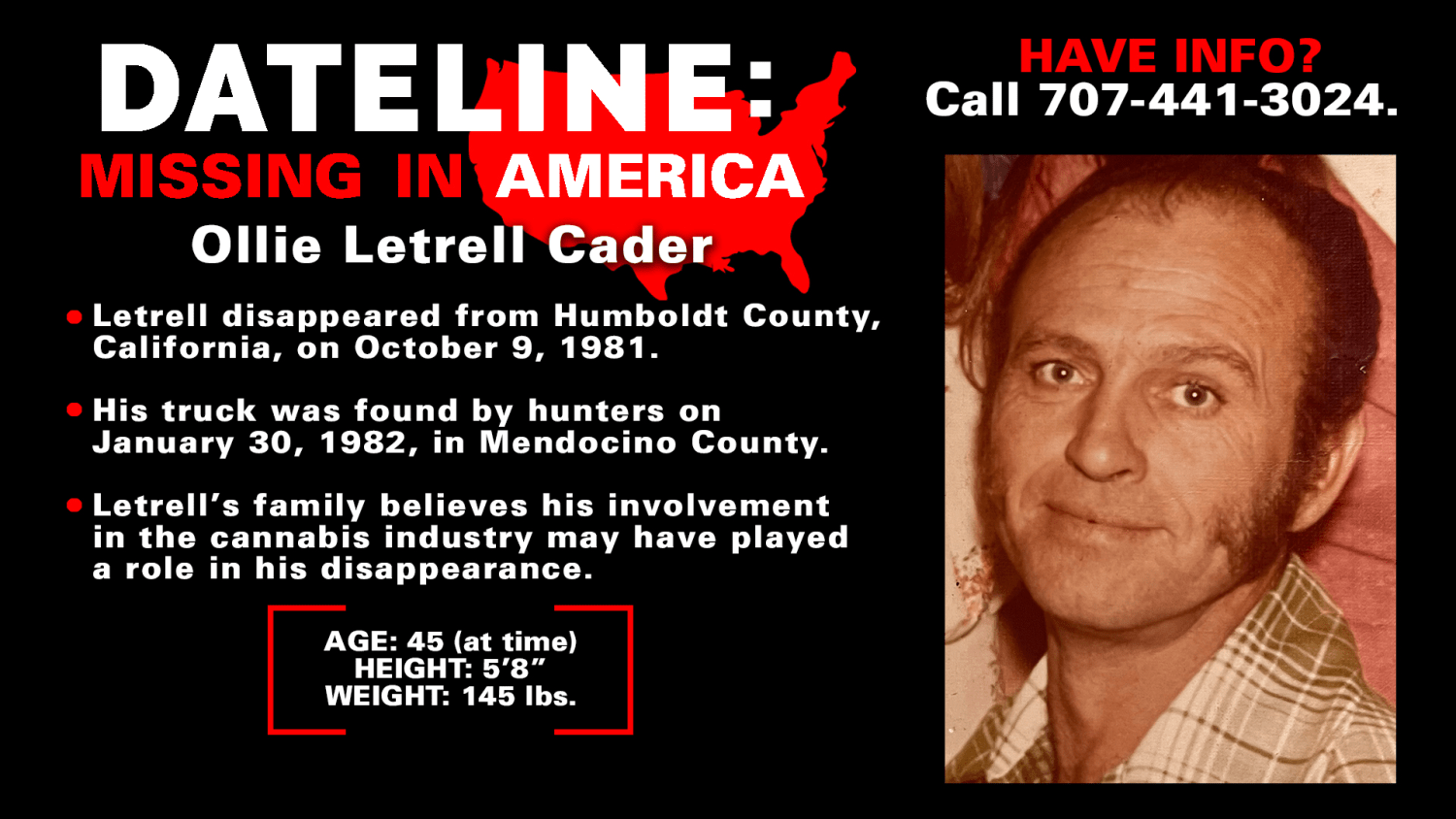
There’s a mystery tucked away behind the Redwood Curtain. A decades-long mystery. “He’s thought to be one of the oldest, if not the oldest, still open missing person cases from the area,” Carrie Cader told Dateline. The “he” in question is Carrie’s grandfather, Ollie Letrell Cader. And he is among hundreds of people missing from what’s known as the Emerald Triangle, an area made up of three counties in Northern California: Mendocino to the south, Humboldt to the north, and Trinity to the east. Carrie grew up in Humboldt County. “It’s a cluster of a bunch of small, rural towns that all blend together,” she said. “Many of them aren’t even official towns.” Her family lived in a modular home, common to the area, not far from her aunts, uncles, and grandparents. “Our entire family was very close,” she said. Carrie says her grandfather grew up in a strict Pentecostal home. His family migrated from Louisiana to California in the 1940s, when Letrell was a child. Carrie says he dropped out of school around age 14 to work in the timber industry. “He actually ended up being a lumberjack, the ones who climb up the really tall trees,” she said. Letrell was in his 40s when Carrie was born and had taken on another new persona. It was the 1970s, the height of America’s Back-to-the-Land movement. “He became pretty much a hippie -- living off the land, growing cannabis before it was legal,” Carrie said. “He left my grandmother and just completely changed who he was as a person.” Victor Pinho is the founder of Emerald Farm Tours and a cannabis expert. He says Letrell’s new lifestyle was not uncommon in the Emerald Triangle, where winding roads weave through the giant redwood trees that cast a shadow on the people living below. “They’re working clandestinely. They’re working underground,” he told Dateline. “If something happens, they kind of deal with the problems themselves, and hence why people go missing up there.” “Almost everyone has, to some degree or another, been involved in the cannabis industry. Because that has been the number one cash crop in that region since the ‘70s,” Pinho explained. “It’s a culture. It’s a lifestyle. It’s a legacy.” In 1970, Congress passed the Controlled Substances Act, which established federal controls on the importation, production, and sale of certain drugs. “People were leaving the city for a better life and then fell into this life of growing weed. And here we are, three generations later, and people are still doing it,” Pinho said. Carrie last saw her grandfather just three days before he disappeared, at her fourth birthday party, on October 6, 1981. “We had probably 20 to 30 relatives over that day just hanging out in the yard,” she said. She remembers her family sharing a giant sheet cake. Her grandfather gifted her candy, a rare treat. “My mom never let me have candy, so that was a big deal.” Letrell often wore Ben Davis shirts, a popular brand among lumberjacks, with the iconic monkey logo. “As a 4-year-old, that’s what I remember,” she said. “He was wearing his monkey shirt.” Carrie says her memories of that day were simple and fond. Three days later, Letrell, her always jolly grandfather, was gone. “It happened so abruptly,” Carrie remembered. She says her family saw each other so often, that after a week passed without word from Letrell, they became suspicious. “That’s when my father and his brother drove up to the mountain and started asking questions.” In other words, they started searching cannabis farms, where Letrell worked and lived. Carrie says her grandfather was somewhat of a nomad when he disappeared. “He had multiple places where he was staying during that period of time,” she said. One of those places was in a town called Loleta, where his mother lived. Another was his girlfriend’s modular home, parked in the mountains of Piercy, where Letrell grew cannabis. An article published in the Times-Standard three months after Letrell disappeared, details his last known steps on October 9, 1981, from Loleta to Piercy. “He had left his mother’s Loleta home in his blue 1971 Chevy pickup at 9 that Friday morning, telling her he was going there to make up with a former girlfriend,” Sam Blackwell of the Times-Standard wrote. “Cader said he’d call if he wasn’t coming back that night, but he didn’t call and he didn’t come back.” The article says Letrell’s mother filed a missing persons report with Humboldt County one week after he left her home for Piercy, which is just over the county line in Mendocino County. Dateline contacted the Humboldt County Sheriff’s Office, and while their department was unavailable for an interview, Detective Mike Fridley confirmed via email that his office took the initial missing persons report and provided some basic information regarding the case. “He was last seen in Mendocino County (Piercy area) on 10-09-81,” Fridley wrote. On January 30, 1982, almost four months after he disappeared, Letrell’s blue Chevy was found in Mendocino County, according to the Humboldt County Sheriff’s Office. “The truck was stripped down and over an embankment. It was actually found by hunters,” Carrie said. She says her grandfather’s case fell right between Humboldt and Mendocino counties. “So it kind of blurs the lines between which county gets it, and neither county wanted it,” she said. In his email, Det. Findley told Dateline the “investigation was turned over to the Mendocino County Sheriff’s Office.” Dateline reached out to the Mendocino County Sheriff’s Office regarding Letrell’s case. The sheriff’s office said they had no records to share and directed us to the Office of the Attorney General, which lists Letrell’s case under Humboldt County. In a follow-up call with Dateline, Det. Fridley said that Letrell will always be listed as a missing person until he is found since that is where he was reported missing, but the investigation is being conducted by Mendocino County. The Times-Standard article at the time also expressed the confusion over jurisdiction in the case. “Mendocino County investigators reportedly questioned everyone Cader saw that day,” the article states. A Mendocino County lieutenant “said his office is not actively working the case, which he claims is Humboldt County’s because Cader last lived in Loleta.” A detective with the Humboldt County Sheriff’s Department disagreed with that claim. “Theoretically, the case belongs to both counties,” he told the paper. “But the odds are against Humboldt County sending its own investigators to Piercy looking for a missing person.” Carrie says she’s read her grandfather’s case file, and in her view, little was done by investigators at the time to find him. “Part of me gets it. He was considered a criminal by law enforcement ‘cause he grew cannabis, he smoked cannabis, he sold cannabis,” she said. “When he disappeared, despite our enormous family making a lot of noise, law enforcement did the bare minimum.” Det. Fridley told Dateline all missing persons cases are taken seriously and detectives did what they could at the time in Letrell’s case. Carrie remembers her family’s initial search for her fun-loving grandfather. “They thought they were gonna find him,” she said. “He’s off high or drunk somewhere and just partying, and they’re gonna find him.” She says she went out as a child and searched, too. “Many times we were out looking for him. So that’s vivid in my brain, too, like, driving around the mountains looking for him, looking for his truck, putting out flyers.” Carrie says even her family gave up looking after a month or so. “Everybody just assumed he was dead.” Carrie believes Letrell’s involvement in cannabis played a role in his disappearance. “My parents used him a lot as a cautionary tale about getting involved with the wrong people,” she told Dateline. “Everybody up there knows somebody who has either been murdered or disappeared because of the cannabis industry.” Victor Pinho says there’s truth to that even today, as you drive through the unincorporated towns of the Emerald Triangle, where miles of one-lane roads stretch between pockets of civilization. “When you stop at those rest areas, there are dozens and dozens of missing persons photos all over those rest areas,” he said. “People leave their state, they come to California, they wanna work in weed, and then they just disappear.” Carrie has moved away from the Emerald Triangle, a place she says looks the same as the day her grandfather vanished. “If you ever go up there, you’ll be like, ‘Wow, I just stepped back into the 1970s,’” she said. But that doesn’t mean she’s forgotten about Letrell, lost among the redwoods. In February, Carrie returned to Humboldt County to retrace her grandfather’s steps. “I drove to Loleta. I just kinda backtracked, which I’ve done a million times. I drove to his mom’s house, which is still there,” she said. “And I backtracked up to the mountain as best I could.” She hoped something would jump out to her, but nothing did. She met with the Humboldt County Sheriff’s Office again around that time, too. Carrie says they confirmed Letrell’s DNA profile in CODIS has yielded no matches. Yet, Carrie holds onto hope that her grandfather’s case will be solved. “My dream would be to find his bones and be able to have a burial for him,” she said. The memories she made at 4 years old have grown into an appreciation of Letrell’s character. “Even when he had nothing, he was still the happiest person in the room.” Letrell was 5’8”, with blue eyes. At the time of his disappearance, he had brown hair and weighed 145 lbs. He would be 90 years old today. Anyone with information regarding Letrell’s case is encouraged to contact the Humboldt County Sheriff’s Office at 707-441-3024. Anonymous tips can be called in at 707-268-2539. If you have a story to share with Dateline, please submit it here.
Topics in this story
Gathered from external sources. Rights to this text belong to whoever originally published it.