In California, Fort Ord trained about 1.5 million soldiers; its former Army grounds now hold 86 miles of trails, wildflowers and mountain lions
US News: Along California's Central Coast, large tracts of unspoiled coastal land are becoming less common as decades of urbanisation gradually fill in the ope.
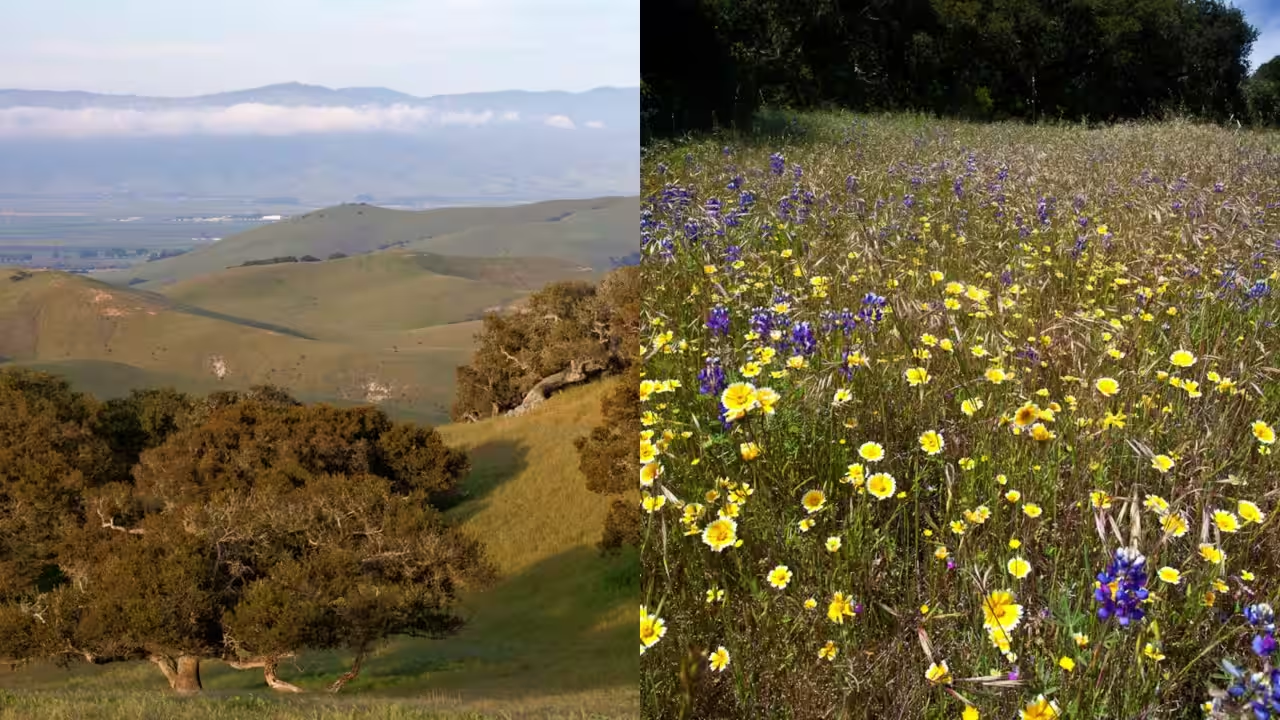
Along California's Central Coast, large tracts of unspoiled coastal land are becoming less common as decades of urbanisation gradually fill in the open space between towns and highways. One noteworthy exception is located just outside of Monterey, where a former military facility that trained over a million soldiers has remained mostly intact due to decades of restricted military use that unintentionally preserved one of the last great wild landscapes in the area.Fort Ord was created by the US Army in 1917 as a field artillery training location along Monterey Bay and eventually became one of the largest Army installations on the West Coast. It served as an important staging area for forces headed to the Pacific during the next several decades, training soldiers prior to World War II, the Korean War and the Vietnam War. During its active years, Fort Ord was one of the largest training grounds in the country’s military history, with 1.5 million American troops passing through it, according to numbers supplied by the Bureau of Land Management.Land formed by restricted accessIronically, the heavy military use protected most of the surrounding terrain from the kind of commercial growth that transformed other parts of the Monterey Peninsula. For much of a century the landscape remained closed to farming, housing and roadbuilding because huge portions of Fort Ord were live fire training zones and artillery ranges, allowing native grasslands, oak woods and marine chaparral to continue mostly undisturbed. When the facility finally shut down in 1994 under a government realignment scheme following the end of the Cold War, most of that area was left in a condition rarely seen elsewhere along the more populated California coast.Recognising the ecological and historic significance of what remained, President Barack Obama signed a proclamation in April 2012 designating about 14,651 acres of the former base as Fort Ord National Monument. The proclamation, signed under the authority of the Antiquities Act, permanently protected the property, citing both its unique ecological diversity and its significance to generations of American military service.A landscape for wildlifeToday the monument spans open meadows, dense stands of chaparral and oak woodland, connected by more than 86 miles of routes for walkers, bicyclists and equestrians. The terrain supports an extraordinary diversity of wildlife for a site so close to a major metropolitan area. Bobcats, coyotes, badgers, and mountain lions live in the area, along with rare and protected species such as the California tiger salamander and the Smith’s blue butterfly, one of the first insects in the country to be given a dedicated conservation reserve. Wildflowers dot the grasslands with the changing seasons, from the bright goldfields of spring to purple nightshade later in the year, attracting hikers and naturalists throughout the year.Managed by the Bureau of Land Management, the monument also has tangible vestiges of its military heritage, such as clearly designated and gated-off explosive ordnance areas, a relic of decades of service as an active training range. Visitors are requested to stay on authorised pathways to conserve vulnerable habitat and to avoid hazards still hidden in some portions of the landscape that have not yet been entirely removed.An old battleground turned public sanctuaryMore than three decades after the last soldiers trained there, Fort Ord has become a silent counterpart to its own history, a site once marked by artillery fire and marching columns now defined by birdsong, wildflowers and the sounds of mountain bikes on packed dirt trails. The BLM is continuing to improve public access and trail infrastructure at the site, creating milestones that tie the monument’s military history to its present-day role as protected public property. The government said the site’s dual heritage will be part of a broader celebration of American service in 2026, when the very same ground on which soldiers prepared for war is now welcoming hikers, bikers and families experiencing one of California’s last vast expanses of open coastal wilderness.For a landscape that was closed to the public for much of the twentieth century, and shaped by the necessities of the military, the transformation of Fort Ord into a protected national monument is an unusual example of how sometimes it is not active conservation efforts that save a landscape, but the fact that it is inaccessible, allowing it to be saved long enough for permanent protection to catch up with it.Catch the latest World News and Live updates. Download the TOI app.
Topics in this story
Gathered from external sources. Rights to this text belong to whoever originally published it.