Whatever happened to 'grandma hair'? Sandra Bullock and Nicole Kidman's glossy locks point to a bigger shift in aging.
The old rules said women should cut their hair short as they aged. Now long, glossy hair has become the norm at almost any age.
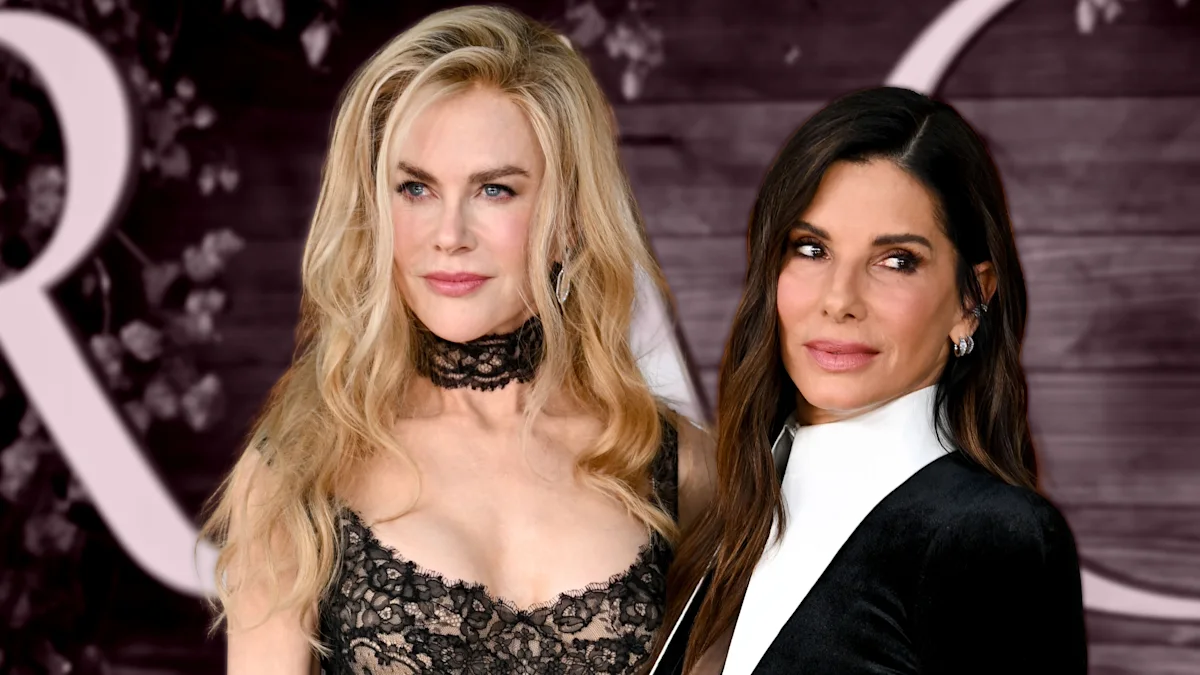
This may not be news to you, but it was to me. Watching Bullock alongside Nicole Kidman , 59 (whose age I also had to Google), during the press tour for Practical Magic 2 , I found myself staring less at their faces than at their hair: long, full, glossy locks that I, at half Bullock's age, would love to have myself.
We spend a lot of time talking about why famous women don't seem to age anymore. We dissect Botox, fillers and facelifts and debate what constitutes "aging gracefully." But somehow, hair has largely escaped the conversation.
Hair used to tell us someone was older. Think of The Golden Girls , the show women over 40 have repeatedly referenced to me when I've asked about what they once imagined their current age would look like. Blanche, Dorothy and Rose were in their 50s when the series began. And all three were immediately legible as older women, in part because their hair was short, curled, set and unmistakably of a certain age. It was considered "grandma hair."
To be clear, neither Bullock nor Kidman are grandmas. But they are older than the Golden Girls ' characters were when the series began, as hard as that might be to believe. So when I look at them, among a sea of Hollywood's ageless women, I wonder: Where did "grandma hair" go? When did older women stop having "old" hair — and how are they pulling it off?
The question isn't confined to Hollywood. Look on Reddit , and you'll find a woman approaching 50 saying someone had asked whether she was "finally" going to cut her long hair.
"What does my age have to do with my hair length?" the Redditor wrote. "She said long hair was for our youth. My hair makes me feel beautiful, so no freakin way I cut it [because] SHE thinks 50 is old."
Women over 50 flooded the comments, calling the suggestion "old-fashioned" and "outdated" and sharing their own plans to keep their hair long.
Of course, some of what we're calling "grandma hair" was simply fashion that aged along with the women who wore it. But there were also real expectations around how women should wear their hair as they got older.
Women's hair has historically been subject to rules about age, sexuality and appropriate self-presentation, according to Julia Twigg , a sociologist who has studied the societal constructs around aging women. She tells Yahoo that long, flowing hair has been associated with youth and sexuality. Getting older meant controlling it, tying it back or eventually cutting it.
"The control of hair has always been part of the control of women and the control of the body," says Twigg. But as women's lives expanded, so did the boundaries around their appearance. "We are seeing freedom — social freedoms, cultural freedoms — of women being reflected in what's happening for hair."
But getting rid of the rules around how older women should style their hair didn't change what happens to the hair itself.
Hair can thin, become more brittle and change in texture and density with age . Twigg calls this the intersection of "embodied aging and cultural aging." Some of what we associate with older women's hairstyles came from what society told them they should do. Some of it was a practical response to the hair on their heads changing. A pixie cut, for example, might be easier to maintain than a wild mane.
So even as we've decided that long hair no longer belongs exclusively to young women, that doesn't mean our hair suddenly got the memo. But there are ways around that too.
The secret to aging hair is sometimes more hair
Merria Dearman has spent decades making wigs and hairpieces, including for Hollywood. And if you think supplemental hair is some new celebrity beauty hack, it's not. Early in her career, Dearman worked for Frank Sinatra's wigmaker and made wigs for Sophia Loren when the actor was in her 70s.
Wigs have "been there this whole time," Dearman, who founded Provenir Hair , tells Yahoo.
What hasn't necessarily caught up is our idea of what wearing one looks like. Even Twigg still associates wigs with "a performance," something with an "alien quality" rather than an everyday beauty tool.
That perception isn't universal. Black women have a much longer history of openly wearing and talking about wigs and supplemental hair, Dearman points out. White women are wearing them too, she says, "but we aren't talking about it the way Black women are within their culture and with each other." That familiarity also means Black women may have a much broader idea of what a wig can actually look like.
The wigs and hairpieces she's talking about aren't necessarily dramatic transformations. Ideally, you wouldn't know they were there at all.
"When it's good, you don't see it," she says.
That could mean a topper that blends into thinning hair on top, extensions or additions for more length and fullness throughout, or a full wig. The goal isn't always to walk out looking like someone else. Sometimes it's to look like you just have really, really good hair growing out of your own scalp.
That's what makes hair such a fascinating blind spot in our increasingly sophisticated understanding of celebrity beauty. We speak more openly about plastic surgery than ever before and suspect that a remarkably smooth 60-year-old face may not have gotten that way through sunscreen and good genes alone. Yet we can look at an equally remarkable head of hair and simply think, Wow, she's been blessed with amazing hair.
Bullock herself recently highlighted the murky line between real hair and Hollywood hair. In a conversation with Jennifer Aniston for Interview magazine , the Practical Magic 2 star revealed that she had experienced two bouts of stress-induced hair loss and said she was "very lucky" it grew back. Aniston marveled at Bullock's still-enviable "mane," and it turns out that she had a hand in it. Bullock's hairstylist has confirmed the actor's hair was styled with products from Aniston's own hair care line, LolaVie, for her latest film; costar Kidman, meanwhile, wore a wig.
A similar reveal played out when Mariska Hargitay — who wore numerous wigs during her Emmys hosting gig last night — appeared on Amy Poehler's Good Hang podcast . Hargitay said she had declined a hairpiece that day because she assumed Poehler was "just real and natural." Poehler quickly corrected her: "I have like 25 pieces of fake hair in." Hargitay's assumption made the point that the illusion is invisible, even to someone accustomed to the glam chair.
There's no contradiction in experiencing hair loss, regrowing your hair and having great hair. Nor does it matter whether every strand seen onscreen grew from an actor's scalp. But the fact that audiences would never know the difference unless someone chose to tell them captures something about the beauty standard we're creating: We're getting better at talking about the realities of women's aging while simultaneously making those realities difficult to see.
That tension is showing up in Dearman's chair.
"They just want to look like themselves," Dearman says of her clients. "They want to look like a better version of themselves."
The inspiration for that better version? Dearman says her clients in their 60s routinely bring in photos of Margot Robbie, who is 36.
Did we get rid of one aging rule to create another?
There's obviously something freeing about all of this. A woman can be 60, want hair down to her waist and go get it. She no longer has to accept that reaching a certain age means retreating from the beauty choices she made when she was younger.
But Twigg cautions that these shifts are often "two-faced." There's empowerment in having more choices, but there's also an ever-expanding beauty industry ready to sell us the products and procedures required to make those choices possible.
"Magazines and cosmetic companies and hairdressers, they don't want you giving up," she says.
And it's not just hair. According to the 2025 Plastic Surgery Statistics Report from the American Society of Plastic Surgeons, adults aged 66 and older were "the fastest-growing age group undergoing procedures" — up 24% from the year before.
"These interventions we've been talking about are very expensive," says Twigg. "So it's about a gorgeous elite who look as if they are some uncertain age, this kind of floating middle years category. But that's only available to a certain element in society."
In other words, appearance might reveal less about how old someone is and more about what they can afford. Hair may just be one of the harder interventions to spot.
There are signs that the secrecy around how people achieve that hair could change. Dearman says many of her clients over 40 still hear the word "wig" and think of something their mother or grandmother wore. Younger women, meanwhile, can watch influencers like Alix Earle, who is 25, take millions of TikTok followers along to appointments where their extensions are removed and reapplied.
Added hair isn't necessarily something to hide anymore. It can just be part of getting your hair done. Twigg expects that attitude to follow younger women as they age.
So "grandma hair" may not be coming back, which is probably a good thing if it means women have shed the idea that reaching a certain age means adopting a certain hairstyle. What's less clear is whether we've also shed the expectation itself, or simply moved it.
Your hair can be as long, sexy or glamorous as you want at any age now. It just might not be allowed to look its age.
Topics in this story
Gathered from external sources. Rights to this text belong to whoever originally published it.