Model T founder Henry Ford owned more than 2,000 acres around Fair Lane in 1909; after his death, the Michigan estate became a historic landmark
US News: Discover the history of Fair Lane, the estate of Henry Ford, complete with architectural marvels, gardens, and its significance as a National Historic Landmark in Michigan.
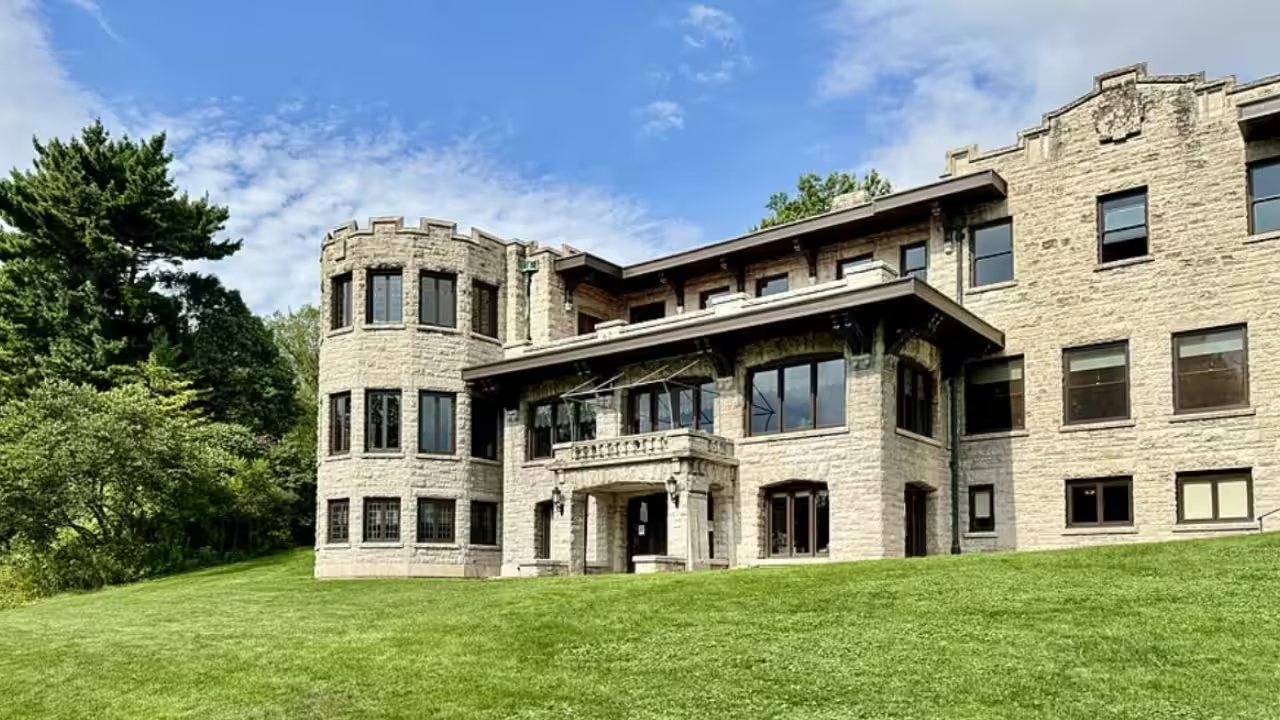
In the years after the turn of the 20th century, Henry Ford began assembling land around Dearborn, Michigan. The National Park Service’s historical nomination records say that Ford had acquired more than 2,000 acres by 1909; this included farmland, woodland and a property along the Rouge River Eventually, the land turned into the setting for Fair Lane, the home he shared with his wife, Clara, a carefully designed estate which combined architecture, gardens, agriculture and Ford’s interest in technology. In 1966, 19 yearsafter Ford’s death, Fair Lane was recognised as a National Historic Landmark.The story from 2,000 acres to a private estateIn 1903, Henry Ford organised the Ford Motor Company; the Model T appeared in 1908, and Ford’s landholdings grew as his automobile business transformed American transportation. Archived records note that by 1909, Ford owned more than 2,000 acres in the general Dearborn area. The Fair Lane grounds themselves were originally conventional Midwestern farmland, with small cleared plots and virgin forest through which the Rouge River meandered. Ford and his wife also treated the landscape as a natural bird and game sanctuary, thus preserving most of its rural character.Historical accounts suggest that Ford bought large tracts of land in Dearborn Township in 1909 and, during the summer, visited architect Frank Lloyd Wright in Oak Park, Illinois. The visit resulted in a commission for a large estate along the Rouge River, though the architectural project progressed slowly and ultimately changed hands.In 1913, Preliminary architectural work began, but Fords reportedly became dissatisfied with the initial plans. Following this, William H. Van Tine of Pittsburgh later became the architect, and the construction of the mansion began in February 1914. The NPS reported that the construction was completed in the following year and that the Fords first moved into the house in 1916.The federal records describe the completed house as a 200-foot-long mansion with 31,770 square feet of floor space. The exterior was a blend of an early English design and modified Scottish Baronial elements. The interiors, meanwhile, contained 56 rooms, which included a library capable of holding more than 4,000 books and a music room with an elaborate marble and walnut fireplace.The mansion was surrounded by farms, orchards and technologyDuring the Fords’ era, the area comprising the home and gardens covered about 1,260 acres. Around 1,180 acres consisted of woodlands, farms and orchards, while gardens, landscaping and lawns occupied the remaining portions. The Rouge River was central to Fair Lane’s design and was crucial to one of Ford’s technological projects there.While his interest in generating his own electric power dated back to about 1909, the permanent concrete dam and small brick powerhouse were ultimately constructed between 1914 and 1915 in tandem with the nearby mansion. According to the NPS, the dam included a fish ladder, thus reflecting the combination of technological experimentation and attention to the property’s wildlife. The dam became a part of that design when landscape designer Jens Jensen later developed Fair Lane’s gardens.Hired by Ford in 1914, Jensen helped connect the formal regions surrounding the mansion with the existing landscape. He developed gardens of the estate and a master plan that incorporated the river, woodland and other rural features. Historical records consider Fair Lane an important example of Jensen’s landscape design, with the grounds becoming an integral part of the property’s historic character rather than functioning merely as a decoration around the house.The estate also had an infrastructure that allowed it to operate with a degree of independence. The power plant was connected to the house by a tunnel approximately 300 feet long, while the wider property included support buildings and facilities associated with the household and surrounding land. These features, alongside the farms, orchards and gardens, made Fair Lane an estate that blended domestic life, agriculture, landscape design and technology.The Ford family home is now recognised as a National Historic LandmarkFair Lane remained the principal home of Henry and Clara Ford for the rest of their lives. On 7 April 1947, Henry Ford died at the estate, while Clara continued to live there until her death in 1950.Six years after Clara Ford’s death, the Ford Motor Company presented the house and 210 acres of the estate to the University of Michigan for development of its Dearborn campus. Records suggest that the university used the house as a conference centre. The federal archived records date the property’s recognition to 1966, when Fair Lane was designated a National Historic Landmark. The designation recognised not just the house but also the property’s national significance through its association with Ford, as well as its architectural and landscape qualities.In the later years, Fair Lane became closely associated with the University of Michigan-Dearborn, and the surviving estate reflected only part of the enormous landholding Ford accumulated around Dearborn. The designated National Historic Landmark district encompassed about 356 acres, which was considerably smaller than either Ford’s broader 2,000-plus-acre holdings or the approximately 1,260-acre Fair Lane property described for Ford’s period. This delta simply reflects decades of municipal expansion and university campus growth, which subdivided outer agricultural plots. The surviving landscape, however, still preserved the central elements that defined the estate: the mansion overlooking the Rouge River, the designed grounds, and the dam.Catch the latest World News and Live updates. Download the TOI app.
Topics in this story
Gathered from external sources. Rights to this text belong to whoever originally published it.