In 2022, a hydrologist’s team launched 40 floating wetlands made from bamboo, foam and discarded materials across Nepal’s polluted Nagdaha Lake; after five months, native flowering plants cut nitrate by up to 94% and iron by 95%
Rest of World News: Discover how innovative floating wetlands made from bamboo and recycled materials are dramatically improving water quality in Nagdaha Lake, Nepal, reducing nitrate and iron levels by up to 94% and 95%, respectively.
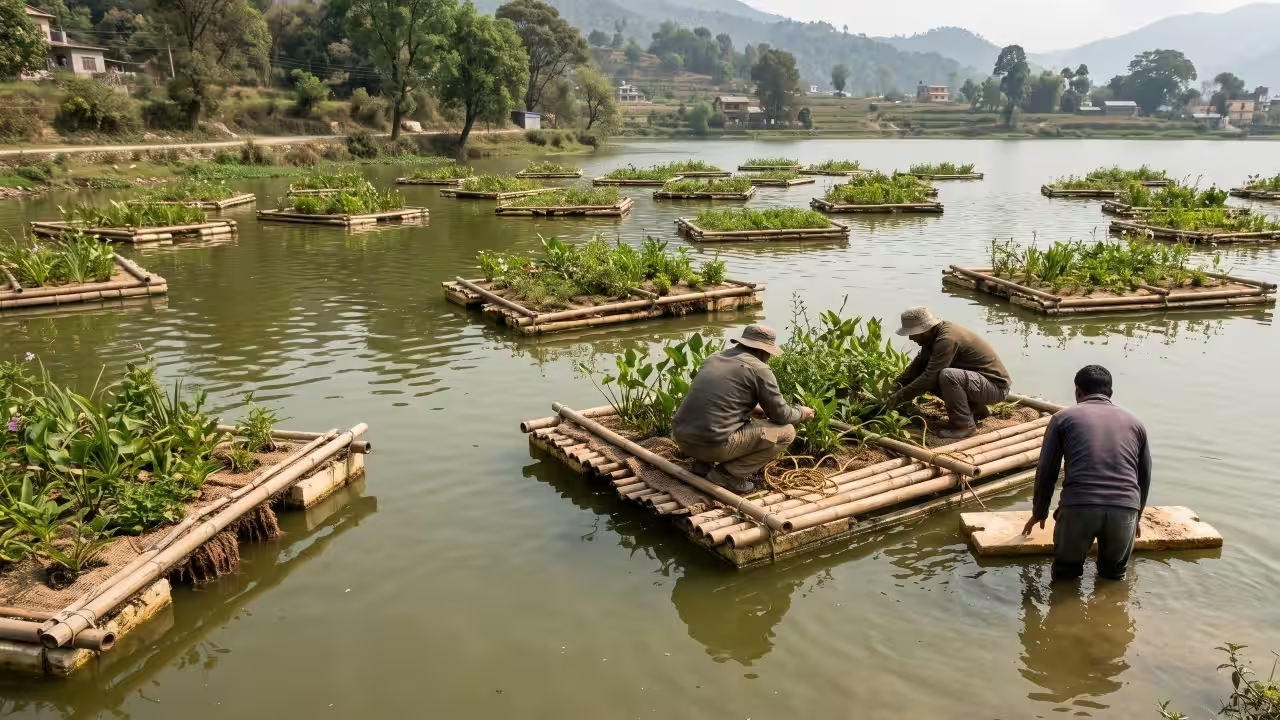
Nagdaha Lake, a small body of water in the Kathmandu Valley in the Lalitpur district, was once used by the locals for daily tasks, irrigation, and washing. Like many urban lakes in South Asia, it has been absorbing runoff from the nearby settlements for the past few decades, absorbing household waste, agricultural fertiliser, and seepage from grazing land until nutrient levels reached a point where the lake was choked with algae and deprived of oxygen. Over the years, local advocacy groups attempted several cleanup initiatives, but because the underlying nutrient load in the water was never truly eliminated, eutrophication kept coming back.A new form of intervention came at the end of 2022, when a hydrologist and her team of researchers set out to see if the lake could effectively be given its own artificial root system. Dr. Soni M. Pradhanang, a hydrologist at the University of Rhode Island, was one of the collaborators on the project, which was led by Professor Sadhana Pradhanang. The design of 40 floating platforms made from bamboo frames, foam layers and matting, using recycled or locally sourced materials where possible.Transforming waste materials into a functional filterFloating treatment wetland is a horticultural concept rather than an engineering one; however, the chemistry beneath is quite advanced. The underside of the raft is covered by a dense, tangled surface of hanging roots, which provides a perfect habitat for biofilm, a thin layer of bacteria that thrives in the root zone. Together, the roots of the plants and the bacteria that live there pull dissolved nutrients straight from the surrounding water, pulling out chemicals such as nitrate and phosphate that would otherwise feed algal blooms.Because the rafts float on the water surface, their submerged root networks remain in direct contact with the water column rather than sitting on the lakebed.The project, funded through the Asia Pacific Network for Global Change Research, deliberately used discarded and low-cost materials to keep the approach replicable in communities with limited environmental budgets. The rafts were built and installed by local youth groups and volunteers along with the study team. For buoyancy they used styrofoam rescued from packaging, and for the structural frame they used bamboo. The project also involved local youth groups and volunteers in preparing and installing the rafts, since their visible presence gave residents and local government officials a tangible way to observe and understand a pollution remediation technology that might otherwise have remained an abstract research exercise.What the monitoring data showed after months in the waterThe team's researchers regularly monitored the water around the rafts to see how nutrient and metal concentrations changed over time, and the results after a few months of operation were stunning. Field monitoring revealed nitrate reductions up to ninety-four percent and a reduction of about ninety-five percent in dissolved iron levels in the treated parts of the lake. A separate 2025 study of polluted Hanumante River water in Nepal found nitrate removal rates of about 86% to 88% in floating treatment wetlands using several plant species, with some systems also removing more than 60% of iron.Not everything with the project went so easily, and that in itself is a helpful reminder that ecological engineering is not a linear process. The team had to replant hundreds of specimens after one of the two plant species withered during a seasonal transition and again the following year to keep the system operating. The project also produced a practical model that other sites can adapt.The regional FTWS project also involved collaborators in Bangladesh and India, and its guidebook provides practical guidance for adapting the technology to different sites and countries.Catch the latest World News and Live updates. Download the TOI app.
Topics in this story
Gathered from external sources. Rights to this text belong to whoever originally published it.