A chimpanzee spent almost his entire 32-year life inside an Indiana garage; after his owner died, rescuers launched an urgent mission to save him
A 32-year-old chimpanzee named Toby spent almost his entire life confined to the garage of a rural home in Indiana, with little opportunity to experience
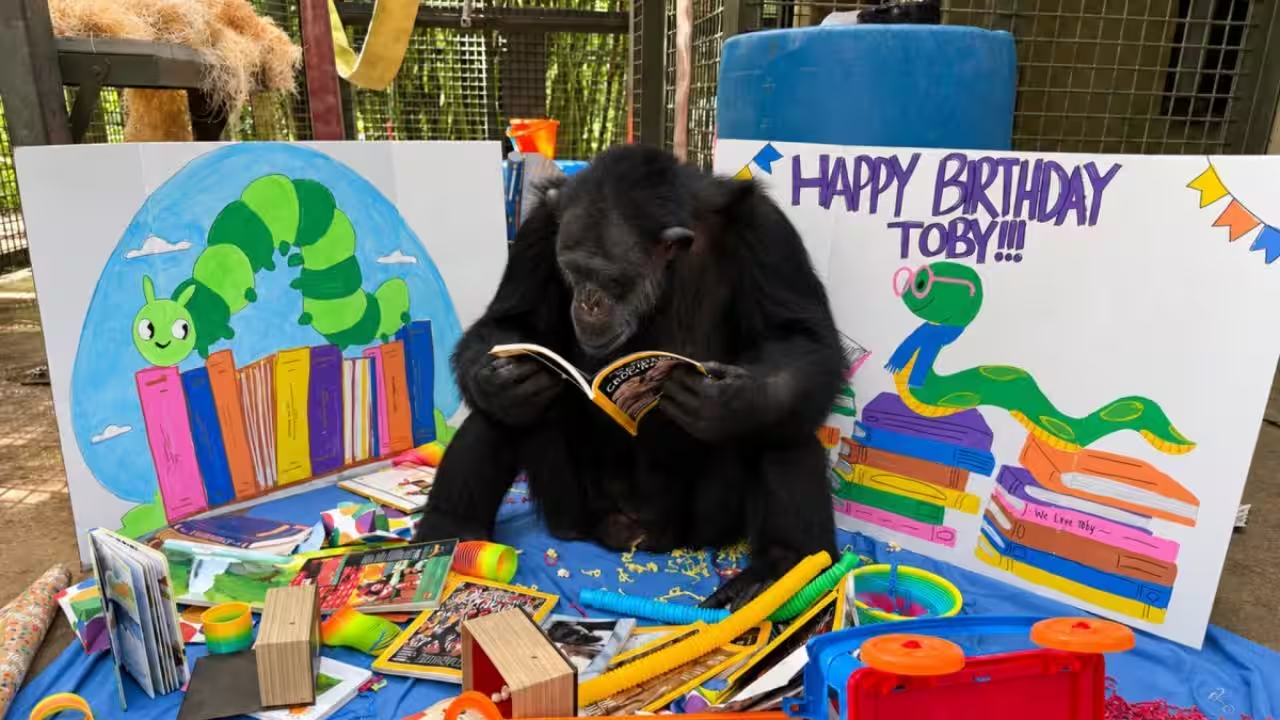
A 32-year-old chimpanzee named Toby spent almost his entire life confined to the garage of a rural home in Indiana, with little opportunity to experience the world beyond his enclosure. His situation became urgent after his owner died, reportedly leaving instructions for the animal to be shot rather than transferred to another home. With the owner's family allegedly intending to follow those wishes, animal welfare advocates and federal officials had only a short window to intervene. Their efforts eventually helped Toby escape a lifetime of isolation and begin a new chapter at a Florida sanctuary.The 32-year-old chimpanzee rescued from an Indiana garageAccording to the Animal Legal Defense Fund (ALDF), the rescue effort began on a Friday afternoon just before a long holiday weekend. Brittany Peet, the organisation's director of Transparency and Regulatory Affairs, received an alarming call about Toby from a contact who had heard about the situation through a concerned member of the public.The information was particularly disturbing. Toby's owner had recently died and had reportedly left instructions that the chimpanzee should be killed after his death. The owner's family was said to be considering carrying out those wishes, putting Toby's life at immediate risk.Peet, an attorney specialising in protecting captive wild animals, understood that there was little time to waste. She knew that chimpanzees are protected under the federal Endangered Species Act, which prohibits killing members of protected species without the required permit. In Toby's circumstances, such permission would not have been granted.She immediately prepared an official complaint and sent it to a senior official at the US Fish and Wildlife Service, the federal agency responsible for enforcing the law.But waiting for the complaint to be processed could have left Toby in danger over the holiday weekend. Peet therefore contacted another person who worked closely with the agency on wildlife trafficking issues. Although both contacts were already travelling for their holiday plans, they stopped to help.Federal officials stepped in before it was too lateThe urgency of the situation prompted an Indiana-based Fish and Wildlife Service agent to travel to the property within hours of receiving the complaint.The agent informed the people responsible for Toby that killing him would constitute a federal crime. The intervention also secured assurances that the chimpanzee would not be harmed.This immediate response prevented a potentially tragic outcome, but rescuing Toby was only the first part of the challenge. After spending more than three decades in a private home, he needed somewhere suitable to live, with people experienced in caring for chimpanzees that had been kept as pets.Peet contacted the Center for Great Apes in Florida, a sanctuary accredited by the Global Federation of Animal Sanctuaries. The organisation had experience rehabilitating chimpanzees rescued from private homes and the pet trade, making it a suitable place for Toby.The sanctuary agreed to take him in. The ALDF, with financial support from its supporters, arranged and funded his transport from Indiana to Florida. Expert veterinarians also travelled with Toby to monitor his health and ensure his safety throughout the journey.What was life like for Toby before his rescueToby's difficult circumstances began when he was very young. He was born at a roadside zoo in Oklahoma and taken away from his mother while still an infant so that he could be sold as a pet.This is a common practice in the wild animal pet trade, where young primates are separated from their mothers much earlier than they naturally would be. In the wild, chimpanzees remain closely connected to their mothers for years and grow up within complex family groups.Toby was denied that experience. For almost his entire life, he had little or no opportunity to interact with other chimpanzees. The ALDF describes this prolonged social isolation as one of the most serious forms of psychological suffering a primate can experience.His living conditions also prevented him from behaving naturally. Chimpanzees are active animals that climb, swing and travel considerable distances in search of food and other resources. Toby, however, spent more than 30 years inside a garage in rural Indiana.The organisation also reported that he appeared to have received little or no veterinary care during that period. Several sanctuaries and accredited zoos had previously offered to provide him with better living conditions, but his former owner never accepted those offers.His diet was another concern. Before arriving at the sanctuary, Toby had reportedly been fed mainly pizza, burritos and Mountain Dew. His new caregivers began introducing him to a more suitable diet designed around the nutritional needs of chimpanzees.Toby began discovering a different kind of life at the sanctuaryThe change in Toby's surroundings was significant. The Center for Great Apes reported that he was settling into his new home, showing curiosity and playfulness while gradually becoming comfortable with his caregivers.He was introduced to toys, enrichment activities and soft blankets. More importantly, he was given opportunities to make decisions for himself, including how he wanted to spend his time.One of his first independent choices involved where to sleep. On a warm night in Florida, Toby gathered his new blankets and made a nest outside. When it rained the following evening, he collected the blankets and moved them indoors.These small decisions represented a major change for an animal whose life had largely been controlled by humans.Toby was initially kept in a temporary enclosure while completing a quarantine period. This is a standard safety measure for new arrivals at the sanctuary, helping protect the health of other primates already living there.Even during this period, he was able to see and hear other chimpanzees. Caretakers noticed him quietly watching a chimpanzee housed nearby and listening closely to the calls of orangutans elsewhere on the sanctuary grounds.Once his quarantine was completed, the plan was to gradually introduce him to other chimpanzees. There was also the possibility that he could meet some of his siblings already living at the sanctuary.The ALDF noted that Toby's father, Joe, had also lived at the Center for Great Apes before his death the previous year. Joe had been captured in the wild and transferred between several facilities during his life before eventually finding sanctuary.Toby's rescue highlights the wider problem of keeping primates as petsThe ALDF believes Toby's story reflects a much larger problem involving the private ownership of chimpanzees and other primates.The organisation points to the case of Travis, another chimpanzee raised in a private home. As he grew older and stronger, his natural behaviour became increasingly difficult for his human family to manage. He eventually attacked a friend of his owner, was stabbed by the woman who had raised him and was fatally shot by a police officer.According to the ALDF, Toby may be among the last chimpanzees living in a private home in the US, but thousands of other primates are still believed to be kept as pets in unsuitable conditions.The organisation also highlighted a report finding that more than 1,600 primates were advertised for sale across just 4 social media platforms during a six-week period in 2025.To address the problem, the ALDF supports the proposed Captive Primate Safety Act, which would prohibit private ownership of apes and monkeys across the US. The proposed legislation would also restrict interstate and international trade in these animals for the pet market.You use AI every day. Now get your AI Quotient. Take the AIQ test.
Topics in this story
Gathered from external sources. Rights to this text belong to whoever originally published it.