'Unrealistic delusion': North Korea rejects denuclearisation; weapons will stay 'forever'
North Korea has doubled down on its nuclear arsenal, declaring its status as a nuclear-armed state “irreversible” and saying the prospect of
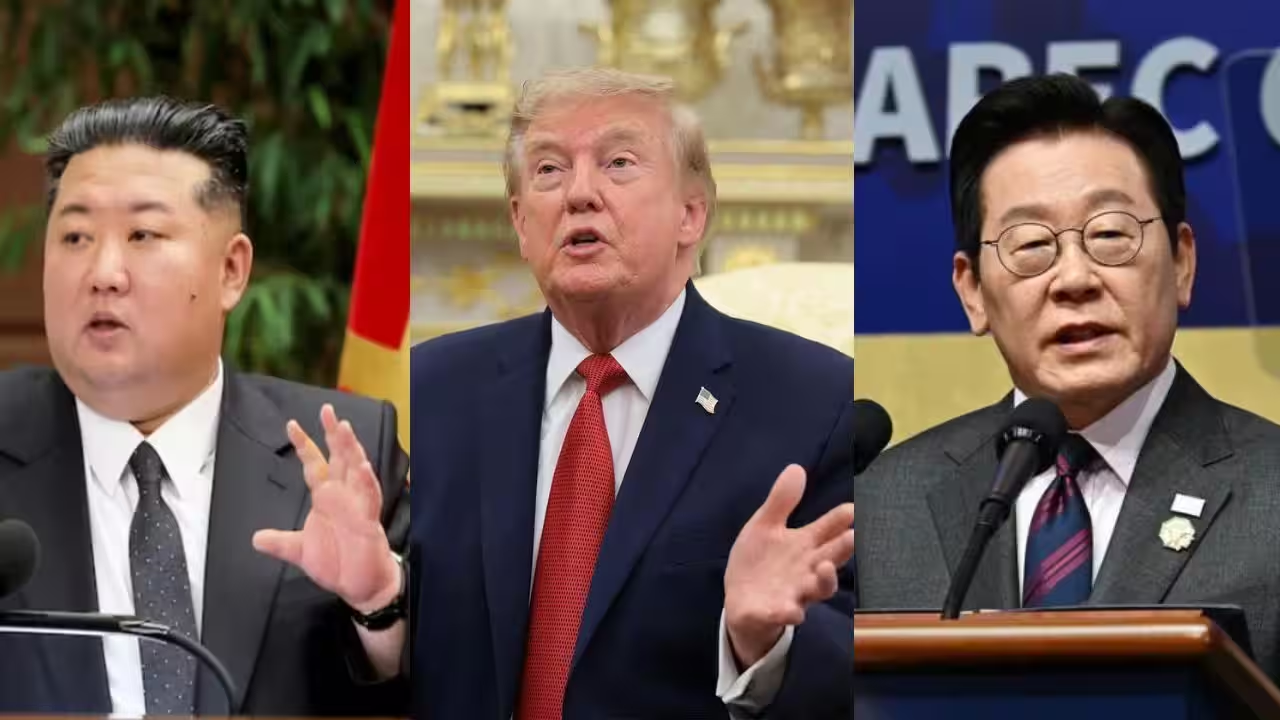
North Korea has doubled down on its nuclear arsenal, declaring its status as a nuclear-armed state “irreversible” and saying the prospect of denuclearisation is an "unrealistic delusion”. Their statement comes days after South Korean president Lee Jae Myung renewed calls for a phased path towards denuclearisation.North Korean foreign minister Choe Son Hui said Pyongyang would not abandon its nuclear weapons regardless of calls from South Korea, the United States and their allies.“I reaffirm and reconfirm in the strongest tone of voice the steadfast will of our state to keep nuclear weapons through all ages,” Choe said in a statement carried by state-run Korean Central News Agency (KCNA).North Korea’s nuclear status was “irreversible in any case and will remain unchanged forever”, she said, adding that the country’s nuclear weapons status was “everlasting” regardless of what hostile forces said.Choe was responding to a meeting between the United States, South Korea and Japan this week, where the three countries reaffirmed their commitment to the complete denuclearisation of North Korea.She also warned that the more Washington and its allies pushed for denuclearisation, the harder Pyongyang’s position would become, describing denuclearisation as an “unrealistic delusion”.Lee’s nuclear freeze proposal meets a hard ‘no’The statement came as Seoul has been trying to move away from an all-or-nothing approach to North Korea’s nuclear programme.Lee told the New York Times earlier this week that the US should consider offering sanctions relief in return for North Korea freezing the development of additional nuclear weapons and intercontinental ballistic missile technology.The South Korean president argued that demanding complete denuclearisation under current circumstances would achieve little, given Pyongyang’s continued expansion of its nuclear capabilities. He proposed a freeze as a first step, followed by reciprocal incentives and concessions that could eventually create conditions for North Korea to reduce its arsenal.Lee has also said he wants to help restart long-stalled dialogue between Washington and Pyongyang. Speaking at the UN General Assembly on Wednesday, he said South Korea would work to create the conditions for dialogue while pursuing denuclearisation through a phased process beginning with a halt, followed by reductions in North Korea’s nuclear and missile capabilities.But Pyongyang has repeatedly rejected the idea of giving up its nuclear arsenal, making even a freeze difficult to negotiate.Lee has argued that North Korea may now be capable of producing, or already producing, an additional 10 to 20 nuclear weapons a year. He has warned that continued expansion could eventually create incentives for Pyongyang to export nuclear weapons and missiles for financial gain.Trump wants talks, but Pyongyang keeps buildingLee has also pointed to US President Donald Trump’s previous meetings with Kim Jong Un as a possible opening for renewed diplomacy.Trump met Kim three times during his first term and has said he plans to meet the North Korean leader again later this year. Lee said last week that Trump “clearly wants dialogue” with Pyongyang.But North Korea has continued its weapons development even as Washington and Seoul have signalled an interest in restarting talks.On Thursday, Pyongyang said it had tested “updated 240-millimetre controlled multiple-launch rockets” on September 22. KCNA said the system was capable of striking targets up to 115 kilometres (71 miles) away.The latest statement also comes after North Korea rejected an International Atomic Energy Agency resolution criticising its nuclear programme, again describing its nuclear status as irreversible.You use AI every day. Now get your AI Quotient. Take the AIQ test.
Topics in this story
Gathered from external sources. Rights to this text belong to whoever originally published it.