Did we just hear the Iranian regime’s last speech at the UN?
When Masoud Pezeshkian stood before the United Nations, he spoke in the name of Iran. That was the first deception. The Islamic Republic — the Shia Caliphate — is not Iran. Khomeinist ideology has been imposed upon a civilization that long predates the order established in 1979. Yet Pezeshkian carried the same exhausted script: victimhood,…
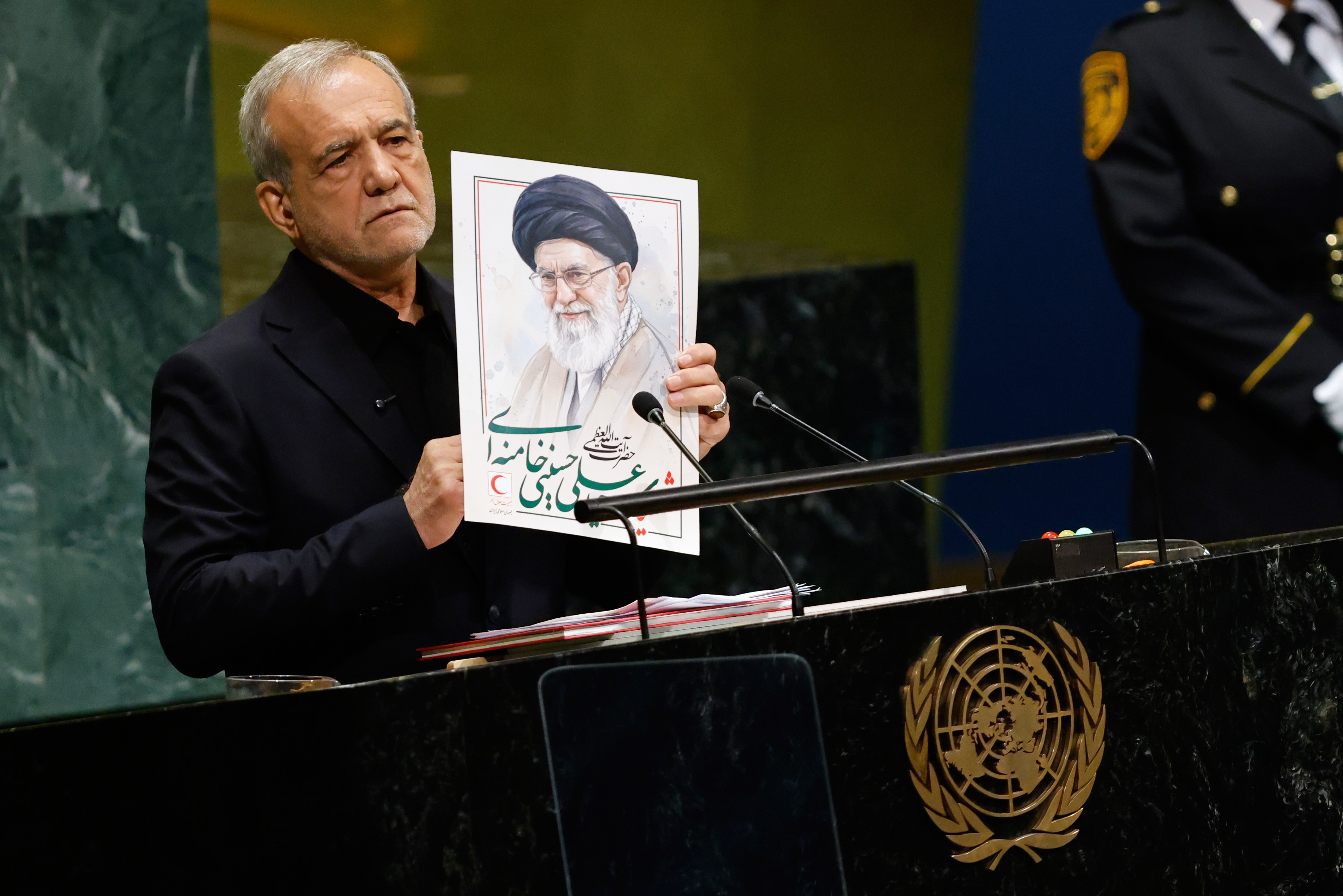
When Masoud Pezeshkian stood before the United Nations, he spoke in the name of Iran. That was the first deception.
The Islamic Republic — the Shia Caliphate — is not Iran. Khomeinist ideology has been imposed upon a civilization that long predates the order established in 1979. Yet Pezeshkian carried the same exhausted script: victimhood, Palestine, resistance, Israel, American hostility, and a regime perpetually surrounded by enemies.
What was conspicuously absent was Iran itself.
Where were the political prisoners, protesters shot in the streets? Where were those arrested, tortured or blinded, and families who have buried their children? Where were the millions crushed by inflation, poverty, censorship, and religious authoritarianism?
They were nowhere in his speech. Pezeshkian portrayed the Islamic Republic as a victim while ignoring its violence against Iranians. He spoke of infrastructure, but Iran’s most precious infrastructure is its people — a generation beset by repression, economic ruin, and isolation from the world.
This is the grotesque contradiction at the heart of the Islamic Republic. A notorious regime that has spent decades financing and arming terrorist groups abroad presents itself at the U.N. as an apostle of peace. A regime that suppresses dissent lectures the world about justice while branding all of its opponents as agents of America or Israel. It speaks endlessly of Gaza and Palestine while trying to hide the blood it has spilled in Iran’s streets. And still, the world is expected to call this “diplomacy.”
For decades, Washington has viewed Iran through the same narrow window: nuclear enrichment, sanctions, negotiations, terrorism, shipping, and the security of American allies. But this obscures the most consequential reality inside Iran. The central conflict is no longer simply between Tehran and Washington or the regime and Israel. It is between the Iranian nation and this cult itself. Confusing Iran with the regime that has ruled it since 1979 remains a fundamental failure in understanding the country.
Iran’s rulers understand this distinction, which is why domestic dissent frightens them so much. Their deepest fear is not diplomatic condemnation; it is a population that rejects the state’s ideological foundations and separates its national identity from the Islamic Republic.
This explains why protests terrify the establishment, communications are restricted during unrest, dissent is portrayed as foreign conspiracy and the prospect of an alternative is so sensitive for Tehran.
Crown Prince Reza Pahlavi has become a prominent advocate of a secular and democratic transition beyond the Islamic Republic. Washington cannot appoint Iran’s next leader — that decision belongs to Iranians. But American policymakers should not behave as though Iranian politics begins and ends with the Islamic Republic. Ignoring political forces advocating a post-Islamic Republic future does not make them disappear, nor does treating the clerical establishment as permanent make it so.
President Trump should understand this distinction before starting another cycle of negotiations. Diplomacy is not inherently dishonorable; states negotiate with adversaries. But negotiations that constrain a dangerous regime are fundamentally different from those that prolong its survival, replenish its resources or grant it international legitimacy.
For decades, Washington has hoped that sanctions, incentives, negotiations, or factional politics might transform the Islamic Republic into a conventional state. Yet presidents and rhetoric have changed while so-called reformists and hard-liners have traded places and the architecture of power has endured.
That is why Pezeshkian’s performance at the U.N. mattered. Beneath the denunciations of Israel, invocations of Palestine, resistance, and accusations against the U.S. stood a political system desperately trying to convince the world that it speaks for Iran. But political alienation within Iran cannot be erased by diplomacy, propaganda, missiles or repression. A regime can possess formidable security institutions while suffering a profound crisis of legitimacy.
The question for Washington is whether the U.S. is strategically prepared for the possibility that the Islamic Republic will not endure. Preparing for that future means documenting human-rights abuses, maintaining Iranians’ access to information, engaging political voices outside the ruling establishment, and planning with allies for a transition. Iran must not descend into chaos if the Islamic Republic collapses; any transition should protect its territorial integrity and institutions while preventing further bloodshed and authoritarianism.
This is the conversation Washington should be having, rather than perpetuating the illusion that the clerical order established in 1979 is an eternal fact of Middle Eastern life.
Perhaps Pezeshkian will return to the United Nations next year. Perhaps another representative of the Islamic Republic will stand behind that green marble podium and repeat the same exhausted slogans of resistance, justice, and victimhood. But history does not guarantee regimes another speech.
The U.S. heard the Islamic Republic this week; the White House should finally hear the Iranian nation. The Islamic Republic is not Iran, and it is not immortal. Behind its missiles, intelligence apparatus, prisons, and propaganda stands an exhausted and increasingly frightened political order sustained not by national consent, but by coercion. The world should begin preparing for the day after it.
Erfan Fard is a counter‑terrorism analyst and Middle East researcher based in McLean, Va.
Topics in this story
Gathered from external sources. Rights to this text belong to whoever originally published it.