Bristol breakthrough could transform science for blind people
A Bristol-made device displays complex data in braille, helping blind people study and work in STEM.
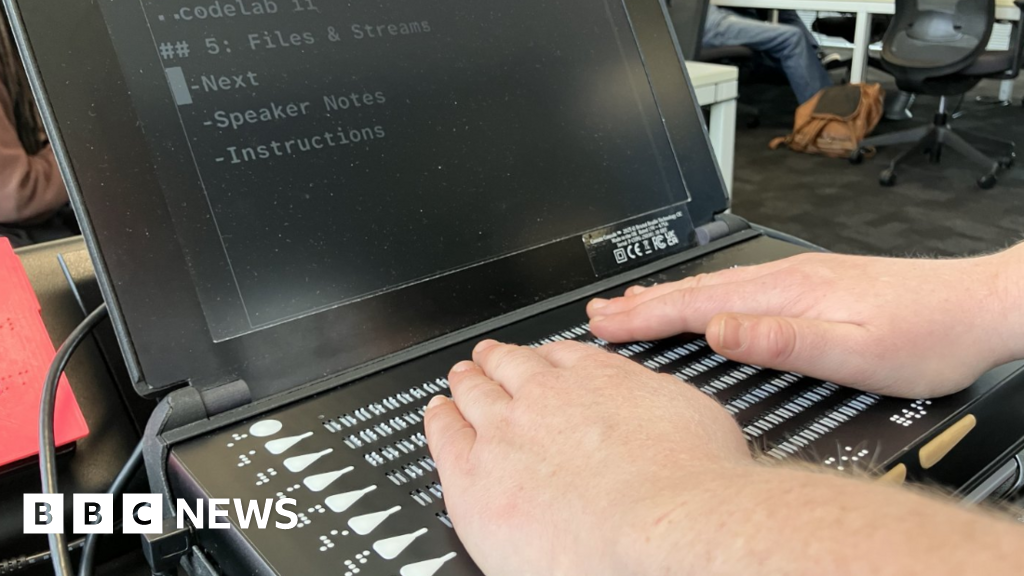
A blind university lecturer says a new braille device could help people with sight loss study and work in science, technology, engineering and maths (STEM).
The Canute Scientific has been created by Bristol Braille, a not-for-profit company that builds specialist technology with braille users.
Designed to display complex scientific and mathematical information in braille, it is hoped the device will help break down barriers for people pursuing STEM subjects and careers.
For Bath Spa University lecturer Hollie Baker, the technology could make a significant difference. "It is essentially a computer, with a multi-line braille display integrated into it," she said.
Former Conservative MP admits assaulting man
Beach motorbike race made 'as extreme as possible'
'I entered foster care at 14 and it saved my life'
The Canute Scientific looks similar to a computer keyboard, but contains rows of holes through which braille dots move up and down, allowing users to feel information displayed on screen.
"The braille shows exactly the same thing as is on the visual screen. This means you can do things like edit text files – or custom apps to view data," said Baker.
Across the UK, about two million people are living with sight loss , including around 340,000 people who are registered blind or partially sighted.
Baker said accessing information while teaching had previously been difficult.
She had found it "challenging" to refer to her notes while delivering a lecture smoothly.
"Without multi-line braille, I'm relying on either a single line of braille which is like reading through a letterbox, or synthetic speech. And I find having speech babbling in my ear puts me off."
The idea for a system of using raised dots to represent letters and numbers, to be read using your fingers, was first invented by French teenager– Louis Braille – back in the 1820s.
Since then, it has transformed the lives of millions of people around the world, allowing them access to a world which was previously completely inaccessible.
Bristol Braille is the not-for-profit company behind the invention of the Canute Scientific.
The company was founded and managed by Ed Rogers who says these machines are changing lives, for the better.
"Braille is traditionally embossed into paper," he said.
"It's a series of dots making up a single character. Those constitute anything in text, numbers, music scores but there is an issue when it comes to getting that digitised.
"The Canute Scientific has a braille display on the front.
"There are slots through which the dots come, representing the braille characters and that is representing data in the same way that a visual monitor is."
Chris Turner has been working at Bristol Braille for about a year.
He describes himself as blind and says the machines they're making here are transforming lives.
"The machines are built here so if a customer wants to speak to someone who's built the machine, they can.
"If there's an issue we're all here and we can work on it."
Follow BBC Bristol on Facebook , X and Instagram . Send your story ideas to us on email or via WhatsApp on 0800 313 4630 .
Braille butterfly trail highlights rare disease
'My student inspired me to spread braille message'
Braille teacher wants method taught more widely
Topics in this story
Gathered from external sources. Rights to this text belong to whoever originally published it.