Reform UK says Britain is broken. Birmingham tells another story
The party’s gains in Britain’s most diverse major city are real, but they are not a verdict against multiculturalism.
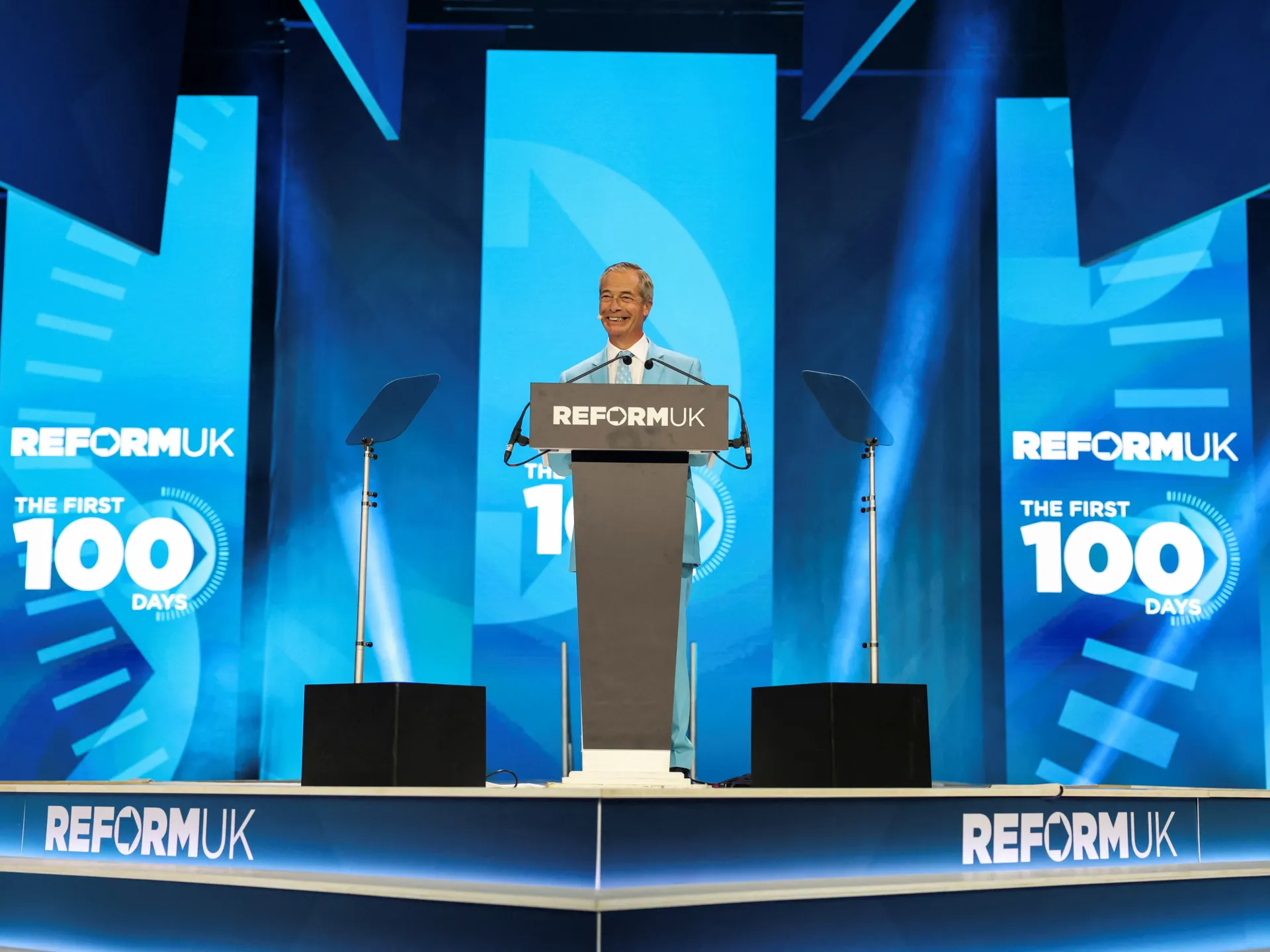
This week, Reform UK gathered thousands of supporters at Birmingham’s National Exhibition Centre to present itself as a government-in-waiting. This was not a sudden interest in Britain’s second-biggest city: Reform has repeatedly used Birmingham for national campaign launches and conferences, committing considerable resources to making it a showcase for its advance.
Birmingham – young, working-class, multiracial and almost evenly divided between residents recorded as white and those from Black, Asian, mixed and other ethnic groups – is precisely the kind of city Reform leader Nigel Farage’s politics portrays as a warning: a place where an older Britain has supposedly been displaced by an alien new one.
In May’s local elections, Reform became the largest single group on the Birmingham City Council, winning 23 of 101 seats.
The party’s growing presence in Birmingham, however, is not proof that multiculturalism has failed. It is a warning about the feeling of abandonment spreading across Britain.
Reform’s gains in the city demand serious attention. They should neither be minimised by those repelled by its politics nor inflated into a popular mandate the party did not win.
Birmingham is not one electoral community. It is a mosaic of neighbourhoods with different histories, class compositions and political instincts. According to an analysis of the 2021 census , 48.6 percent of residents identified within the broad white category and 51.4 percent within Black, Asian, mixed or other ethnic categories. But citywide diversity does not mean every ward is equally diverse, or that ethnicity is the only lens through which people vote.
Reform’s strongest performances were concentrated in particular outer-city wards which are poor and less diverse. Meanwhile, the Green Party won the largest number of votes across the city, but due to Britain’s first-past-the-post system, got only 19 seats. Labour collapsed to 17 seats (down from 65), the Conservative Party got 16, the Liberal Democrats 12, and 14 went to independent groups and candidates. The overall result of the election was fragmentation, not a far-right conversion.
Being the largest group in the council has not translated into power for Reform either. The party has found no partners. The city is now run by a collaborative minority administration of Liberal Democrats, Greens and the “Better Birmingham” Independents group, with a Liberal Democrat leader and Green deputy.
Reform has neither won Birmingham nor governs it. It has a foothold.
This matters because too much national commentary treats disillusionment with Labour as if it can travel in only one direction. It is benefitting Reform, but it is also creating space for a progressive challenge.
Under their leader Zack Polanski, the Greens have offered a clearer language of economic justice, public investment and opposition to racism. Nationally, they won the Gorton and Denton by-election in February, cementing their position as a credible progressive electoral option, leading to unprecedented council gains, took control of councils, won mayorships, and broke new ground in the Scottish and Welsh parliaments
The result has exposed Labour’s twin vulnerability: voters are moving to the right, but also to a left that has rejected the premise that Farage speaks for everyone left behind.
What Reform and other parties are doing is occupying a political vacuum left by failed centrist politics.
In Birmingham, it is hardly surprising that Labour is being abandoned. For years, residents were told to absorb decline as though it were unavoidable weather. The Labour-controlled council effectively declared bankruptcy in 2023 after historic equal-pay liabilities, a disastrous IT programme and the long erosion of local government funding.
Services were cut, council tax rose, youth provision disappeared and a prolonged refuse strike left rubbish in the streets. The cost-of-living crisis struck communities already weakened by low pay, insecure work and threadbare services.
The social conditions behind the anger are stark. Recent local data show that more than half of Birmingham’s neighbourhoods fall within England’s most deprived fifth. Official estimates put 44.4 percent of the city’s children in poverty.
Until recently, I served as associate director of health inequalities across Birmingham and Solihull’s NHS system. I saw how those pressures enter the body and the mind. Poverty becomes ill health long before a patient reaches a clinic: through cold or overcrowded housing, insecure work, unaffordable food, chronic stress, poor air quality and the practical barriers that make prevention and treatment harder to access. A city cannot remove the conditions for a healthy life and then be surprised when both illness and anger deepen.
That pain is real. Reform’s explanation for it is a fraud.
Reform offers false nostalgia: the promise of return to a secure, culturally uniform Britain that never existed for millions of working-class people. It replaces history with a comforting myth, then names migrants and minorities as the thieves of an imagined inheritance.
But simply denouncing Reform voters as racists is morally lazy and politically useless. Racism exists, and some voters are attracted precisely because Reform licenses prejudice. Others vote from fury, alienation or the desire to punish every party that has governed them. The task is to distinguish between the legitimate wound and the poisonous diagnosis offered for it.
Scapegoating is not an accidental excess of Reform’s politics. It is the mechanism that allows anger to be directed sideways and downwards rather than upwards at the people and institutions that hold economic power. It deflects from Reform’s own sources of financial support.
The party poses as an insurgency against the establishment while drawing extraordinary support from the super-rich. An analysis of Electoral Commission records found that Reform received almost 15 million pounds ($20m) in large donations in the first half of 2026, overwhelmingly from a small group of high-value donors in cryptocurrency and finance.
A party funded by millionaires and billionaires, while proposing sweeping cuts that would fall hardest on poorer households, does not threaten oligarchic power. It protects it by turning its own economic victims against one another.
What Reform’s strategy misses is that ethnic-minority communities are not adjacent to the working class; they are part of it. The Pakistani care worker, Black graduate, white pensioner and former Longbridge factory worker have more in common than their differences: they share an interest in decent wages, homes, services and democratic power.
As a former Birmingham councillor, I have seen abstract differences recede when people organise around a threatened school, poor housing or a missing bus route. Solidarity does not erase racism or difference. It refuses the lie that security for one community requires insecurity for another.
Reform chose Birmingham to claim that even this city has turned against the Britain it represents. The result says something more urgent: a minority embraced Reform, while many more abandoned parties that had abandoned them.
In the end, Birmingham is Britain: diverse, unequal, wounded, creative and capable of solidarity. Its history and its present both point to the same answers – individual rights, community and public power, economic justice and common purpose – not division and scapegoating.
The views expressed in this article are the author’s own and do not necessarily reflect Al Jazeera’s editorial stance.
Topics in this story
Gathered from external sources. Rights to this text belong to whoever originally published it.