Wildfires: Are Hampshire, Dorset and the Isle of Wight prepared?
Experts have warned the risk of wildfires could double within the next 50 years.
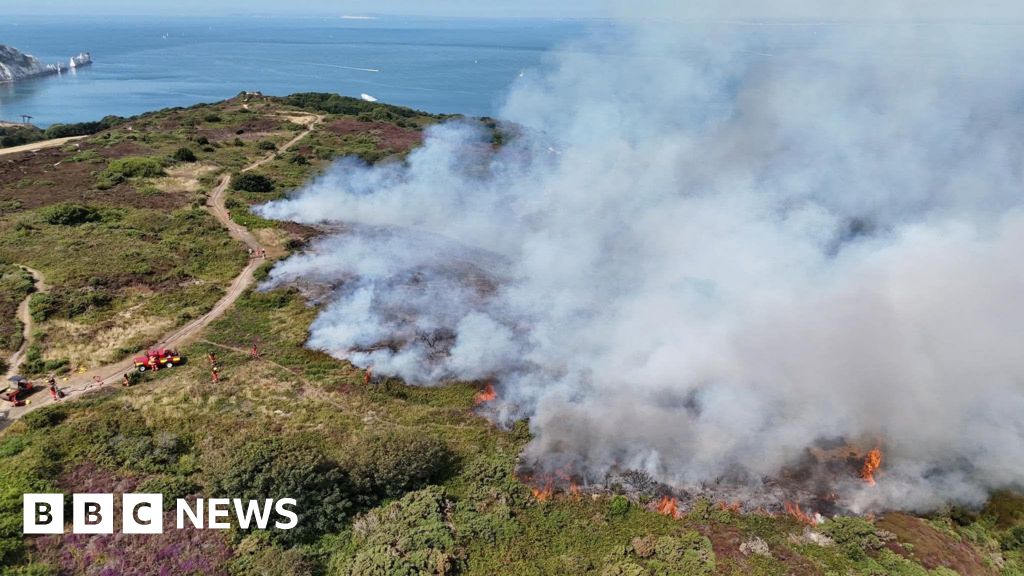
Wildfires will increasingly become the norm in the South with the risk likely to double within the next 50 years, according to an expert.
Dr Mark Hardiman, an expert in wildfires from the University of Portsmouth, said fires across the region were larger, burned for longer, and came closer to people's homes and roads.
It comes after a record 1,350 wildfires across England and Wales this year , as the Fire Brigades Union warns crews are overstretched and lack the right equipment to meet the challenge.
Dorset and Wiltshire Fire and Rescue Service said it had significant capability to tackle wildfires, while the government said it was investing nearly £100m to improve national resilience.
Fires broke out right across the region during this summer's heatwaves.
The largest of the blazes came in August, when a van fire on the A31 spread to heathland in the New Forest , affecting more than 100 hectares, an area equivalent to about 140 football pitches.
Firefighters were at the scene for two weeks, while the road was closed for nearly a fortnight as National Highways replaced damaged safety barriers and fencing.
A blaze at Headon Warren, near the Needles, burned for five days and needed 80 firefighters at its peak. Fire engines were ferried across the Solent and a helicopter dropped water on areas crews were unable to reach.
In the New Forest, more than 60 firefighters were called to a fire near Ashurst in July, where discarded disposable barbecues were found.
Nationally, figures from the National Fire Chiefs Council show there were 1,350 wildfires in England and Wales in 2026, the highest number on record and more than 1,000 more than in 2024.
Hardiman said wildfires would "increasingly be the norm".
"Over the next 40-50 years, the risk - particularly in places like the South, the Isle of Wight - is probably going to double," he said.
The UK's Climate Change Committee has also warned that the risk could double across much of the UK by 2050.
Antony Bholah, area manager at Dorset and Wiltshire Fire and Rescue Service, said the conditions that allowed fires to start and spread quickly were becoming more frequent.
"We need to recognise that the risk is changing. We need to be more prepared for it," he said.
While hot, dry weather creates the conditions for wildfires, fire services say many still start because of human activity, including barbecues, campfires, discarded cigarettes, farm machinery and deliberate fire-setting.
James Leslie, South West regional secretary of the FBU, said crews had done "remarkably well" but had worked long hours "under really arduous conditions".
He said crews were "more often riding a fire engine with four instead of the safe system of five".
"You're waiting longer for the second fire engine to come, and all that time the fires are getting bigger," he added.
The FBU says one in five firefighter posts across the UK have been cut since 2010.
It says Hampshire and Isle of Wight Fire and Rescue Service has lost one in four of its firefighters over that time, while Dorset and Wiltshire's firefighter numbers have fallen from 1,297 to 981.
Both fire services have been approached for comment on the union's figures.
Hardiman said more resources were needed to cope with several large fires at once.
"If you don't have the resources, you have to start picking and choosing which ones you fight," he said.
Bholah admitted it was "challenging", but said the service planned for it.
He said Dorset's firefighters had worked with neighbouring services to provide help across borders, and could call on national resilience arrangements.
Leslie said most firefighters in the South West, including those in Dorset and Wiltshire, were still using kit designed for structural fires in buildings rather than lightweight equipment made for fighting fires in the open.
Bholah said the service was "quite fortunate" to have four-by-four fire engines and specialist vehicles designed for rough terrain, and was continually reviewing whether it had enough.
Dorset and Wiltshire Fire and Rescue Service has a £500,000 off-road Unimog based at Wareham to reach fires in remote rural locations , while the Hampshire service has a new specialist off-road fire engine based at Rushmoor.
Hardiman said fighting wildfires required different equipment from house fires, because crews had to travel long distances and spend long periods on foot.
He said fire services across the South had been learning from crews in Portugal and Spain about how to tackle larger, more aggressive wildfires.
Hardiman said the solutions for fighting wildfires were already known and tackling the problem came down to a "political choice".
He argued for investment in people as well as equipment, so that "when we do have another year or even a worse year over the next few decades, we are able to fight it and hopefully defend homes".
Leslie called for a national approach, including a consistent definition of what counts as a wildfire, national aerial firefighting capability and nationally recognised training.
Bholah said: "I don't think it's always a case of just throwing money at a problem. I think we need to be really sure about where that money needs to be spent."
The government temporarily banned the sale of disposable barbecues in August, saying they had caused a number of serious wildfires over the summer.
Bholah said the service had been campaigning for the ban and was "really pleased" when it came in, but said more needed to be done to educate the public.
The government said its £97m would fund six specialist firefighting teams to work across the UK, as well as equipment such as off-road vehicles.
The prime minister has also said the government will hold a summit with fire and rescue services to make sure they have the right equipment and resources.
Where, why and how the South caught fire this summer?
Why can just a few hot days increase fire risks?
Hampshire and Isle of Wight Fire and Rescue Service
Dorset and Wiltshire Fire and Rescue Service
Topics in this story
Gathered from external sources. Rights to this text belong to whoever originally published it.