What archival records reveal about Jyoti Basu’s studies in London
For decades, West Bengal has been told a simple story about Jyoti Basu: that he went to London to study, completed his studies at University College
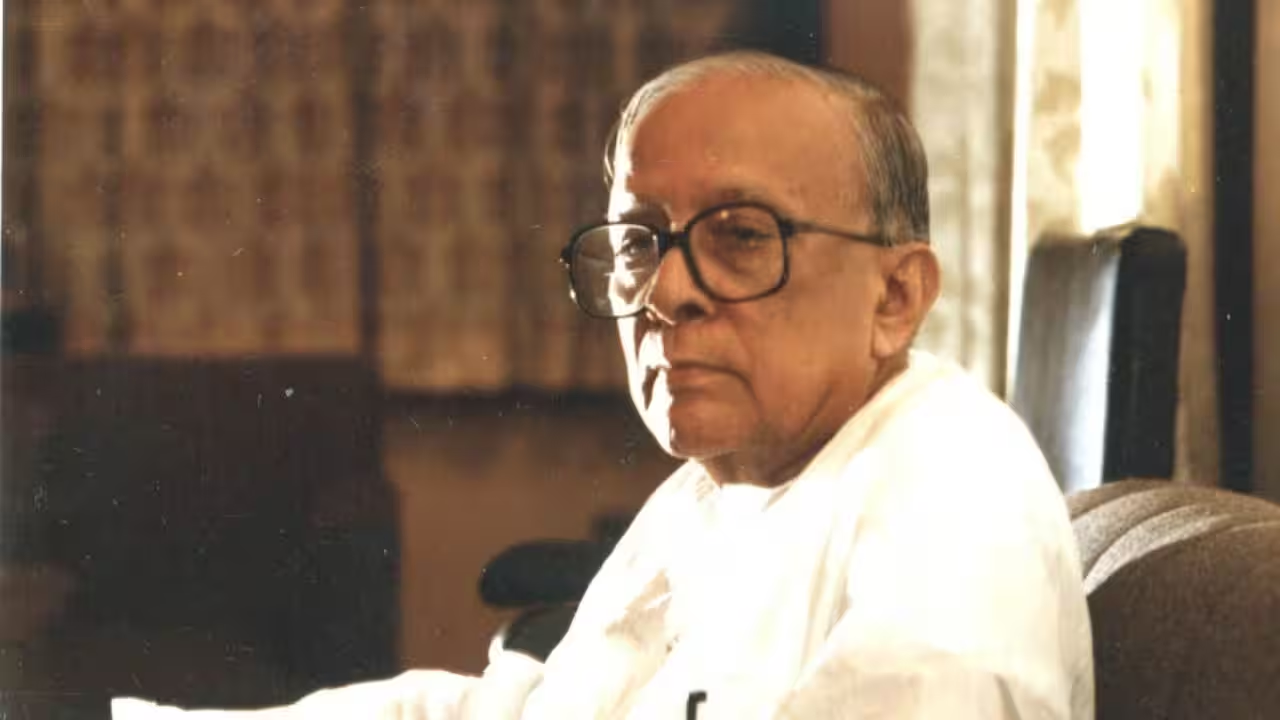
For decades, West Bengal has been told a simple story about Jyoti Basu: that he went to London to study, completed his studies at University College London (UCL) and at the London School of Economics (LSE), became a barrister, returned to India, and dedicated his life to communism. But institutional records that have recently come under examination raise an important question: is that account as straightforward as it has been made to appear?Records from UCL indicate that Basu entered the institution in 1935 and that his examination status in 1939 was not recorded as “Passed.” Instead, it appears as “conditionally passed,” suggesting that he still had papers to clear before he could obtain an academic degree. UCL and the University of London have also clarified that neither institution conferred a degree upon him. The London School of Economics, meanwhile, has clarified that Basu was never admitted to or enrolled in any course there, despite his long-standing description as an LSE alumnus in various media reports.Despite not having obtained an academic degree from London, Jyoti Basu is listed among the notable alumni of the Middle Temple. Yet, unlike several other prominent alumni, his academic credentials and the details surrounding his call to the Bar are not explicitly presented in the same manner.For example, the alumni profile of Sardar Vallabhbhai Patel clearly states that he was admitted to the Middle Temple in October 1910 and was called to the Bar in 1913. Similarly, the profile of Lee Kuan Yew, the first Prime Minister of Singapore, clearly records his academic degree from the LSE as well as his call to the Bar in 1950. Jyoti Basu's alumni profile, however, does not clearly state any academic degree and mentions only that he was called to the Bar in 1940 in absentia.This distinction is significant. Based on formal requests made to the Middle Temple to clarify this ambiguity, certain documents appear to indicate that Jyoti Basu was admitted to the Middle Temple in 1936 as a self-financing student and that, in 1940, he himself submitted a petition to be called to the Bar in absentia, subject to the condition that he would subsequently clear certain outstanding papers. In addition, archival documents reveal that Basu had also intended to qualify for the Indian Civil Service (ICS), but he did not ultimately qualify for the examination.These archival documents therefore leave an important historical ambiguity that should not casually be converted into the categorical statement that Jyoti Basu obtained academic degree from London. Basu's principal political contemporaries and opponents included figures such as Ajay Mukherjee, Dr. Bidhan Chandra Roy, and Siddhartha Shankar Ray—individuals with distinguished professional and educational backgrounds. Against that backdrop, the repeated public portrayal of Basu as an unequivocally qualified from London deserves careful scrutiny.For decades, those who questioned communist ideology were often dismissed as intellectually inferior or “uneducated.” Yet the historical record surrounding one of the most celebrated leaders of communist party in India may itself be considerably more complicated than the familiar political narrative suggests. There is also a broader question concerning academic standards and political double standards. Those who have spent decades pointing fingers at the educational credentials, intellectual abilities, and academic qualifications of their political opponents should be prepared to subject their own leaders to the same scrutiny. If questions can legitimately be raised about another person's degree, the duration of their education, or the circumstances under which a qualification was obtained, then such questions cannot suddenly become illegitimate when directed at members of one's own political camp.This is not an attempt to diminish Jyoti Basu's political importance, but to examine his educational history through institutional records rather than political mythology. The records examined here show that his clearly documented academic qualification was a B.A. in English, Second Class, from Presidency College, Kolkata, obtained in 1935. The question, therefore, is not whether Basu studied in UCL —he did—but what, precisely, did he complete there, and why was that distinction lost in the political narrative of his life?This case should also serve as a warning about the communist's long-standing approach to Indian history. For decades, communist intellectuals and political writers have constructed and promoted ideological narratives about India's past, often repeating selective interpretations until they acquire the appearance of established historical fact. Challenging every such narrative requires enormous time, archival research, and careful examination of original documents.If even the educational history of one of the communist's most celebrated leaders in India can contain such significant discrepancies between popular narratives and institutional records, then the many historical narratives promoted by the communist also deserve serious re-examination. People should therefore stop accepting ideologically constructed and politically convenient stories of communists about India's past as unquestionable historical truth. Indian history must be rebuilt on original records, evidence, and honest scrutiny—not on narratives manufactured to serve a political agenda.Disclaimer: Views expressed above are the author's own.
Topics in this story
Gathered from external sources. Rights to this text belong to whoever originally published it.