A French geologist spent 205 days underground with no clock or daylight, and his body eventually treated almost 48 hours as a single day
Michel Siffre’s first descent was meant to be a geological expedition.
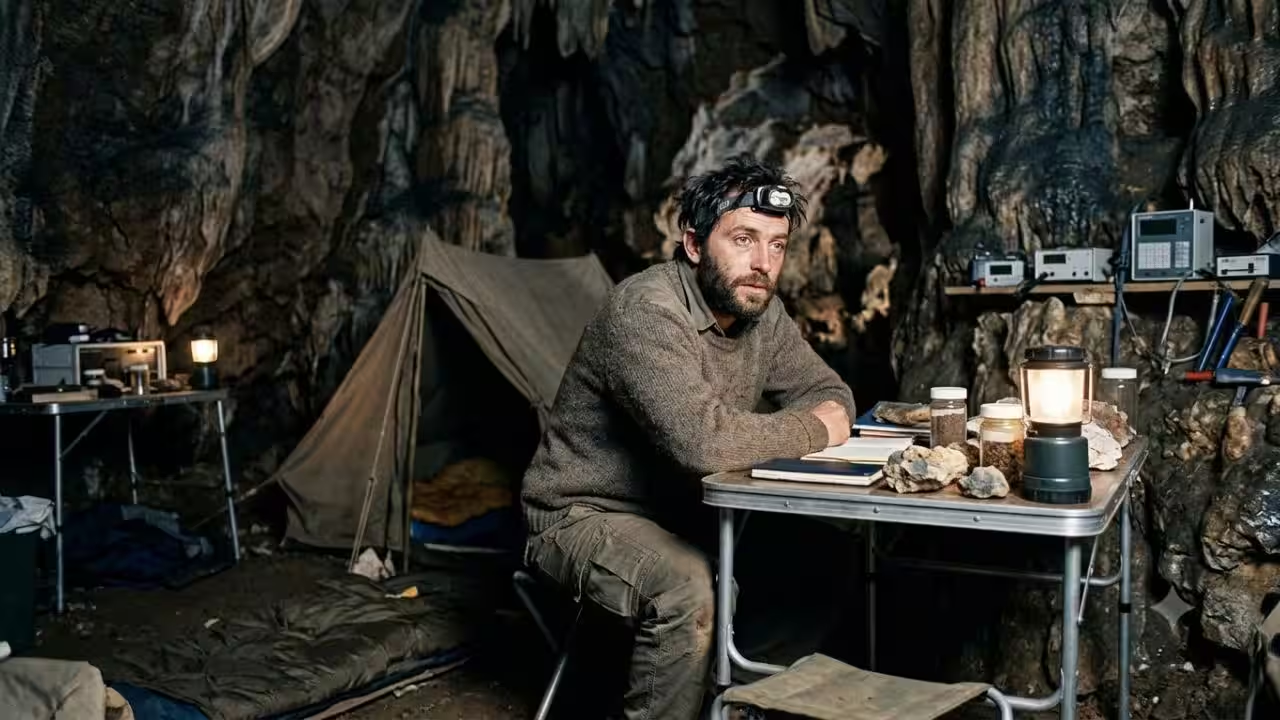
Michel Siffre’s first descent was meant to be a geological expedition. Instead, it became an experiment in what happens when a person loses every ordinary clue to the passing of time. In 1962, the 23-year-old French speleologist entered a cave in the Alps and stayed there alone for 63 days, with no clock, calendar or sunlight. He ate, slept and worked according to signals from his own body while a team outside recorded what happened. By the time he emerged, Siffre believed far less time had passed than actually had. In an email interview by Joshua Foer, published in Cabinet's Summer 2008 issue, a decade later, he repeated the experiment in Texas, remaining underground for 205 days and occasionally falling into a sleep-wake cycle that stretched across almost 48 hours.French geologist Michel Siffre turned a cave expedition into a body clock experimentSiffre did not originally set out to investigate human timekeeping. He was trained as a geologist and had become interested in an underground glacier discovered in the Alps in 1961, roughly 70 kilometres from Nice. His initial plan was modest: spend around 15 days underground studying it.That seemed too short once he considered what he might actually observe. He decided to extend the stay to two months and, somewhere in the process, changed the experiment completely. Rather than simply studying the cave, he would remove himself from the ordinary markers of time and see what his body did without them.There would be no watch and no daylight. A small team would remain near the entrance, but it would not tell him the time or contact him unnecessarily. Siffre would call them when he woke, when he ate and before going to sleep. The researchers could then compare his reported routine with the actual passage of time outside.It was an unusually simple arrangement, but it separated his biological rhythms from the 24-hour cycle imposed by the surface environment.Inside the cave: Siffre’s sense of time began to unravelThe conditions were not comfortable. Siffre described his equipment as poor, with his small living area crowded with supplies. The cave was extremely damp and cold, with temperatures below freezing and humidity approaching 98 per cent. His feet remained wet and his body temperature at one point fell to about 34°C.There was little to do beyond reading, writing, carrying out research and thinking. A light bulb provided illumination, but there was no distinction between morning and evening, and no sunrise to announce the beginning of another day. Siffre's contact with the outside world was deliberately limited. Each time he called the surface, he measured his pulse and performed a simple psychological test. He was instructed to count from one to 120 at a rate of one number per second.The results revealed how far his internal sense of duration could drift. What should have taken two minutes according to the test took him around five minutes in his subjective experience. The passage of time inside the cave was no longer matching the clock outside.Siffre had entered the cave on 16 July and expected to remain there until 14 September. When his team finally told him that the agreed end date had arrived, he believed it was only around 20 August. He had effectively lost track of almost an entire month.Without daylight, the body kept its own scheduleThe experiment suggested that people do not simply stop having a rhythm when external clocks disappear. Instead, the body's own timing system continues to operate, although it does not necessarily follow exactly 24 hours. Siffre's sleep-wake cycle during the first experiment was roughly 24 and a half hours. He would decide for himself when to sleep and when to eat, without knowing what time it was on the surface.Later experiments with other people produced something even stranger. Some subjects developed cycles lasting close to 48 hours. Rather than sleeping every night, they could remain awake for roughly 36 hours and then sleep for 12 to 14 hours.The pattern was important because it showed how dramatically human behaviour could become separated from the familiar day-night cycle. The subjects were not being told to remain awake for longer. Their routines were emerging in an environment where the normal cues had been removed.Siffre himself did not consistently fall into the longer rhythm during his first experiment. That became one of the reasons he eventually decided to return underground.The cave became a laboratory for sleepSiffre's later experiments went beyond simply recording when people slept. His teams monitored different stages of sleep, including rapid eye movement, or REM, and slow-wave sleep. They reported a relationship between extended periods of wakefulness and the amount of REM sleep that followed. According to Siffre, approximately 10 additional minutes of activity was associated with about one extra minute of REM sleep.There was also an apparent connection with performance afterwards. Subjects who spent more time dreaming appeared to have shorter reaction times during their following waking period. The findings attracted interest from the French military, which was investigating whether soldiers might be able to remain operational for unusually long periods. Siffre's work was taking place during a period when sleep and biological rhythms had obvious military and spaceflight implications.France was developing its nuclear submarine programme, while the United States and Soviet Union were competing to send humans into space. Knowing how people might sleep when the usual 24-hour environment was absent had practical value.NASA also examined the results from Siffre's 1962 experiment and helped fund mathematical analysis of the data.He returned to the darkness in TexasTen years after his first experiment, Siffre went underground again. This time the setting was Midnight Cave near Del Rio, Texas. The second experiment lasted 205 days. There was a personal scientific question behind it. Siffre wanted to examine how his perception of time might change as he aged, and he also wanted to see whether he could eventually develop the 48-hour rhythm that had appeared in several of his other subjects.The Texas experiment was considerably more elaborate than the first. Electrodes were used to monitor physiological activity, including signals associated with the heart, brain and muscles. Yet the basic principle remained: Siffre was separated from the outside world's clocks and natural light. He was left to determine his own periods of sleep, eating and activity.At times, the experiment produced the long cycle he had been looking for. On two occasions, he experienced periods of about 36 hours of wakefulness followed by roughly 12 hours of sleep.A 48-hour day did not feel like a 48-hour dayPerhaps the most revealing part of the Texas experiment was that Siffre could not reliably tell which sort of day he was experiencing. A period of wakefulness lasting 36 hours did not necessarily feel unusually long to him. A much shorter period could feel similar. His diary allowed him to reconstruct the cycles afterwards, but his own perception provided little warning that one of his biological days had stretched to almost twice the conventional length.He also described sleeping for dramatically different amounts of time, sometimes only two hours and sometimes as long as 18 hours, without having a clear subjective sense of how different those episodes were. The distinction between measured time and experienced time had become central to his work.For someone living underground, the disappearance of daylight removed one of the most powerful signals used to organise everyday life. There was no sunrise after sleep, no changing sky during waking hours and no evening darkness arriving at a predictable point. The cave remained essentially the same. Siffre later suggested that memory itself might contribute to the effect. With little changing around a person, individual days become difficult to distinguish from one another. Waking and sleeping provide the main divisions, while everything in between takes place against the same darkness.The experiments had consequences beyond cavesSiffre's work became part of the emerging study of human biological rhythms, now known as chronobiology. The central observation was straightforward: humans possess internal timing mechanisms, and those mechanisms can continue operating even when the external cues normally used to regulate them are removed.The research also intersected with questions that were becoming increasingly important in spaceflight and military operations. Astronauts and submariners could spend long periods away from ordinary patterns of daylight and night. Crews working irregular shifts faced related problems.The military interest in Siffre's findings was particularly strong during the Cold War. Researchers wanted to understand whether human wakefulness could be extended without simply exhausting the person involved. Some of the ideas were experimental and never became practical methods. The French army, for example, explored whether medication could increase REM sleep in the hope of manipulating the length of an individual's waking period.The cave experiments nevertheless provided something difficult to obtain in a conventional laboratory: people were living for weeks or months without knowing what time it was.One subject slept for 33 hoursThe risks were considerable, especially by modern research standards. During one early experiment in 1964, a man being monitored underground slept for 33 hours. Because he had a microphone attached to his head, the researchers could listen for signs that he was still alive. For a long period, they heard nothing.Siffre eventually decided he needed to enter the cave to check on him. At about the 34-hour mark, the sleeper snored. A short time later, he contacted the surface himself and asked the team to take his pulse.The episode illustrates how differently these experiments were conducted in the 1960s compared with modern human research. Siffre later acknowledged that current ethical oversight would make such an approach far more difficult. A subject who remained asleep for that long would be regarded as a medical concern rather than simply another unexpected result.The willingness to accept that level of uncertainty was partly a product of the period in which the experiments took place.His final cave experiments came decades laterSiffre's long spell in Texas also had a financial cost. He had underestimated the expense of transporting the equipment and running the operation in the United States, and he emerged from the cave with substantial debts. He eventually moved away from chronobiology.It was not until 1999 that he returned underground, this time to Clamouse Cave in southern France. He was interested in the effects of ageing on the circadian cycle and wanted to compare his experience with his earlier experiments.The timing was deliberate. Siffre had been inspired in part by astronaut John Glenn, who returned to space at the age of 77. Siffre saw a similar opportunity to revisit a question he had first explored as a young man and examine whether his perception of time had changed with age. He spent two months underground.By then, the era of the great isolation experiments was largely coming to an end. Modern research ethics placed much greater limits on the degree of risk researchers could ask human subjects to accept, making prolonged isolation in a cave much harder to justify.You use AI every day. Now get your AI Quotient. Take the AIQ test.
Topics in this story
Gathered from external sources. Rights to this text belong to whoever originally published it.