In Wyoming, an automated camera system detected approaching eagles and triggered turbine shutdowns; an initial study estimated 82% lower fatalities than at a control site
A groundbreaking automated camera system in Wyoming has led to an 82% reduction in eagle fatalities at wind turbines, highlighting the potential for technology to protect wildlife while harnessing renewable energy.
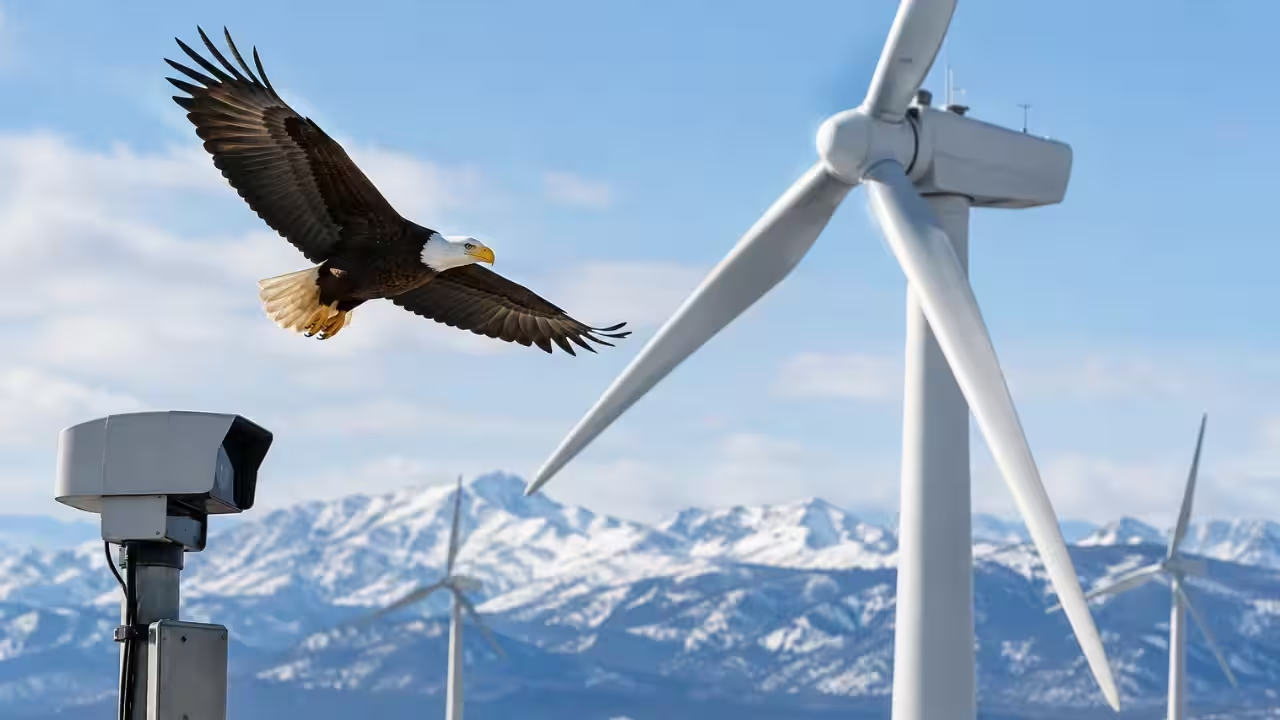
Wind power and eagles both depend on open, windy land. Large raptors such as golden eagles use steady winds and rising air currents to travel and hunt with little effort and wind developers site turbines on ridges and plains for the same conditions. This spatial overlap places eagles within range of the moving blades and has long complicated wildlife management and turbine permitting operations. Operators either shut down turbines temporarily or slow them when birds are detected, generally with the help of on-site human observers. Observers could monitor only a limited number of turbines and could not remain active all day. This prompted research into whether cameras and software could do the job without human direction. A case study conducted in Wyoming tested this idea.How IdentiFlight works at Top of the WorldThe Peregrine Fund describes IdentiFlight as a combination of camera and machine learning technology that detects flying objects, classifies them and shuts down the turbine if an eagle is threatened with impact. In a 2021 study published in the Journal of Applied Ecology, Christopher J. W. McClure, Brian W. Rolek, Leah Dunn, Jennifer D. McCabe, Luke Martinson and Todd E. Katzner evaluated an automated camera system designed to detect approaching eagles and stop wind turbines at the Top of the World Windpower facility in Wyoming. The researchers compared eagle fatalities at the facility with those at a nearby control site. The above-mentioned study found that estimated eagle fatalities at the treatment site declined by 63% between the periods before and after automated curtailment was introduced, while fatalities at the control site increased by 113%.The January 2021 before-after-control-impact studyThe findings were published on January 20, 2021, in the Journal of Applied Ecology in a paper titled Eagle fatalities are reduced by automated curtailment of wind turbines, available through the US Geological Survey (USGS) publication page. The researchers used a before-after-control-impact experimental design. They compared eagle fatality rates at Top of the World with those at a control location 15 km away, which lacked automated curtailment, both before and after the implementation of the automated system. A control location is important because eagle abundance and weather conditions change annually.The 82% lower fatality rateThe USGS summary of the study explained that the team corrected for carcass detection probability using the GenEst software and scaled fatality estimates to turbine-years, which is why the comparison was framed as a rate rather than a raw count. After those modifications, the team concluded that the mortality rate at the treatment site was 82% lower than at the control site. The summary also noted that the technology does not eliminate all collisions and that the authors viewed automated curtailment as promising but not a standalone fix, saying its effectiveness could improve when paired with other mitigation measures. The 2023 USGS reanalysis: 50%, from -159% to 89%A later 2023 paper in the Journal of Applied Ecology, Reanalysis indicates little evidence of reduction in eagle mortality rate by automated curtailment of wind turbines, was written by USGS scientists Manuela Huso and Daniel Dalthorp. The reanalysis examined the same treatment site over roughly four years before IdentiFlight was installed and only about six months to one year afterwards, alongside a control site and argued that the data do not support a clear change in underlying mortality rate. The authors concluded that the effect estimate was too imprecise to rule out either a decrease or an increase.There were four problems that Huso and Dalthorp found with this data. First, the original study compared the mean of four years before activation with just one year after, without controlling for year-to-year variation. Also, there was only one treatment year at one location, which is insufficient to establish a causal effect. The effect size was exaggerated because it assumed the deviation at the neighboring site would also apply to the treatment site, and it varied depending on the arbitrary date used to divide the before and after periods. Lastly, 7 of 42 reported eagle fatalities were left out of the analysis and the reason was unclear. With these corrections in mind, the USGS note provides an estimate of a 50% reduction with an interval from -159% to 89%, a range that includes no reduction or even an increase.What remains open: more years at more sitesThe 2023 authors did not claim that automated curtailment cannot benefit eagles. They wrote that it has obvious potential in theory, but that the Wyoming results do not support the overly optimistic effect size and precision first reported. The authors added that evaluating the technology and informing management decisions will require several more years of data from multiple locations. For the wind industry and regulators, the Wyoming results should be treated as inconclusive: the technology’s potential is plausible in theory, but the data have not yet demonstrated it. Replication across multiple sites and years is still needed before automated shutdown systems can be considered a well-supported solution to eagle fatalities.You use AI every day. Now get your AI Quotient. Take the AIQ test.
Topics in this story
Gathered from external sources. Rights to this text belong to whoever originally published it.