In the early 1970s, a South Carolina contractor began casting famous buildings in his backyard; by 1998, his 33-piece Concrete City had been rescued by a state museum
Explore the remarkable story of L.C. Carson, a South Carolina contractor who created Concrete City in his backyard—a collection of 33 architectural replicas that now inspires future generations in a state museum. Discover the preservation efforts and the impact of self-taught creators on cultural heritage.
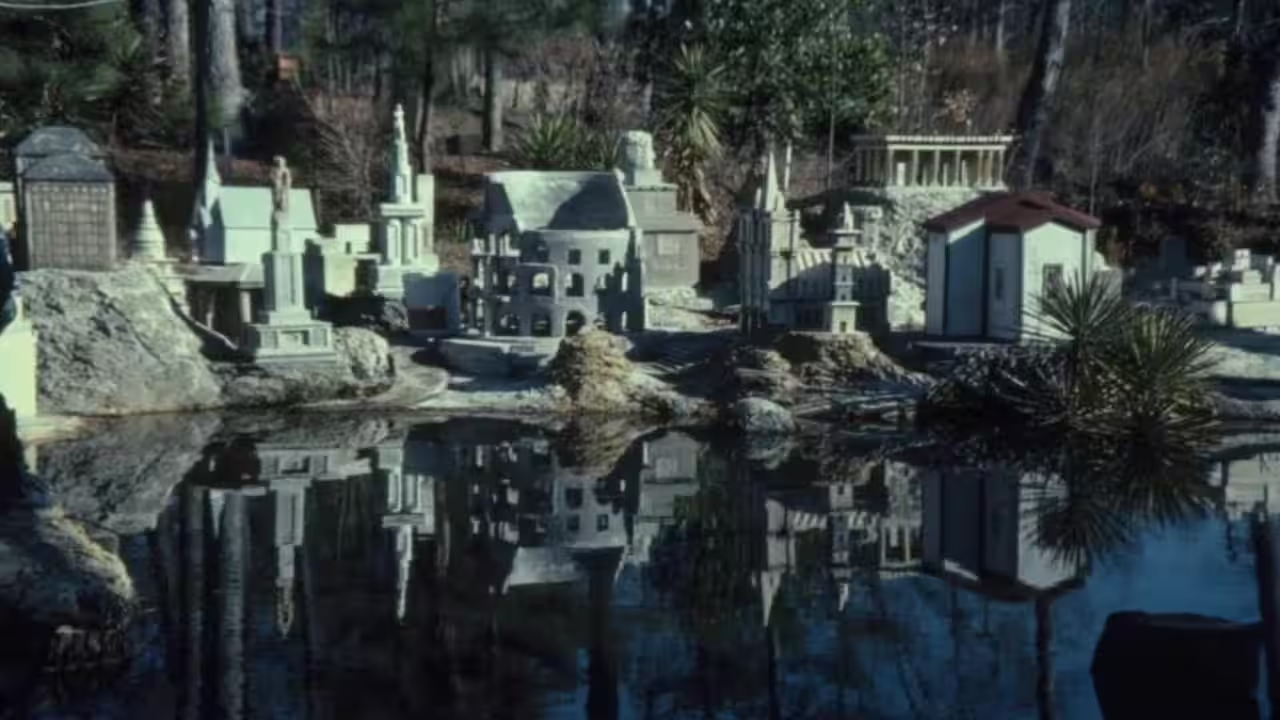
Every builder has a project of their dreams. Some see it as a church, while others see it as a bridge or a large public space. Many people spend their entire careers building on other people's ideas, without ever having the chance to create something truly original. One contractor in Orangeburg County, South Carolina, chose to begin construction in his yard without waiting for a commission.Leslie Cosgrove Carson, or L.C., was his name. He dropped out of school to support his family during the Great Depression and worked as a contractor for 47 years, according to the South Carolina State Museum. He started creating scale replicas of well-known buildings in the early 1970s, and the project developed into Concrete City, a collection of 33 waist-high skyscrapers that the museum eventually took in and preserved.From the job sites to a back gardenCarson was self-schooled in history, mythology and art history and journeyed to Europe and Central America to see some of the sites he had only read about firsthand. Back home he applied what he knew best. The museum says he built his copies of the Parthenon, the Sphinx, Rameses’ Temple and the Colosseum from ordinary building materials, and the finished pieces represented the techniques of a working builder.A colourful profile of Roger Manley’s book Weird Carolinas appears in the Times and Democrat of Orangeburg. Carson got the idea after he visited the Ave Maria Grotto in Cullman, Ala., and decided to copy buildings from throughout history, it claims. Another story describes a garden with a croaking frog by the Shrine of the Virgin of Guadalupe, with tadpoles swimming under London Bridge. Carson had always wanted to create a major building, just one, and Concrete City was his response.Moving a City, 1998By that decade Carson could no longer care for his invention, and the elements had begun to wear it down. He talked to his family, museum officials and representatives of a local university and he explained his perspective. He figured the city wasn’t going to raise the worth of his house and whoever could move it could have it. "Then he and his family gave the museum the environment it needed.The transfer was carried out in stages. The museum selected Our Lady of Lourdes Cathedral as a test case to see what it would take to move these huge yet delicate items. The sculpture was moved in 1996 and was part of the 1997 exhibition Still Worth Keeping. The remaining structures followed in May 1998, and Carson died later that year at the age of 85.Conservation continued for years after that. Almost all of the sculptures have been stabilised and conserved, with several fully recreated under the leadership of Wisconsin conservator Tony Rajer, the museum reports. That work is based on widely known principles. The National Park Service guidance on historic concrete says, “Maintenance and repair are best accomplished using the principle of minimum intervention and maximum retention of original material, with replacement reserved for badly degraded elements.” It’s a good reminder that concrete, despite seeming permanent, does age like everything else.The necessity of preserving folk art contextsConcrete City is one of a larger group that specialists call art environments, places developed by self-taught creators on their own property. They are tough to save, as they generally rely on the energy of one individual. Still, the preservationist Don Howlett told SPACES Archives that mainstream preservation does not yet acknowledge art spaces as important cultural treasures. He also said that several sites were under threat but more sites have been saved and now have strong organisations behind them. He said the Garden of Eden in Lucas, Kansas, and the Watts Towers were the first preserved in the country.Carson’s work found a different outlet in a state museum eager to take on a backyard full of concrete. Later the museum got a grant from the South Carolina Arts Commission to rehouse the collection with unique shelving and materials so it can keep inspiring for decades to come. Visitors should know that museums rotate artefacts. The State Museum is at 301 Gervais St. in Columbia. It is important to confirm with the museum what is on view before making the journey. The point is straightforward. Carson never got his cathedral but built something more suited to his talent, and a community determined was worth preserving. Concrete City shows that a backyard project may become a museum collection when someone chooses to save it.You use AI every day. Now get your AI Quotient. Take the AIQ test.
Topics in this story
Gathered from external sources. Rights to this text belong to whoever originally published it.