Israel vote results confirmed as election commission rejects fraud claims
Netanyahu’s allies refuse to back the result, as President Herzog begins talks on who should form the next government.
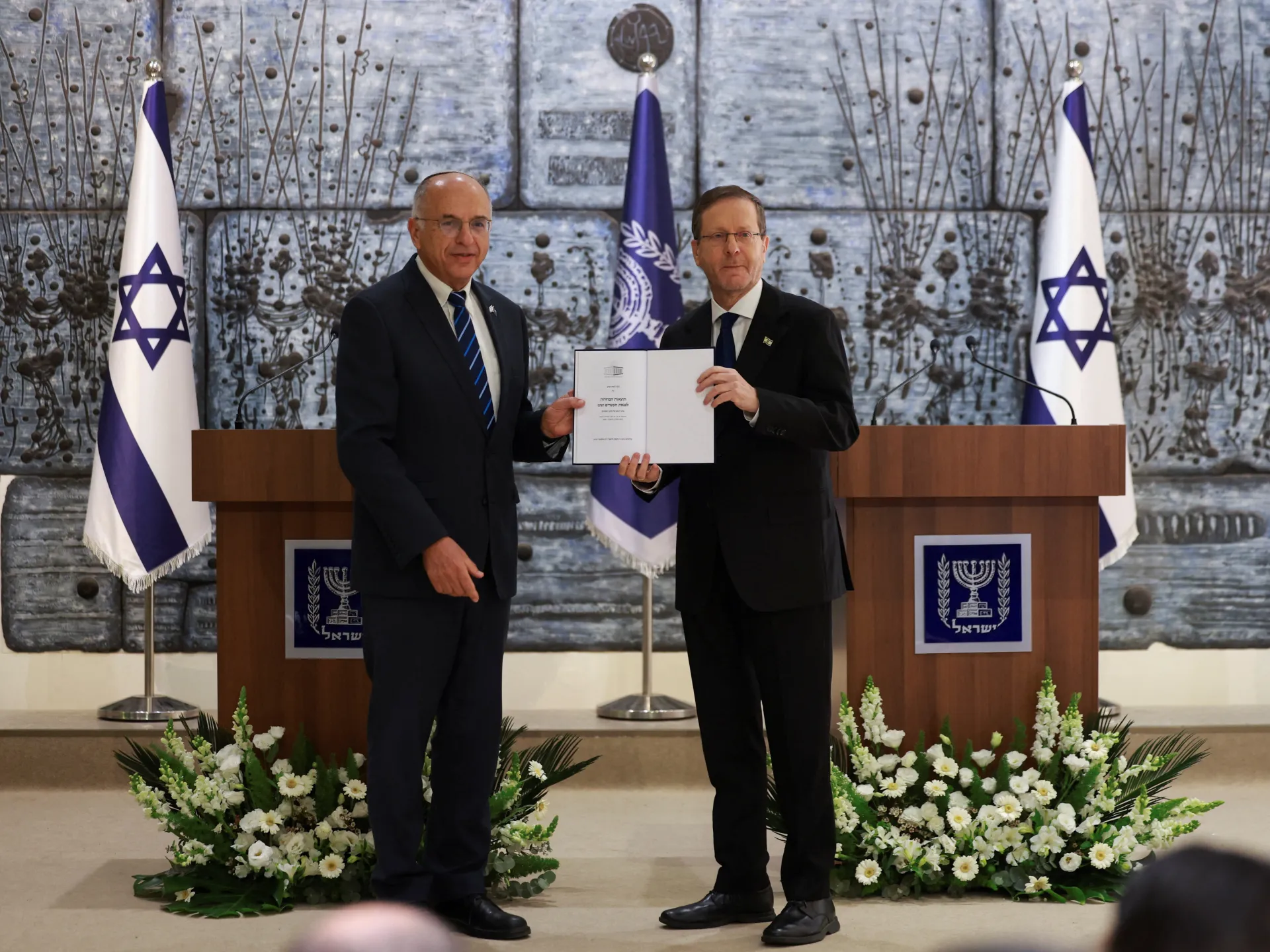
Israel’s Central Elections Committee has certified the results of last week’s general elections after finding no evidence of fraud, a blow to Prime Minister Benjamin Netanyahu’s efforts to discredit the vote.
The results were submitted to President Isaac Herzog on Wednesday, who will now hold two days of consultations with the leaders of the blocs before choosing the candidate best placed to form a coalition.
This comes after the Netanyahu-led bloc won 53 parliamentary seats in the October 27 vote, while Gadi Eisenkot’s opposition bloc got 48, and the Arab-led parties Ra’am and the Joint List secured a record 19.
With neither bloc able to attain the 61-member majority needed to govern in the 120-seat Knesset, Herzog said both sides needed to accept that “not every commitment and promise can be fulfilled” and to avoid new elections.
“In the current reality, in which there is no clear winner after the elections, I ask for originality and creativity, courage and goodwill, so that the State of Israel emerges the winner,” Herzog said as he formally received the election results.
The election saw soaring support for lists from the Arab minority, descendants of Palestinians who stayed in Israel after its 1948 creation and who have largely been outraged by the harsh rhetoric and actions of Netanyahu’s far-right government.
Netanyahu and his allies have repeatedly claimed, without evidence, that Arab-led parties “stole” the election, possibly with foreign help.
Speaking at the official results ceremony at Herzog’s residence, Supreme Court Justice Noam Sohlberg, who is also the chairman of the Central Elections Committee, said those casting doubt on the results pose “a real danger” to Israel’s democracy.
The committee said a review of 9,069 polling stations found no irregularities that compromised the integrity of the election or changed its results. Its acting director general, Dean Livne, said every complaint had been examined individually and the results accurately reflected voters’ choices.
In the committee’s five-member presidium, representatives of Yesh Atid and Blue and White voted to ratify the results, while Likud and Shas abstained. Justice Sohlberg cast the deciding vote.
The election deadlock raises the possibility of a unity government or an alliance between Eisenkot and Arab-led parties. If no one is able to form a governing coalition, Israel would hold another election early next year.
In a break from custom, The Times of Israel reported that Herzog will meet the smaller parties’ leaders first, starting with Religious Zionism, followed by Shas and Yisrael Beytenu. It is expected the remaining factions will meet with the president on Thursday, ending with Eisenkot ’s Yashar and, finally, Likud.
After holding two days of consultations, the president will give a contender 28 days to form a government, with a potential 14-day extension.
It took Netanyahu, who at the time had a better showing by Likud, 58 days to form a government after the last election in November 2022.
Israel held five elections between 2019 and 2022 after repeated deadlocks.
Justice Sohlberg of the elections committee said Israeli authorities would keep investigating allegations of vote misconduct but that they would not fundamentally change the results.
After the vote, the internal security agency Shin Bet told the committee that intelligence pointed to widespread foreign funding and influence operations involving “thousands of people and possibly more”, The Times of Israel reported. Law enforcement sources told Haaretz daily they were unaware of any operation of that size.
The Shin Bet is reportedly seeking to question four Arab politicians, but has not given prosecutors evidence regarding three of them. Likud accused Attorney General Gali Baharav-Miara of blocking the interrogations. In turn, she effectively accused Shin Bet chief David Zini, a Netanyahu appointee, of undermining the rule of law, according to The Times of Israel.
National Security Minister Itamar Ben-Gvir called on Zini to arrest all Arab party leaders and question them in Shin Bet cells, even without the attorney general’s approval. He also demanded a freeze on certification and on forming a government. “The elections were stolen, the results are fraudulent, foreign countries interfered,” Ben-Gvir wrote on X, adding that his far-right Otzma Yehudit party would therefore vote against approving the results.
Likud legislator Amit Halevi resigned from the committee. He alleged that some lawmakers “bought their seats with bribe money” and that the vote reflected “the choice of the rulers of Qatar, Iran or Turkey”. Qatar has rejected claims that it funded Arab-led parties, calling them “disinformation”.
Haaretz reported that Likud had weighed refusing to recognise the results altogether. Such a move would be unprecedented in Israel and would likely be swiftly overturned by the courts. Sohlberg rejected a Likud demand to discuss the results before certifying them, writing that no party, “however distinguished or senior”, could withhold their publication. He has said even if foreign interference were confirmed, it would not undermine the overall result.
Warning not to erode democracy, Sohlberg said: “There is one thing on which we must agree: election results, as lawfully determined, are binding on us all.”
Topics in this story
Gathered from external sources. Rights to this text belong to whoever originally published it.