What's Suwalki gap? Europe's 'achilles heel' that it fears could be Putin's target
Europe News: Belarusian tanks rolling close to the Polish and Lithuanian border last week, followed almost immediately by Ukraine's biggest strike deep inside Russ.
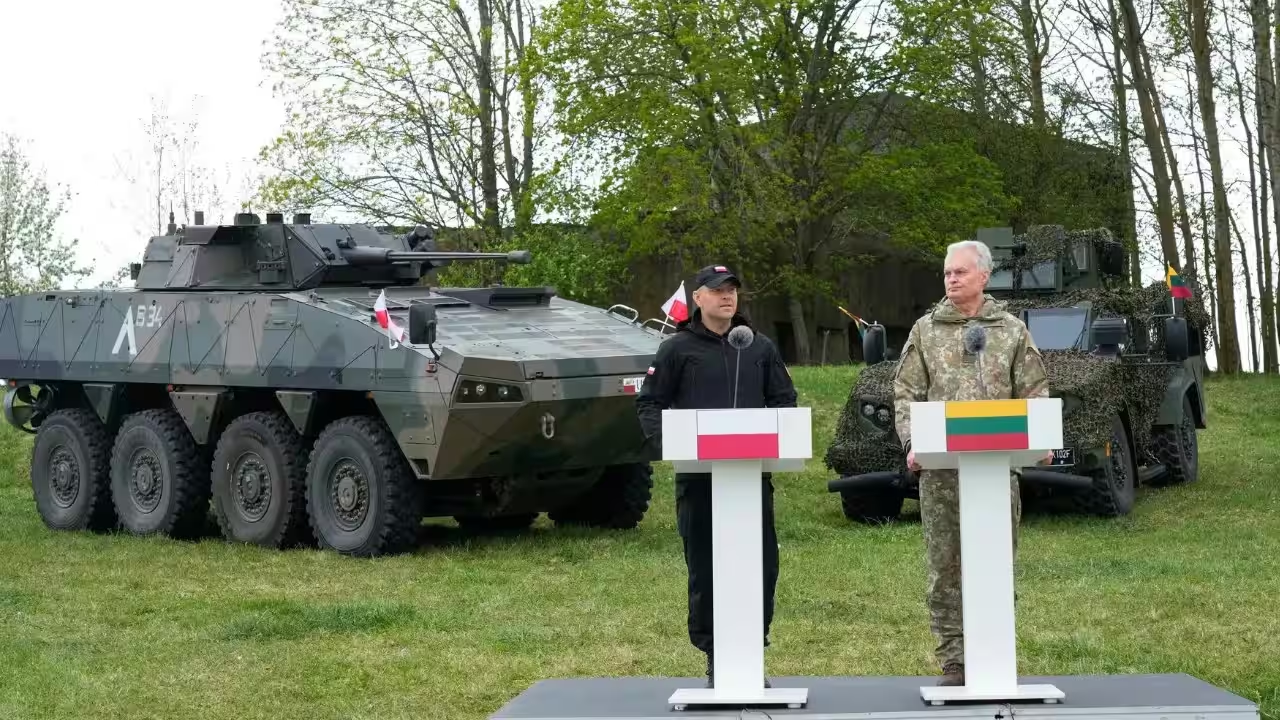
Belarusian tanks rolling close to the Polish and Lithuanian border last week, followed almost immediately by Ukraine's biggest strike deep inside Russia, has pushed a little known patch of land back into the spotlight.Barely 100 kilometres long, the Suwalki Gap is the only route by land connecting the three Baltic states (Lithuania, Latvia and Estonia) to the rest of Nato. The European leaders and security officials worry it could become the place where Vladimir Putin chooses to test the alliance without firing the first shot of a full scale war.The gap sits squeezed between Belarus on one side and Kaliningrad on the other, a heavily armed Russian territory, which is not part of the mainland Russia.Kaliningrad, the Russian exclave, was once German land and home to a large German population for centuries, until the Soviet Union took it over after the Nazi army collapsed at the end of the World War II.It was then formally handed to Moscow under the Potsdam Agreement of 1945, signed by the wartime allies as they carved up the map of Europe. It has stayed Russian ever since, cut off from the Russian mainland and sitting right between Poland and Lithuania like a loaded gun pointed at Nato's eastern edge.Why the gap is being watched so closelyIf this narrow corridor were ever blocked or seized, the Baltic states would effectively be sealed off from reinforcement by land. Troops, tanks, fuel and ammunition all rely on this single stretch to move from Poland northwards. That is exactly why Nato treats it as a strategic weak spot, even though there is no solid proof right now that Russia plans to attack it.The Belarusian drills involved mechanised and armoured units training in border defence, counter sabotage work and responses to drones. Minsk called them purely defensive and said their scale stayed below the level requiring advance notice under international agreements, but their location so close to the Suwalki Gap still drew immediate attention from Western capitals.The suspicion compounded after Ukraine's deep strike on Russia, which was also the biggest since 2022 when the war began.A test of nerves?There is, however, no public evidence that Moscow is preparing to seize the corridor or launch a direct attack on Nato territory. The concern lies instead in the possibility of pressure below the threshold of open conflict, including drone incursions, sabotage, cyberattacks and military manoeuvres that could test Nato's ability to distinguish between deliberate aggression and incidents that can be denied or attributed elsewhere.Since Russia's invasion of Ukraine, Nato has strengthened its eastern flank with multinational forces, reinforcement plans and pre-positioned equipment stretching from the Baltic region to southeastern Europe.The measures are intended to ensure that any attempt to disrupt access to the Baltic states can be met quickly and collectively. However, for European security planners, the Suwalki Gap is therefore less a prediction of where the next conflict will begin than a reminder of how it could be its "achilles heel".ALSO READ | Russia planning 'grey zone operations'? Why is Europe intuitively spookedCatch the latest World News and Live updates. Download the TOI app.
Topics in this story
Gathered from external sources. Rights to this text belong to whoever originally published it.