Silicon Valley pioneer helped build HP’s first computer and collected wine for 60 years; 6,814 bottles from his cellar went to Christie’s auction
An original Silicon Valley pioneer who helped build Hewlett-Packard's first computer in the 1960s later became a venture capitalist and a key player in
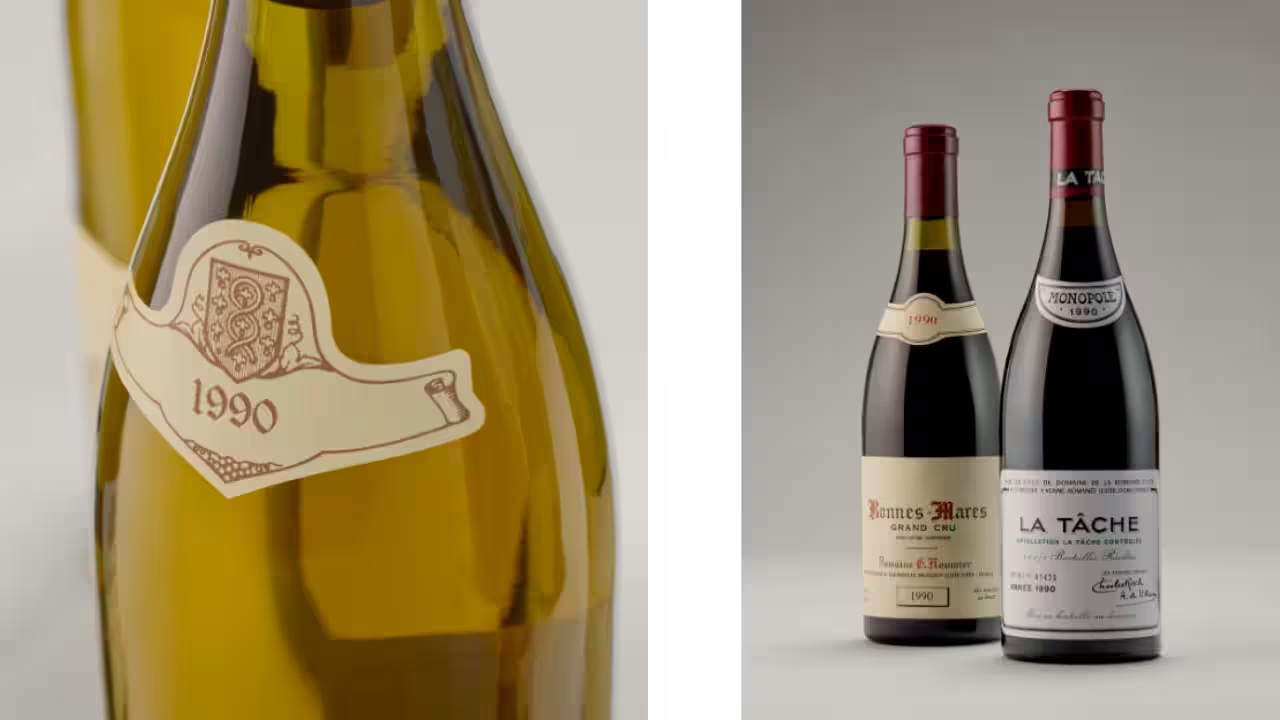
An original Silicon Valley pioneer who helped build Hewlett-Packard's first computer in the 1960s later became a venture capitalist and a key player in the modern renaissance of Napa Valley, according to Christie's. His private cellar grew to perhaps as many as 20,000 bottles, and after he died in 2025, Christie's was asked to sell the remaining 6,814 bottles. The sale took place on 5 June 2026 at Rockefeller Centre in New York. Chris Munro, Vice President of Christie’s Wines and Spirits, says every bottle has only ever had one owner and never left the cellar.Silicon Valley trailblazer who helped build Hewlett-Packard's first computer and began a wine cellarAfter graduating from Princeton with an electrical engineering degree, the future collector drove from New Jersey to California in 1964, as the electronics and defence industries were turning Santa Clara Valley into a technology hub. Christie's reports that he took a job at Hewlett-Packard's Palo Alto headquarters, where he helped build the company's first computer.Around the same time, he bought a modest house in the rural town of Woodside, which decades later would be home to leaders of Apple, Sony, Intel and Oracle. Its cool basement soon began filling with wine. He went on to file multiple technology patents, co-found several start-ups and shape digital innovation as a venture capitalist.Napa Valley renaissance: weekend visits to Ridge Vineyard and Joe Heitz when few Americans collectedAt weekends he made the hour-long drive to the newly established Ridge Vineyard, or to see his friend Joe Heitz, the pioneering vintner who was helping usher in Napa's modern era. He came home each time with cases of the latest vintages.Munro told Christie's that at the end of the 1960s very few people in the United States drank fine wine, let alone collected it, because the national taste ran to bourbon and martinis. Napa began to take off around 1968, and this collector was there at the very start.Early client of Kermit Lynch buying Bordeaux and grand cru Burgundy by caseload before prices soaredAs his tastes widened, he became one of the earliest clients of the merchant Kermit Lynch, who opened his shop in the San Francisco Bay Area in 1972. He bought Bordeaux and Burgundy prolifically, at a time when great wines cost far less.Christie’s explains that a case of First Growth Bordeaux may now be worth ten times its 1970s price, and Burgundy has risen even more. The collector bought grand cru wines from producers such as Domaine Armand Rousseau and Domaine Dujac by the case, sometimes for as little as 50 dollars a bottle. Some now change hands for thousands. Collecting then did not require great wealth.Rare Heitz Martha's Vineyard, Ridge Monte Bello 1974, Burgundy and Barolo standouts from the cellarThe sale included twenty vintages of Heitz Cellar Martha's Vineyard going back to 1973, which he had never seen in such quantity. It also offered an eleven-bottle case of Ridge Vineyard Monte Bello from 1974, estimated at 22,000 to 32,000 dollars. Other early Californian names included Inglenook from 1964 to 1968, Mayacamas from 1974, Stag's Leap from 1973 and Freemark Abbey from 1969.Beyond California, Christie's lists Bordeaux from the celebrated 1966 vintage, Petrus and Château Lafleur from the 1960s and 1970s, and Burgundy from Domaine de la Romanée-Conti, Meo-Camuzet and Domaine Georges Roumier. There was also a full unopened case of Gentaz-Dervieux Côte-Rôtie from 1989, eight bottles of Giuseppe Rinaldi Barolo from 1985 and a full case of Bruno Giacosa Barolo from 1967. The sale closed with rare whiskey, including a Van Winkle Special Reserve nineteen-year-old bourbon bottled for Corti Brothers, estimated at 15,000 to 20,000 dollars.Single-owner provenance, impeccable storage and why this cellar was ahead of the curve for collectorsThe cellar is a single-owner collection in the truest sense. The bottles were stored lying down on simple, practical racks, and the team found cases untouched since the 1970s. When space ran out, the collector converted a bathroom into extra storage.A classic, old-school collector who bought what he loved and shared it with friends and family, never for money or investment. He ran his cellar "with curiosity and intellect." He also left behind a large pile of labels, each removed from its case, laminated and filed. The collection was far ahead of its time; a list of the great wines wanted for a modern cellar would look much like this one.You use AI every day. Now get your AI Quotient. Take the AIQ test.
Topics in this story
Gathered from external sources. Rights to this text belong to whoever originally published it.