Guam's snake invasion became so bad that power lines were a problem: How brown tree snakes climbed poles, caused blackouts and forced researchers to find bizarre ways to keep them away
Guam’s brown tree snake problem is far stranger than a typical invasive-species story.
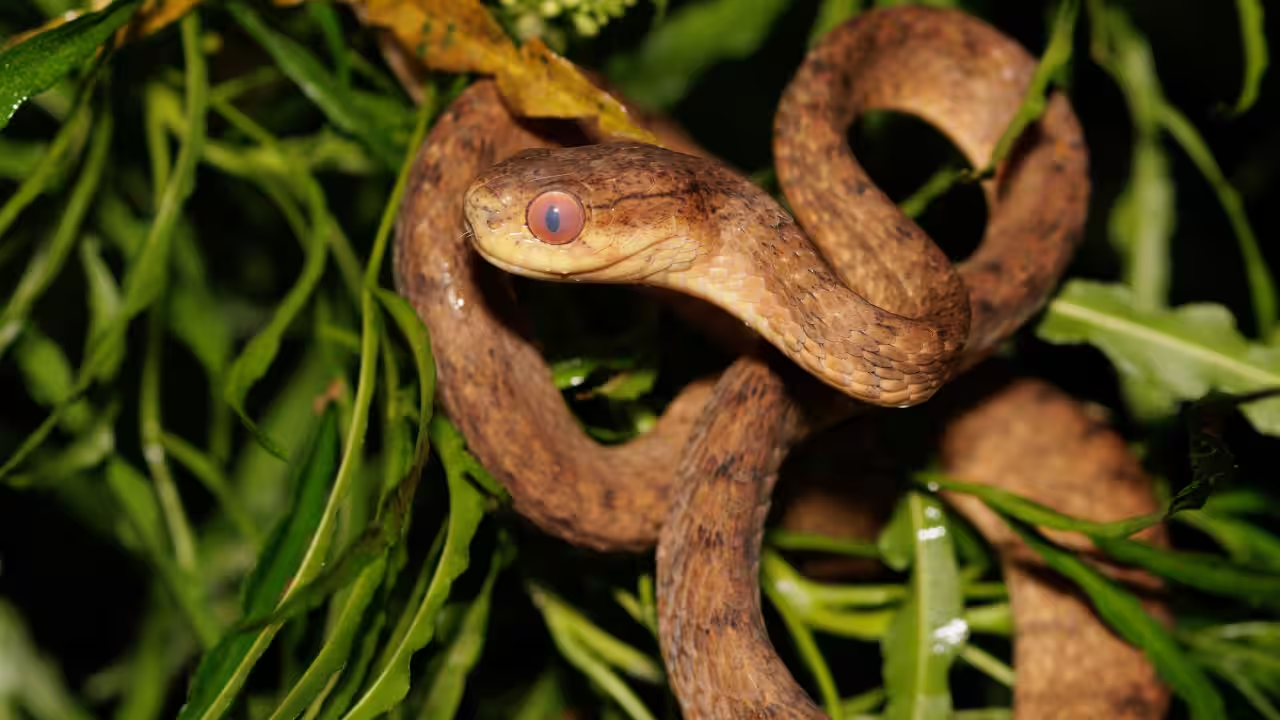
Guam’s brown tree snake problem is far stranger than a typical invasive-species story. The snakes did not simply spread through forests and prey on native wildlife. They learned to exploit the island’s infrastructure too, climbing poles, reaching electrical equipment and triggering costly power failures.The brown treesnake (Boiga irregularis) arrived on Guam sometime after World War II, probably as a stowaway in cargo. With few natural controls and plenty of prey, its population exploded. The consequences were severe for native birds and eventually reached something far less wild: the electrical grid.When a snake became an electrical problemBrown tree snakes are excellent climbers. They can move onto guy wires, poles, transformers and other electrical structures. When a snake touches two electrical points at once, its body can effectively bridge the circuit.The result can be a short circuit, electrical fault or surge. The snake may be electrocuted, while transformers and other equipment can also be damaged.The problem is not new. More than 1,600 snake-caused outages were recorded between 1978 and 1997, and older estimates put the annual economic impact at more than $4.5 million over a seven-year period.The snake that found a way around barriersThe strangest part came when researchers tried to stop the snakes from climbing smooth cylinders.Scientists discovered that brown tree snakes could form their bodies into a loop resembling a lasso. They use that loop as an anchor, then make small waves with the rest of the body to inch upward.Researchers named this previously undocumented movement “lasso locomotion.” It allows the snakes to climb smooth, wide cylinders that would defeat more conventional climbing movements. The discovery also explained why some seemingly clever barriers were not as snake-proof as expected.Then came the parachuting miceGuam’s snake-control efforts have produced one of the strangest wildlife-control methods ever attempted.Researchers discovered that acetaminophen is toxic to brown tree snakes. Instead of scattering bait across the forest floor, wildlife managers developed a way to place treated dead mice high in the canopy, where the snakes naturally hunt.Helicopters were used to release dead mice containing acetaminophen. Small cardboard-and-paper devices slowed their descent and helped the baits become caught in vegetation rather than simply falling to the ground.The method was designed to target snakes while reducing exposure to other wildlife. It has been used as a targeted control tool, not as a solution capable of eliminating Guam’s entire snake population.Dogs, traps and better barriers joined the fightThere is no single fix for an invasion this deeply established. Researchers have therefore tried several approaches, including traps, improved barriers, toxic baits and detection methods.Specially trained detector dogs can help locate brown tree snakes, while rapid-response teams work to intercept snakes that may leave Guam aboard ships or aircraft. That matters because Guam is a major Pacific transportation hub, making accidental spread to places such as Hawaii and the Northern Mariana Islands a continuing concern.The brown tree snake story shows how an invasive animal can reshape an island far beyond its forests.It has been linked to the decline or local extinction of many native bird species. It has disrupted electrical infrastructure and created an expensive maintenance problem. And its ability to hitchhike in cargo means Guam's problem could become another island's problem if prevention fails.Perhaps the most striking lesson is that wildlife does not always stay on the side of the landscape humans consider “natural.” On Guam, the snake adapted to poles, wires and other structures with surprising ease. The response had to become equally inventive.Disclaimer: This article is based on information from the U.S. Geological Survey and published scientific research. Control methods described above are specialized wildlife-management techniques and should not be attempted by the public.Get the latest movie news, reviews, and celebrity updates. Download the TOI App.
Topics in this story
Gathered from external sources. Rights to this text belong to whoever originally published it.