In 2019, a Florida activist grew or foraged his food to test whether he could live without grocery stores; he completed one year without a grocery store
In an inspiring one-year project, activist Rob Greenfield foraged and grew all of his meals in Florida, avoiding grocery stores and showcasing the potential for urban foraging and food independence. Discover insights from his journey and the challenges he faced along the way.
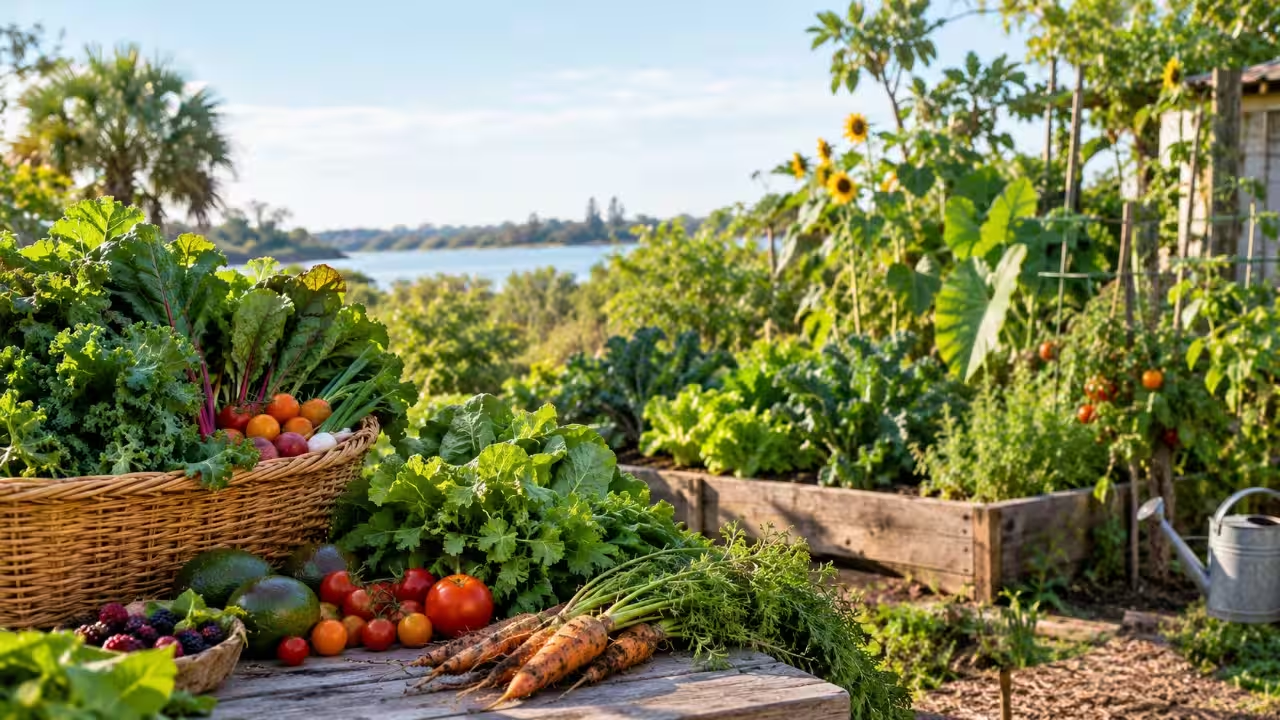
From November 11, 2018 to November 11, 2019, activist Rob Greenfield set out to see whether he could meet all of his food needs by growing or foraging for everything he ate. WUSF described how, for 365 days in Orlando, Florida, he avoided grocery stores, restaurants, takeout and food prepared by friends. He completed the project in November 2019 and later documented it in the book Food Freedom: A Year of Growing and Foraging 100 Percent of My Food, as noted in National Geographic’s profile of Rob Greenfield.Food Freedom project, November 11, 2018 to November 11, 2019National Geographic reported that Greenfield learned which plants worked well in Florida by talking with local growers, visiting community gardens, attending classes, watching YouTubers and reading books about local and native flora. He explained that this preparation, done before the project began, took him from knowing little about growing food in the region to being able to grow and forage all of his food. Greenfield relocated from San Diego to Orlando for the project, where the nonprofit Orlando Permaculture provided support, according to a January 2022 WUSF profile. With no land of his own in Florida, Greenfield built a 100-square-foot tiny house from repurposed materials in the backyard of Orlando herbalist Lisa Ray, who offered him the space.Project rules: no packaged, processed or shipped foodNothing packaged, processed or shipped became part of his food intake, according to the book's summary. Even vitamins and supplements were excluded. According to Greenfield's page on the project, he grew over 100 foods in his garden and over 200 foods in nature, including medicinal herbs and vitamins. The only thing he consumed but did not swallow was toothpaste, as he explained in an interview with WUSF.Protein and starch challenges, according to forager Hank Shaw, 2019This has been termed the “forager’s dilemma” by Shaw, who is a forager and author of cookbooks in California. Protein had to be obtained from legumes in the absence of hunting and fishing, but the state of Florida has very few wild legumes. Greenfield fished a few times per month, kept his catch frozen, and included pigeon peas and southern peas. Yucca, yams, and sweet potatoes were his sources of starch.Honey harvest: 75 pounds from three colonies after 100 daysBy the time of National Geographic's visit, more than 100 days into the project, Greenfield kept three honey bee colonies and had harvested 75 pounds of honey. He would also boil the salt from seawater. WUSF listed papaya, beets, spinach, sweet potatoes and moringa among the crops he raised. The rules governed the food he ate, and he also got an Instant Pot and containers to preserve the produce. The project page of Greenfield states that there were 15 gardens created for others, more than 200 fruit trees planted for the community, and more than 5,000 seed packs distributed free of cost. Some of this work began before the year started, so the figures cannot be taken as results of the 365 days alone.Vienna foraging survey: 458 residents, 64 percent of green space visitorsThe study Urban nature at the fingertips: Investigating wild food foraging to enable nature interactions of urban dwellers, by Christoph Schunko and Anjoulie Brandner in the journal Ambio, surveyed 458 residents of Vienna, Austria. Among the surveyed residents who visit public urban green spaces, 64 percent had previously foraged for wild food. Foraging frequency was related to the targeted plant species and their life forms. People who foraged more often reported a stronger connection to nature, had more childhood foraging experience and lived on the outskirts of the city. Social acceptance and lack of access to wild foods were perceived as barriers. That figure covers green space visitors in one city, not all urban residents or all cities. The scale differs sharply from Greenfield's project, in which he foraged more than 200 foods over a year.Ocean View Growing Grounds study, 2020: arsenic in chard, lead in strawberriesThe study Monitoring and mitigation of toxic heavy metals and arsenic accumulation in food crops: A case study of an urban community garden, published in Plant Direct in January 2020, repeatedly tested fruits and vegetables over four years at the Ocean View Growing Grounds community garden, on a formerly contaminated brownfield site in southeastern San Diego. Swiss chard grown directly in the ground contained arsenic at 0.80 mg/kg dry weight, while lettuce contained 0.42 mg/kg. Strawberries contained lead at 0.84 mg/kg dry weight. Tomatoes and Brussels sprouts showed no detectable levels of heavy metals or metalloids. Over the four-year sampling period, lead in the leaves of Black Mission fig trees measured 0.843 to 1.531 mg/kg dry weight, and in Mexican lime leaves 1.103 to 1.522 mg/kg dry weight, the study authors reported. When the raised beds made of uncontaminated soil were introduced, there were no detectable levels of heavy metals and metalloids in the crops.A Plantae summary of the same study, written by Mary Williams, noted that contaminants were found in the tree leaves but not in the fruits. The San Diego results do not describe the yards Greenfield used. Naturalist Steve Brill said in his interview with National Geographic that the lead settles in places where it is released, so he is careful about picking anything within 50 feet of heavy traffic. Greenfield told National Geographic that he never picks anything sprayed or contaminated. Phil Ackerman-Leist, an expert on pesticides, suggested that foragers in the city should use the same caution when gathering produce as they do while shopping at the produce aisle of a supermarket.You use AI every day. Now get your AI Quotient. Take the AIQ test.
Topics in this story
Gathered from external sources. Rights to this text belong to whoever originally published it.