How Russian dissidents are pressing for action on Putin in DC
Nobel Peace Prize laureate and Moscow-based journalist Dmitry Muratov is careful about what he says and for good reason. He was assaulted in 2022 with red paint laced with acetone, and he’s seen colleagues murdered or forced into exile and his newspaper shut down. In a rare appearance in Washington, D.C. on Monday, he spoke…
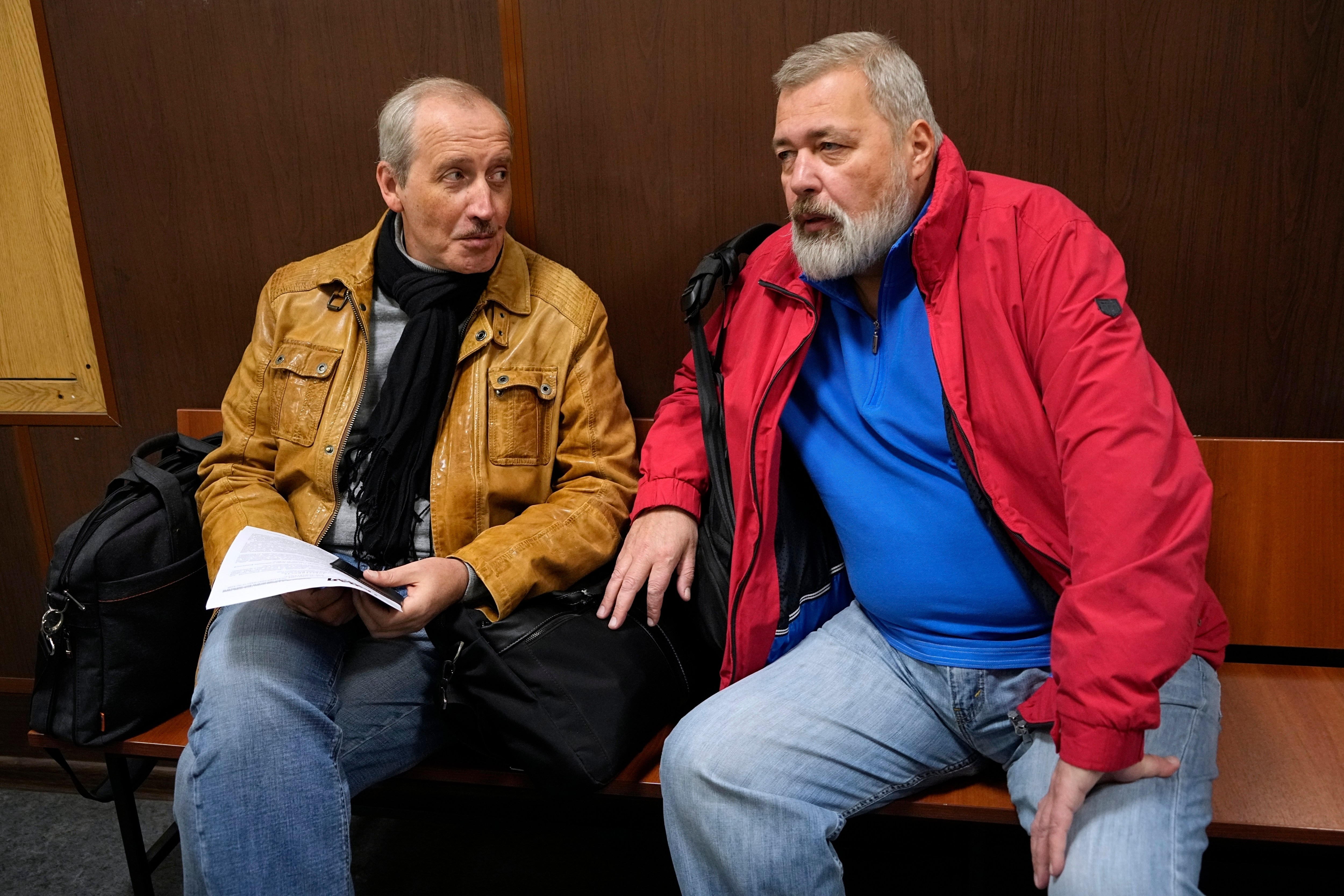
Nobel Peace Prize laureate and Moscow-based journalist Dmitry Muratov is careful about what he says and for good reason.
He was assaulted in 2022 with red paint laced with acetone, and he’s seen colleagues murdered or forced into exile and his newspaper shut down.
In a rare appearance in Washington, D.C. on Monday, he spoke about the human rights abuses Russian President Vladimir Putin’s regime is carrying out against political opponents and those critical of the war in Ukraine.
His Nobel recognition provides some protection in Putin’s Russia.
But Muratov is careful not to discuss how he continues to travel, speak abroad and carry out his journalistic work. He’s also careful not to share his opinion on global sanctions against Russia. Such remarks could see Muratov put behind bars with Russia’s approximately 1,400 to 1,700 political prisoners.
“My story is about putting the person at the center of things, at that point we can also start the process toward peace,” he told the small gathering in Washington.
The Ben Franklin Fellowship, an organization made up of current and former diplomats as well as international affairs experts who largely align with President Trump’s foreign policy, hosted the event in Washington on Monday. Muratov’s appearance comes during a flurry of activity in Washington surrounding Russia’s war in Ukraine. Congress passed legislation on Wednesday granting Trump tariff authorities against countries who purchase Russian energy.
And a major gathering of Russian dissidents and former political prisoners also took place this week. The Free Russia Foundation — founded by individuals the Kremlin has labeled extremists and terrorists — and the congressionally funded nonprofit National Endowment for Democracy hosted the “Washington Dialogue” conference in D.C.
In recognition of the Washington Dialogue, Sens. Roger Wicker (R-Miss.) and Jeanne Shaheen (D-N.H.) introduced a resolution Wednesday urging the State Department to work more closely with Russia’s opposition inside the country and in exile.
Muratov won’t be at the conference, however. Natalia Arno, president of the Free Russia Foundation, praised Muratov’s appearance in Washington and added she was careful not to approach him at the gathering. She wanted to avoid giving the Kremlin an excuse to accuse him of associating with “terrorists.”
“He’s really the most recognizable, most respected symbol of independent Russian journalism,” she said.
“Again, him still living and working inside Russia, it’s really a huge deal, and I think it also challenges Putin’s main narrative, that basically there is no opposition to him,” Arno added.
Trump has recently revived efforts to end Russia’s war in Ukraine as the U.S. war against Iran spirals and sends global energy prices soaring. Trump announced on Monday an effort to get both Moscow and Kyiv to halt attacks on each other’s energy facilities and stabilize oil prices.
The president’s top envoys for negotiations — his son-in-law Jared Kushner, and close friend and business partner Steve Witkoff — met Putin in Moscow earlier this month and made their first-ever visit to Kyiv to speak with Ukrainian President Volodymyr Zelensky.
In remarks at the Republican National Committee’s first-ever midterm convention in Dallas last week, Trump said Putin was willing to come to an agreement and blamed Zelensky as the obstacle. It was a swing back by Trump toward favoring Moscow after he had signaled greater support for Ukraine.
“I understand President Trump is trying to save Putin’s face, and he thinks that Putin will be more willing to do things,” Arno said. “I think it’s wrong to try to please the dictators, the dictator will never play according to civilized norms, according to civilized rule.”
Arno said that Russian society is brewing — not yet boiling — in its agitation toward Putin and the war in Ukraine, which has stretched on for more than four years, dubbed a “special military operation” by the Kremlin. Arno said this moment is important for the U.S. to engage with Russian civil society actors that are working to survive and be ready to act for a time when Putin is gone.
Activists are lobbying the Trump administration to demand the release of political prisoners inside Russia as a necessary first step. It’s a shrewd appeal to the president, who relishes the power of freeing people wrongfully imprisoned. He often boasts of his success in freeing a Christian pastor imprisoned in Turkey as well as aiding in the return of an estimated 100 Americans unjustly detained or held hostage and the release of hundreds of more political prisons in Belarus.
In August, Trump celebrated Russia’s release of American Robert Gilman after four years in detention. But Putin has yet to release American Stephen Hubbard, among other Americans detained in Russia.
“I want to say, let Witkoff and Kushner go to Moscow as much as possible, but why are they coming back with an empty plane? Why didn’t they bring anyone back?” Muratov said at the event.
In measured remarks — and contrary to Arno’s position — Muratov called for engaging Putin’s “friends,” like right-wing parties in Europe or U.S. officials who have expressed sympathy toward Russia, suggesting that Putin might be more open to ideas about ending the war coming from voices he doesn’t consider enemies.
“I addressed the right-wing parties in the European Parliament, and in America you have people who have views that are close to Putin, they can influence the decisions Putin makes,” he said.
Muratov called for the U.S. to push for a ceasefire between Russia and Ukraine, an exchange of prisoners of war and political prisoners, and a guarantee that there are no strikes during the winter — a particularly cruel Russian military strategy that froze Ukrainians in their home earlier this year.
Backing that call are two Russian Orthodox priests who refused to bless the Russian invasion into Ukraine.
Father Andrei Kordochkin and Father Valerian Dunin-Barkovsky are the founders of Peace Unto All, a Russian civic group that supports Russian clergy persecuted for their opposition to the war in Ukraine. They estimate dozens of church officials are jailed in Russia or the occupied territories, from the Orthodox church and other denominations.
Kordochkin and Dunin-Barkovsky, who live outside of Russia, came to the U.S. to attend the Washington Dialogue and accept an award from the National Endowment for Democracy for promoting freedom of religion. Their mission is countering Putin’s use of the Russian Orthodox Church to bless the war in Ukraine as a “holy war.”
“What the Russian state is not going to tolerate is any personal or institutional moral authority which is autonomous from the state. This is why we are dangerous,” Kordochkin said.
The Russian opposition is far from united, and Kordochkin said that Peace Unto All does not share all the same positions. But he said it’s important to stand together against Putin’s repression.
“We think it is important to be with these people because ultimately whether they are believers or not, the values we share of human freedom, of human dignity are the same for all of us.”
Topics in this story
Gathered from external sources. Rights to this text belong to whoever originally published it.