In 1994, Don Williams paid $1.35 million for 1.137 acres beside Maui's Maalaea Harbor; 32 years later, a Hawaii appeals court vacated a $7 million compensation judgment in the state's long-running eminent-domain fight
In August 1994, Don Howard Williams Jr. paid $1.35 million for roughly 1.137 acres of waterfront property beside Maui’s Maalaea Small Boat Harbor.
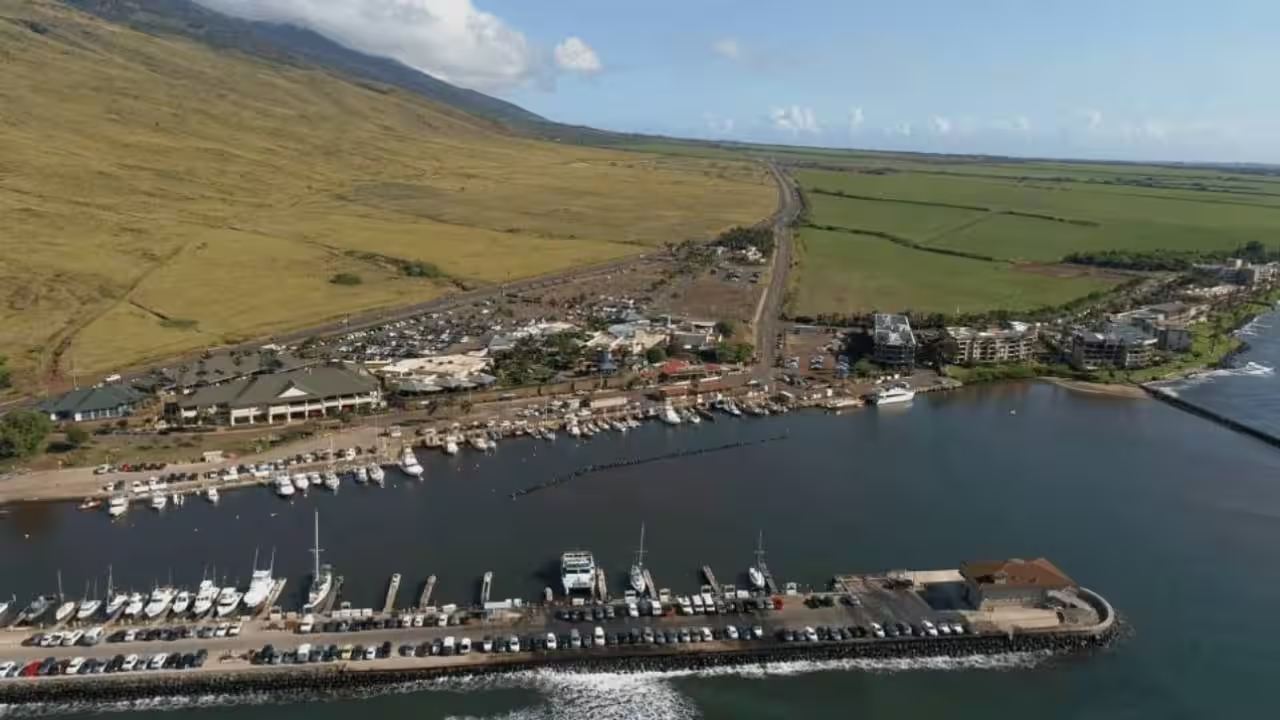
In August 1994, Don Howard Williams Jr. paid $1.35 million for roughly 1.137 acres of waterfront property beside Maui’s Maalaea Small Boat Harbor. Four weeks later, he entered into a 30-year lease with the State of Hawaii.More than three decades later, that property remains at the center of a prolonged legal battle over how much the state should pay after seeking to take the land through eminent domain.On September 30, 2026, the Intermediate Court of Appeals of the State of Hawaii vacated a 2025 Circuit Court order and final judgment that had granted Williams’ motion for summary judgment and determined that he was entitled to $7 million in just compensation based on the evidence before the lower court, according to court document published on Justia.The appeals court did not rule that Williams was not entitled to compensation. Instead, it found that the Circuit Court had improperly excluded evidence from the state’s expert appraiser and had erred in resolving the valuation dispute through summary judgment while competing evidence remained.The case was sent back to the Circuit Court for further proceedings.A $1.35 million purchase becomes a decades-long legal fightWilliams purchased the Maalaea property on August 4, 1994, from FSO Oklahoma Investments Corp., an entity connected to the Church of Scientology’s Flag Service Organization.The land had a complicated ownership history stretching back more than a decade before Williams’ purchase.In the late 1970s, two of the parcels that eventually became part of Williams’ property were acquired by Maalaea Landing Inc., which planned to develop a condominium project there.The development plans never came to fruition. After financial difficulties, the property was transferred to Pioneer Federal in 1981. It subsequently changed hands through a series of transactions involving private investors, Oceanfront Associates and entities connected to the Church of Scientology.By 1992, FSO Oklahoma Investments Corp. had acquired the parcels that would eventually form part of Williams’ property.Williams bought the land for $1.35 million in August 1994.Four weeks later, on September 1, the State of Hawaii entered into a 30-year lease with him.The state initially agreed to pay rent for the propertyThe lease provided Williams with a long-term income stream from the waterfront property.State payments began at approximately $150,000 a year in 1994 and had increased to around $350,000 annually by 2013.The arrangement changed in June 2013, when the State filed a complaint seeking to condemn the property rather than continue making lease payments.The state said it sought the property in connection with improvements to the adjacent Maalaea Small Boat Harbor.That condemnation action transformed the property’s lease into a legal dispute over how its value should be calculated.The central question became whether the value of Williams’ interest in the existing lease should be taken into account when determining the compensation owed to him.The state’s position on the lease changedThe State of Hawaii initially argued that the value of the lease should be considered when determining just compensation.When the condemnation case was filed in 2013, the state deposited approximately $4.17 million based on its estimated compensation for the property.The state’s appraisal at the time included the land and the value of the lease.But the state later changed its position and argued that the lease income should not be presented to the jury when determining the property’s value.The dispute became especially important because the lease was producing hundreds of thousands of dollars annually.Williams argued that excluding the economic value of the lease could prevent him from receiving the full compensation required when private property is taken by the government.2018 agreement set compensation at $4.165 million - subject to appealIn June 2018, before trial, the parties entered into a stipulation agreeing that just compensation for the property was $4.165 million.However, Williams expressly retained the right to appeal earlier rulings in the case.The agreement also stated that the parties would remain bound by trial-court rulings that were not subsequently reversed or vacated by an appellate court.That provision became central to the latest appeals court decision.Earlier appeals court ruling reopened the valuation disputeThe case reached the Intermediate Court of Appeals previously.In April 2024, the appeals court ruled that the Circuit Court had abused its discretion by excluding evidence concerning the leased interest.The court held that evidence relating to possible future lease income could be presented in determining the property's value.The Hawaii Supreme Court later rejected applications from both the state and Williams seeking further review.The case then returned to the Circuit Court.Williams sought $7 million in compensationBack in the Circuit Court, Williams filed a motion for summary judgment in February 2025.He argued that the property interest he owned on June 27, 2013, the statutory valuation date, was worth $7 million.Williams relied on an appraisal by his expert, R.W. Spangler, and argued that the income-capitalization method was the appropriate way to value the leased property interest.The state filed its own motion for partial summary judgment in March 2025.It argued that the comparable-sales approach should be used instead.The Circuit Court ultimately granted Williams’ motion and denied the state’s motion.That decision led to the latest appeal.Appeals court says state’s expert evidence should have remained admissibleThe state raised three main arguments before the Intermediate Court of Appeals.It argued that the Circuit Court had wrongly granted summary judgment when material facts remained disputed, improperly excluded the state’s expert appraisal and wrongly determined that the income-capitalization method should be used instead of comparable sales.The appeals court agreed that the Circuit Court had erred.A key issue was the state’s expert, James Hallstrom.In earlier proceedings, the Circuit Court had ruled that Hallstrom could testify as a valuation witness for the state. That ruling had not been reversed or vacated.Under the parties’ 2018 stipulation, the appellate court said, Williams remained bound by that ruling.“Because the 2018 Stipulation bars Williams from arguing the Hallstrom report should be excluded, the Circuit Court erred by excluding it,” the appeals court ruled.The court said the competing valuations meant Williams’ motion had not established that there was no genuine issue of material fact.As a result, the Circuit Court should not have granted summary judgment in his favor.Court says there is no single valuation methodThe appeals court also addressed the dispute over how the property should be valued.Williams argued that the earlier appellate decision meant the income-capitalization method was controlling because the property had generated actual lease income.The state argued that comparable sales should be used.The appeals court said evidence based on income capitalization was admissible, but that did not make comparable-sales evidence automatically inadmissible.The court noted that the earlier decision had not established that comparable sales were invalid.“If an appraisal relied upon sales of similarly encumbered property, a jury could find the appraisal was reasonable,” the court said.Differences between the properties and their lease encumbrances, it added, would go to the weight of the evidence rather than its admissibility.Property had been sitting largely undevelopedThe legal battle has also drawn attention because of the property's location and its use.The Maalaea property sits beside the small boat harbor on Maui’s South Shore.Historical accounts describe the land as prime waterfront property that remained largely undeveloped for years.Williams had long been familiar with the area. He began visiting Maui in the 1970s and later lived in Maalaea, where he rented a condominium.He recalled regularly seeing the vacant property next to the Maalaea Mermaid and wondering why it had not been developed.When the land went up for sale in the early 1990s, Williams said he immediately saw an opportunity.He described the property as a “mini-Ilikai,” referring to the landmark Ilikai hotel in Honolulu.The lease became increasingly valuableWilliams’ lease with the state was structured around the market value of the waterfront property and prevailing rental rates in Maalaea.As property values increased, so did the state’s payments.The annual rent rose from approximately $150,000 when the lease began to around $350,000 by 2013.That income became the heart of the dispute over just compensation.Williams argued that the economic value of the lease represented an important component of what he owned when the state moved to condemn the property.The state eventually argued that the jury should instead focus on the value of the underlying property without separately considering the lease income.Condemnation triggered the valuation battleThe state's condemnation complaint was filed on June 27, 2013.The lease contained a provision under which the agreement would terminate if the property were condemned.The state therefore sought to acquire the land rather than continue making lease payments.But the question of what Williams was entitled to receive remained unresolved.The dispute has moved through the Circuit Court, the Intermediate Court of Appeals and the Hawaii Supreme Court system for years.The latest ruling does not settle the amount of compensation.Instead, it reopens the valuation process by requiring the Circuit Court to consider the evidence that had previously been excluded.What happens nextThe September 30 appeals court ruling vacated the Circuit Court’s April 2, 2025 order and July 9, 2025 final judgment and remanded the case for further proceedings.That means the $7 million figure that Williams successfully obtained in the Circuit Court is no longer the operative final judgment.The lower court must now reconsider the case in light of the appellate ruling, including the competing appraisals and the permissible valuation methods.The income-capitalization approach can be considered because the property generated actual lease income, but the comparable-sales approach can also be presented.The ultimate amount of compensation remains unresolved.You use AI every day. Now get your AI Quotient. Take the AIQ test.
Topics in this story
Gathered from external sources. Rights to this text belong to whoever originally published it.