In 1865, settlers left rabbits on Enderby Island as food for castaways; 127 years later, the isolated population had developed into a distinct rabbit variety
Rest of World News: Discover the fascinating journey of Enderby Island rabbits, introduced in 1865 as food for castaways, and their evolution into a unique variety facing extinction due to conservation challenges.
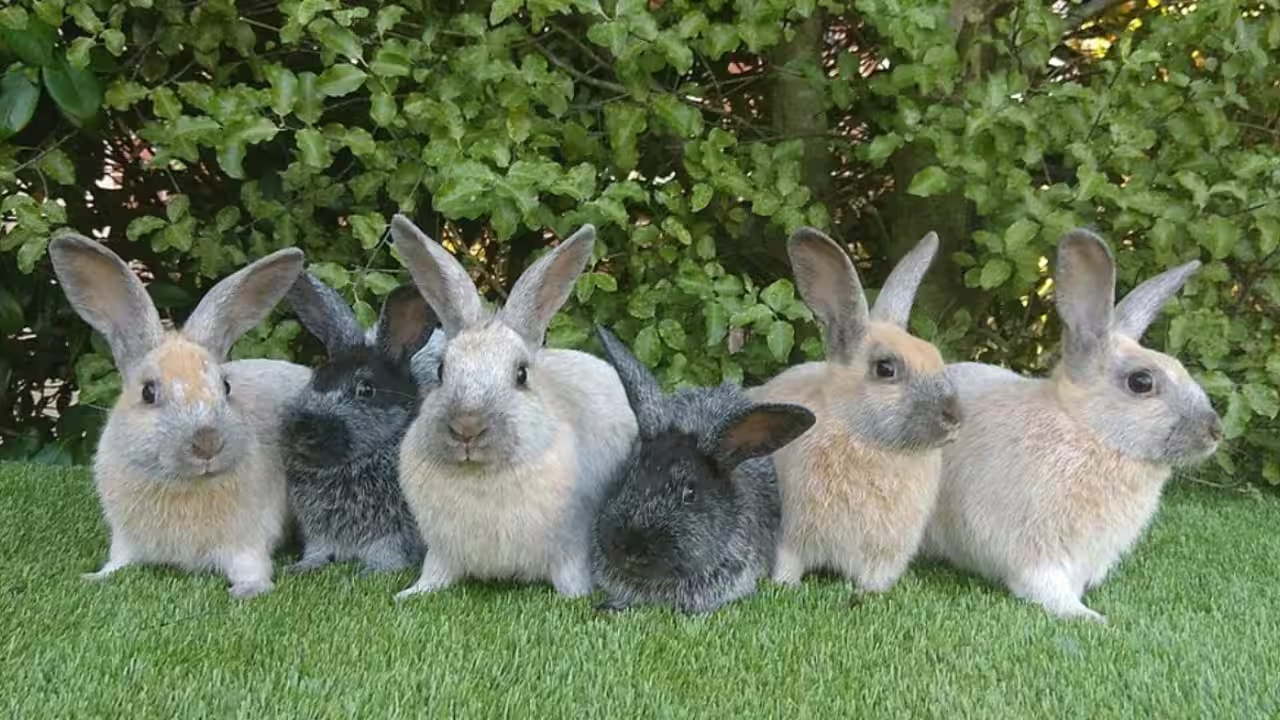
Rabbits were deliberately released on New Zealand’s remote Enderby Island in October 1865 to provide a potential food source for people who might be shipwrecked in the subantarctic Auckland Islands. The animals were brought from Australia and released in the hope that a breeding population would establish itself. Ultimately, the species survived there for 127 years. They also developed distinctive characteristics after being isolated from the mainland rabbit populations.Enderby Island is the northernmost island of the Auckland Islands group, and it offered an unusually harsh environment for a domestic animal population. The introduced species survived in the cold, wet and windy conditions with no regular management from humans. New Zealand’s Te Ara encyclopedia, using the materials provided by the Department of Conservation, shared that the rabbits were likely descended from British silver-grey rabbits and developed over those 127 years into a distinct population with a silver-grey coat and dark slate-blue undercoat.Due to the isolation, the generations produced looked sufficiently different from ordinary wild rabbits that are found on the mainland. Enderby rabbits are usually moderate-sized animals weighing around 2kg. Most of them had a striking silver-grey appearance. Their heads, ears and tails were relatively darker, sometimes almost black.A rare population turned into an ecological challengeThe isolation that played a role in making the rabbits scientifically and genetically interesting also made them a part of a growing conservation challenge. By the late 20th century, New Zealand authorities were trying to remove introduced mammals from the Auckland Islands because of the effect they had on native vegetation and wildlife. The Enderby rabbits were thus caught between two competing conservation priorities: preserving a genetically distinctive population and restoring an ecosystem from which introduced mammals were removed.A 1995 IUCN report detailed how the rabbits’ extensive burrowing systems were considered a threat to Hooker’s sea lions, as the burrows could potentially trap and suffocate pups. The report detailed how an eradication effort was later executed in 1993, using poison bait followed by hunting over several months. This conservation dilemma was created by the rabbits’ genetic value and the absence of another known wild population of the type.By 1991, estimates suggested that thousands of rabbits remained on the island, and a later review of the eradication programme recorded an estimate of approximately 5,000-6,000 animals at the time. The DOC had reportedly already carried out poison-bait trials in 1991 and 1992 before they decided to proceed with eradication as part of their programme to remove the introduced species from the island.The eradication programme, however, did not allow the distinctive population to disappear completely. The Department of Conservation worked with the Rare Breeds Conservation Society of New Zealand before the eradication began to capture a representative group. In September 1992, 50 rabbits were captured, with 49 surviving the transfer to the mainland. Those animals subsequently became the foundation of a managed breeding population.The rescue before complete eradication The following year, the remaining rabbits on Enderby Island were eradicated. The operation was conducted as part of a bigger effort to restore the Auckland Islands by removing introduced mammals. As per the government records, the eradication operation ran from February to May 1993, and subsequent monitoring completed by February 1994 found no evidence of rabbits remaining on the island or nearby Rose Island.The 1992 capturing of the rabbits therefore meant that the ecological restoration of Enderby did not necessarily put a complete end to the unusual rabbit population. The New Zealand Journal of Ecology notes that breeding groups representing the Enderby rabbits are still maintained in New Zealand. However, their numbers have remained below the level considered necessary to guarantee the breed’s long-term survival.Today, the Enderby Island rabbits survive on the mainland instead of living in the harsh island environment that once isolated and preserved their distinctive genetic legacy. For over thirty years, dedicated breeding programmes have been responsible for breeding programmes are now involved in maintaining the population.Catch the latest World News and Live updates. Download the TOI app.
Topics in this story
Gathered from external sources. Rights to this text belong to whoever originally published it.