In 1903, 110 million tonnes of rock buried a Canadian town in under 2 minutes; much of it remains buried today
Rest of World News: At 4:10 AM on April 29, 1903, the eastern face of Turtle Mountain in southwestern Alberta suddenly broke apart and came crashing down toward the small.
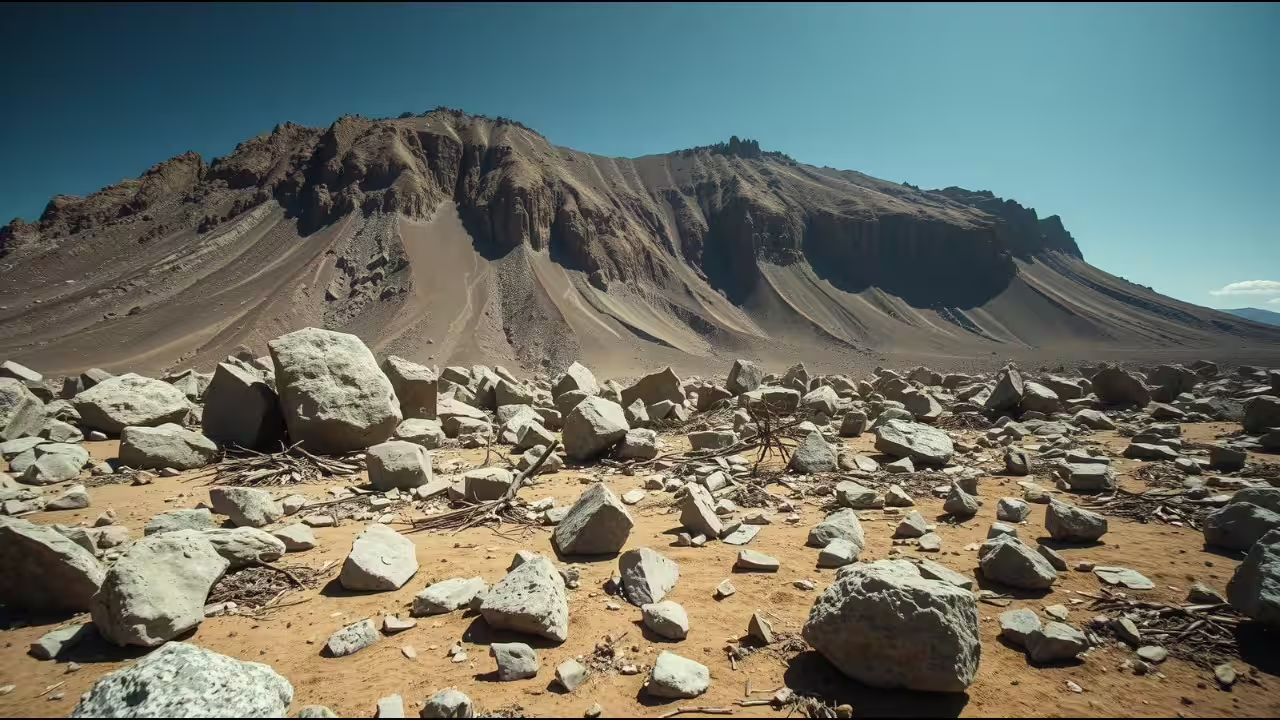
At 4:10 AM on April 29, 1903, the eastern face of Turtle Mountain in southwestern Alberta suddenly broke apart and came crashing down toward the small mining town of Frank below. In less than 2 minutes, an estimated 110 million tonnes of limestone, according to the Frank Slide Interpretive Centre, tore across the valley at speeds estimated at 70 to 75 miles per hour, burying buildings, railway tracks and part of the town beneath a huge field of shattered rock. Frank was home to around 600 people, with roughly 100 living directly in the path of the slide. Between 70 and more than 90 people are believed to have died, although only a small number of bodies were recovered. The disaster became Canada's deadliest recorded rockslide, and more than 120 years later, the remains of the original settlement are still buried beneath the rubble. The mountain itself was permanently changed, leaving behind a scar that remains visible today.How a section of Turtle Mountain buried 3 square kilometres of AlbertaThe rock that came down that morning was enormous. According to the Frank Slide Interpretive Centre, the failed section of Turtle Mountain was approximately 1 kilometre wide, 425 metres high and 150 metres thick. It consisted primarily of Livingstone Formation limestone that had formed more than 300 million years ago, when the region was covered by a shallow ancient sea. When the rock mass broke away, it did not simply fall vertically. It accelerated down the mountain and spread across the valley floor, covering approximately 3 square kilometres. The debris reached an average depth of around 14 metres, with some areas buried as deeply as 45 metres.The material varied enormously in size, from fine particles to enormous boulders. Some of the largest blocks were estimated to be around 40 feet across. The force of the moving rock was so great that when the debris hit the softer sediments of the Crowsnest River valley, the ground itself was disturbed and displaced, allowing the slide to spread farther across the valley. For people living in Frank, there was almost no warning. The collapse happened before dawn, when most residents were still inside their homes. Within moments, an enormous section of the mountain had crossed the valley.Why nobody knows exactly how many people died at FrankThe precise death toll has never been established. Estimates generally place the number somewhere between 70 and more than 90, but the uncertainty exists because so many victims remained trapped beneath the enormous rock field. Only a fraction of the bodies were recovered. Depending on the historical source, between 12 and 18 bodies were eventually found, leaving many victims permanently buried beneath the debris. The timing of the collapse may have saved hundreds of other residents. Although around 100 people were believed to be in the direct path of the slide, many of them lay outside the area that was buried. The disaster therefore devastated part of the town without completely destroying the entire community.The collapse was also extraordinarily loud. Contemporary accounts and later historical records describe the sound travelling an enormous distance, with reports that it could be heard roughly 200 kilometres away. Survivors described the noise and movement as resembling an enormous explosion or a tremendous rushing force. The physical appearance of Turtle Mountain changed just as dramatically. The collapse removed a large section of the eastern face and left the mountain divided into two prominent peaks, creating the distinctive landscape visible around Frank today.Why geologists continue watching Turtle MountainThe 1903 disaster did not end the geological story of Turtle Mountain. The mountain remains heavily fractured, and scientists have continued studying its structure and monitoring movement in the years since the slide. Geologists with the Alberta Geological Survey have examined cracks, rock movement and other signs of instability to better understand how the mountain behaves. The original collapse exposed geological features that had previously been hidden, including rock formations and a coal seam, providing researchers with an unusual opportunity to study the mountain's internal structure.A future rockfall from Turtle Mountain is considered possible because of the mountain's fractured geology, but that does not mean another disaster on the scale of 1903 is imminent. Any future collapse would depend on which section of rock failed and how that material moved. Scientists therefore monitor the mountain not because another massive slide is expected at any specific time, but because understanding its instability is important for the communities and infrastructure below. The lessons from Frank have also become important far beyond Alberta. The disaster demonstrated how quickly a seemingly stable mountainside can fail and how far enormous quantities of rock can travel once a collapse begins.What remains of Frank beneath the rock field todayFrank itself survived the disaster, although the slide permanently changed the community. Some residents eventually left because they feared another collapse, while others remained and rebuilt their lives around the enormous boulder field that now dominates the landscape. Highway 3 passes through the area today, winding through and around the rocks left behind by the 1903 collapse. Huge limestone blocks remain scattered across the valley, providing a physical record of the scale of the event more than a century later.The Frank Slide Interpretive Centre, overlooking the debris field, preserves the history of the disaster through geological exhibits, historical records and accounts from the people who experienced it. The site also helps explain a detail that is sometimes lost when the story is retold: the entire mountain did not collapse, and the entire town of Frank was not buried. Instead, a massive section of Turtle Mountain failed in a matter of seconds, sending enough rock into the valley to destroy the part of Frank directly in its path. More than a century later, much of that material remains exactly where it came to rest.Catch the latest World News and Live updates. Download the TOI app.
Topics in this story
Gathered from external sources. Rights to this text belong to whoever originally published it.