A 19th-century Colorado mining town was abandoned; a German investor bought the entire ghost town in the 1990s and spent decades rebuilding it
US News: Dunton Hot Springs in southwestern Colorado is a rare place where a deserted mining town became a luxury retreat without losing its frontier character.
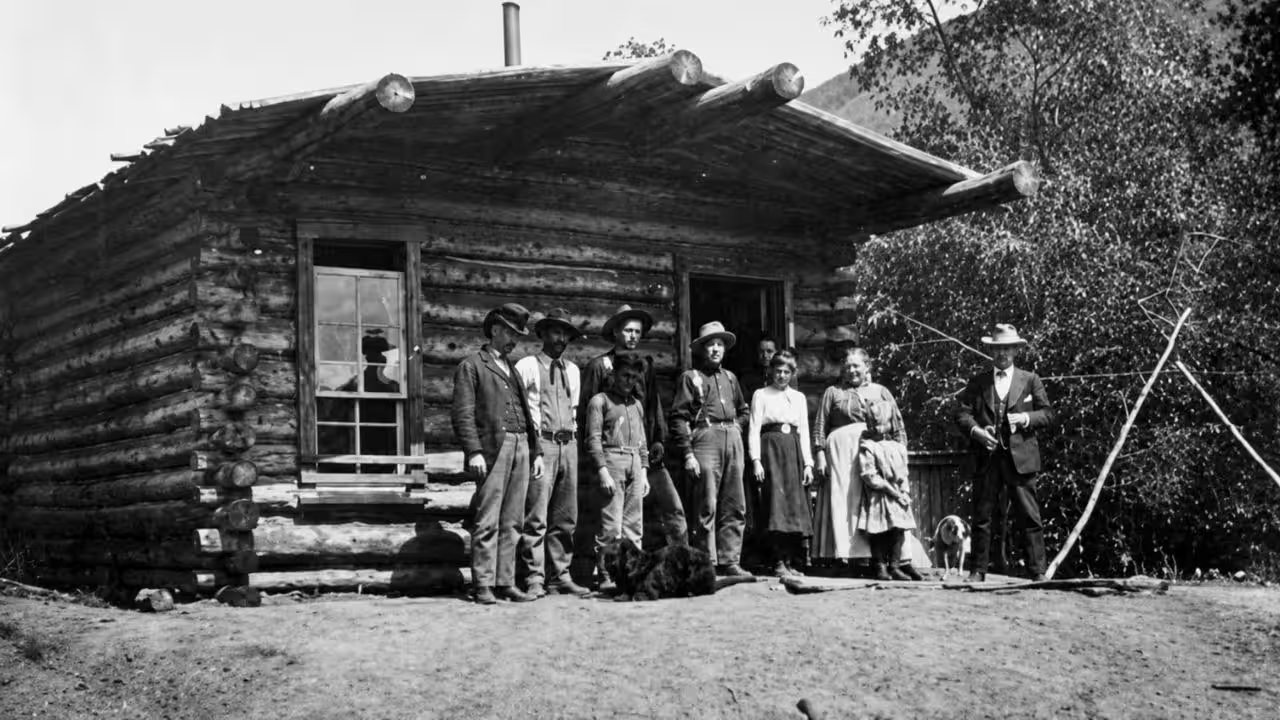
Dunton Hot Springs in southwestern Colorado is a rare place where a deserted mining town became a luxury retreat without losing its frontier character. Founded in 1885, Dunton was once a small mining settlement in the San Juan Mountains before it was largely abandoned in the early 20th century. Decades later, German investor Christoph Henkel bought the entire ghost town in the 1990s and began an ambitious effort to bring its buildings, hot springs and history back to life. The result is ‘Dunton Hot Springs,’ a secluded resort made from restored cabins and historic structures. Its story is not simply about turning old buildings into expensive accommodation. It is about carefully reshaping a forgotten community while keeping enough of its original character to make the past feel surprisingly close today.19th-century mining settlement turning into a ghost townDunton began in 1885 as an unincorporated mining town in the remote mountains of southwestern Colorado. Like many settlements created around mining, its fortunes were closely tied to the search for valuable minerals. According to the MICHELIN Guide, the town eventually emptied as miners and their families moved towards areas with better access to the railway system. By the early 20th century, Dunton had largely become a ghost town. Yet its buildings and hot springs prevented the site from disappearing completely. The natural springs remained an important part of its identity, providing warm mineral-rich water in a remote mountain setting. The town also passed through several unusual chapters before its luxury revival. The MICHELIN Guide reports that Dunton later became a makeshift tourist camp and, during the 1970s and 1980s, was associated with a hippie community. By the time Henkel acquired the property in the 1990s, many of the buildings had been left abandoned.What happened after Christoph Henkel bought the ghost townThe transformation began when German investor Christoph Henkel bought the entire ghost town during the 1990s. Instead of clearing the site and constructing a conventional resort, he and his team chose to work with what remained. ‘Emerald Coast Magazine’ describes Henkel's project as a decade-long effort to restore, reuse and resurrect the old frontier settlement. Salvageable elements were preserved, while historic structures from other parts of Colorado were also brought to the property. The approach meant Dunton Hot Springs was never intended to be a perfect museum reconstruction. The MICHELIN Guide explains that buildings were sometimes taken apart, their logs numbered and then put back together. Some structures were also moved closer together to create a more practical village layout around the saloon. The resort was not trying to pretend that nothing had changed since the mining days. Instead, it created a modern retreat that openly blended old and new.Remains of the original 19th-century mining settlementEmerald Coast Magazine reports that the resort occupies the footprint of the original 1885 settlement and includes 14 log cabins. Some were built by miners in the late 19th century. The Dunton Store, for example, remains on its original 1887 site. The buildings also contain reminders of the town's past. The MICHELIN Guide highlights the old saloon, where a signature attributed to ‘Butch Cassidy’ remains on the bar. Other historic objects have been incorporated into the resort, including a ‘copper tub’ from the town's former brothel. Not everything came from Dunton itself. According to the MICHELIN Guide, the ‘Pony Express building’ now used for spa and yoga facilities came from Colorado Springs, while another cabin was moved from Parachute, more than 200 miles away. These additions were chosen to fit the period, helping create a coherent frontier setting without pretending every building originally stood there.What makes Dunton Hot Springs feel like a luxury hotelAccording to Emerald Coast Magazine, cabins feature thick robes, fireplaces, distinctive furniture and private bathrooms. Major Ross, for example, has a wood-burning fireplace, a king bed and a barrel soaking tub, while the historic setting remains visible through its design. The saloon and dance hall have also become important communal spaces. According to ‘MeetingsMags,’ that the property recently completed a multimillion-dollar renovation that began in late 2022. The work included guest cabins, communal spaces, the Saloon and Dance Hall, and the Potter House. One of the restored cabins, Chuck's, is more than 130 years old. It was updated with hand-hewn log walls, custom furniture, a wood-burning stove and four bedrooms. The renovation was designed to give the old buildings new life rather than erase their character.Present reality of Dunton Hot SpringsThe latest restoration has strengthened the balance between history and modern hospitality. MeetingsMags reports that the three-year renovation was completed in January 2026, with the Potter House among the final areas completed. The result is a place where the remains of a mining town have become part of an entirely different kind of life. Guests can eat in the old saloon, sleep in restored cabins, soak in the same hot springs that helped define the settlement and walk through a landscape that has changed remarkably little. Dunton's story is therefore less about rebuilding a ghost town exactly as it once was and more about giving an abandoned place a second life. What began as a remote mining settlement in 1885 eventually became a luxury hotel, proving that sometimes the most remarkable new destinations are created by preserving what history left behind.Catch the latest World News and Live updates. Download the TOI app.
Topics in this story
Gathered from external sources. Rights to this text belong to whoever originally published it.