Buildings damaged in Israeli bombings risk collapse as rain inundates Gaza
Floods have swept through Gaza after heavy rain, endangering families and putting war-damaged buildings at risk.
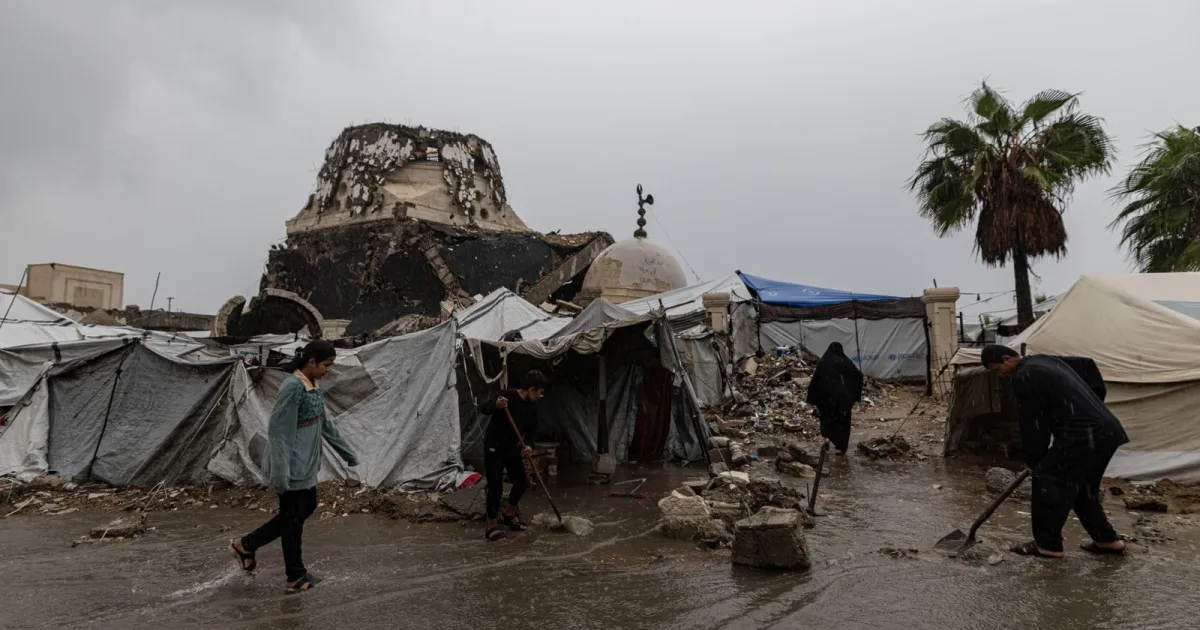
Gaza City – Rana Adnan Hmeida, 29, stands at the entrance to her tent in al-Mina camp in northern Gaza, holding her two-month-old daughter as she tries to keep her warm after rainwater has flooded their shelter overnight. The family’s bedding, blankets and clothes are all soaked, with her children exposed to the cold and wind of Gaza’s latest storm.
Hmeida, her husband and children have been awake since midnight as heavy rain and strong winds swept through the camp. Water seeped into the tent and drenched their belongings. With all their clothes wet, Hmeida had to ask neighbours to help dry their clothes.
“Since midnight, we have been sitting awake. Water came into our tent, and the bedding, blankets and everything else got soaked. In the morning, I found my son and little daughter shivering. My two-month-old baby was freezing,” Hmeida told Al Jazeera.
“What am I supposed to do? Hold my children or try to stop the water? I was trying to keep them warm while carrying my little girl, but the water kept coming in. The wind was so strong that we felt the tent was about to be ripped out of the ground.”
Her husband, Sameh Hmeida, 30, said the family’s tent is particularly exposed due to its close proximity to the sea. It has no tarpaulins or insulating materials that might have helped in the storm.
Heavy rain has flooded camps and cities across Gaza over the past days, where many Palestinians are spending the fourth winter outside their homes since Israel began its genocidal war on the enclave in October 2023.
Water levels have risen by 30 to 40cm (12 to 16in) at several camps in Gaza due to Saturday’s rain, with Gaza’s civil defence agency receiving hundreds of calls.
Rainwater has flooded many tents in al-Mina camp, where about 1,700 Palestinian families live, turning the ground into pools of muddy water.
Raed Abu Amsha, 40, said his tent collapsed on top of his family during the storm. The clothes and blankets of all nine children in his care, four of them from his late brother, were soaked.
“I am responsible for orphans as well as my own children, and I cannot provide for their needs. This storm lasted only two hours, and look what it did to us. We need tents, tarpaulins and anything that can protect our children. How long are we going to keep living like this?” he said.
In Nuseirat, a decades-old camp in central Gaza with permanent structures, rainfall also threatens families living in buildings damaged by Israeli bombardments.
Nasser al-Hajj, 54, lives in a tower block that was hit in an Israeli strike in September 2025. Debris from upper floors fell onto his home, leaving a large hole in the ceiling where water now enters every time it rains.
Although the ceiling has been reinforced with support beams, an engineer has warned al-Hajj that the apartment is dangerous, with the risk of further rubble falling from the building if more bad weather hits Gaza.
During the latest storm, al-Hajj took his children to a neighbour’s home and waited for the debris to stop falling from the roof. Two of his children, who have autism, sleep in the tower block’s guard room, away from the damaged area.
“I am forced to live somewhere that could collapse over our heads at any moment. But where am I supposed to go? Rent is expensive, and a tent is not safe either,” he told Al Jazeera. “I know how dangerous this place is, but I have no other option,” he added.
According to the United Nations Office for the Coordination of Humanitarian Affairs (OCHA), about 950,000 displaced people in Gaza are living in areas exposed to flooding. Low-lying locations and sites near the coast are particularly vulnerable, with more than 400,000 people living in areas considered at high risk of flooding.
About 44,000 Palestinians are living in structurally unsafe buildings, while more than 4,000 buildings across the territory are estimated to require full or partial demolition due to damage caused by Israeli air strikes. About 294,250 families need shelter assistance ahead of winter, but the available supplies cover only 18 percent of their needs.
The Gaza Municipality is also struggling to respond to the storms. About 15 kilometres of rainwater drainage lines and 212 kilometres of sewage networks have been damaged. Eight pumping stations and three main stormwater collection basins are out of service.
The remaining system can handle no more than 20 percent of rainwater under the best of circumstances, according to municipality spokesperson Hosni Muhanna.
“[We] continue to clean drainage systems in preparation for the rainy season,” Muhanna said.
The municipality has deployed workers to clean drains and manholes, remove rubbish and clear water channels, repair damaged sections of drainage lines and operate water pumps.
But Muhanna warns that these efforts cannot restore the network’s capacity amid shortages of fuel, equipment and spare parts.
More than 2,000 buildings in Gaza City alone are at risk of collapse, he said, and the volume of rubble in Gaza City has exceeded 25 million tonnes.
Emergency committees in displacement camps are also struggling with shortages of shelter supplies. Adli Awad, an official with the emergency committee in Nuseirat refugee camp, said his team is trying to distribute tents and tarpaulins, particularly to families affected by the rain. But the number of people in need far exceeds available stocks.
“We are trying to provide as many tents and tarpaulins as possible. We are also helping families dig channels to divert rainwater away from tents and reduce flooding,” Awad said.
Topics in this story
Gathered from external sources. Rights to this text belong to whoever originally published it.