In 1985, a 10-year-old threw a message bottle into the Atlantic; 37 years later, a Florida family found it and mailed his childhood note back to him
In a touching tale of nostalgia and ocean magic, a Kentucky man receives his long-lost childhood note after it was discovered in a bottle washed ashore by Hurricane Nicole. The story highlights the enduring connection between children’s dreams and the vastness of the ocean.
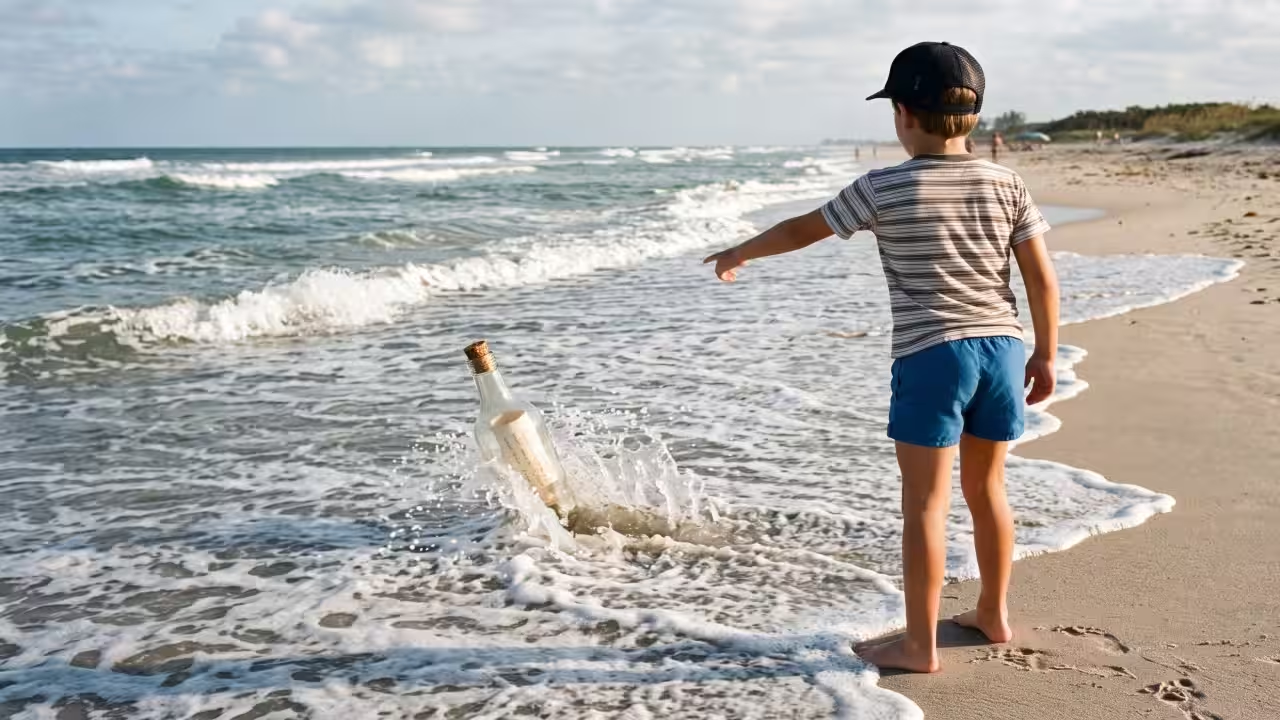
For generations, kids on beach vacations have tried the same straightforward experiment. Half expecting the sea to take their words to some far stranger, they scribble a little letter, fold it inside a bottle, and hurl it into the waves. Most of these bottles are lost at sea, buried in sand, or broken against rocks. Occasionally, however, a child's note reappears decades later and reaches someone who has long forgotten who wrote it. That's precisely what happened to a Kentucky man whose message drifted in the Atlantic for 37 years before a family on the Florida coast found it and traced it back to him.A childhood note sealed in glassIt was 1985, and ten-year-old Troy Heller was on a family holiday in Vero Beach on the Atlantic coast of Florida. He wanted to attempt something he had never done before. He scribbled a brief letter, asking whoever found it to call or write him, included his contact details, put the paper in an old glass Pepsi bottle and tossed it into the sea. It was the kind of modest, hopeful gesture most children make and then forget about. Heller was no exception. He grew up and resided in Mount Washington, Ky, and never gave the bottle another thought.Way before satellites, government scientists used this precise kind of sealed bottle to investigate how water travelled over the oceans, a procedure with a remarkably deep institutional history. Agencies in the United States have cast thousands of drift bottles into the sea since the eighteenth century, requesting finders to report the date and site of discovery so researchers may chart ocean circulation, as the NOAA Ocean Service has detailed in its archives. Some of those scientific bottles floated back up after decades at sea, a chronology not far different from what Heller’s personal note would eventually undergo.The storm brings the past ashoreThe bottle’s reappearance coincided with one of the more odd weather phenomena of 2022. That November, Hurricane Nicole hit the coast near Vero Beach, another uncommon late season storm, and only the third hurricane on record to strike the US mainland in November, after the 1935 Yankee Hurricane and 1985's Hurricane Kate. Beaches all along Florida's eastern coast, including parts badly ravaged weeks earlier by Hurricane Ian, churned up in the storm and dislodged all manner of long-buried debris.Heller's bottle was among the objects that came ashore, recovered on a beach near Sebastian, Florida, about 13 miles north of where it was first tossed. The Carrmax family discovered it while helping to remove storm debris. They opened the bottle and found a legible note with a phone number attached, then set out on a quest to track down its author. Their investigation took them right to Heller in Kentucky, who was shocked to be shown evidence of something he had done as a boy and never expected to hear about again.Most message bottles are never recovered at all, lost to the sea long before anyone finds them. It counts as a statistical rarity, not a common occurrence: a glass bottle that survives nearly four decades of tides, storms and salt water, only to be found by people determined to track down a stranger a thousand miles away.Today’s floating bottles and the quiet scienceHeller’s account is somewhere between folklore and a very real branch of oceanography that’s still going on now, just with far more powerful instruments. Researchers no longer use glass vials for this kind of work. Instead, they use satellite-monitored buoys that work on the same basic idea but automatically communicate their position, delivering real-time information to weather and climate models. Today, NOAA’s Global Drifter Program has more than a thousand of these buoys drifting around the world’s oceans at any given moment, and the data they produce helps forecasters understand everything from surface currents to the behaviour of storms like Nicole.His bottle was never going to be a scientific instrument but a child's secret hope that someone, somewhere, would read his words. But it travelled the same secret routes that buoys and research vessels take every day, showing in the most personal way imaginable exactly how far and how long the ocean can carry something little. Nearly forty years later that same interest came back to him, brought home by a hurricane and a family of strangers who thought to look a little harder at what the storm had left behind.You use AI every day. Now get your AI Quotient. Take the AIQ test.
Topics in this story
Gathered from external sources. Rights to this text belong to whoever originally published it.