In 2012, New Zealand built a floating wetland with 20,000 native plants and nearly 500,000 recycled bottles; it was expected to remove five tonnes of lake nutrients yearly
Rest of World News: Discover how New Zealand's unique floating wetland, built with 400,000 recycled plastic bottles and 20,000 native plants, helps to tackle nutrient pollution in Lake Rotorua. Learn about its impact and innovative design.
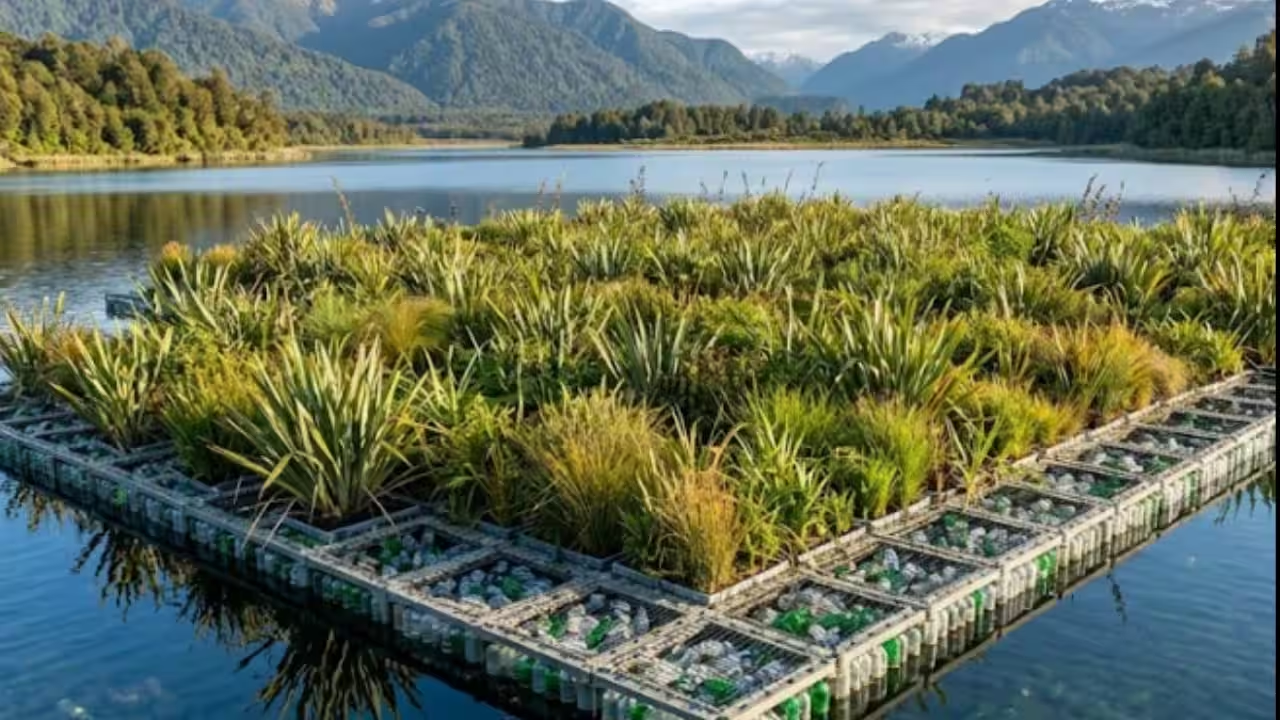
Lake Rotorua has a nutrient problem. More than 750 tonnes of nitrogen wash into the lake every year, much of it from farm runoff and old septic systems, feeding the kind of algae blooms that turn clear water into green scum, as NIWA's reporting on the Rotorua lakes clean-up describes. Fixing that meant more than just tightening farm rules. In 2012, local authorities tried something unusual: they built an island out of rubbish and let plants do the cleaning.A 4,000-to-5,000-square-metre wetland built from half a million bottlesA huge artificial island was constructed at Sulphur Point on Lake Rotorua that, when completed in 2012, was said to be the world’s biggest artificial floating wetland. Constructed out of around half a million recycled plastic bottles and filled with approximately 20,000 native plants, the project ran for nearly ten years before being taken apart due to storms and the expiration of its consent. The modules were connected and forced into rows 'like knitting a scarf,' noted one of the council managers, until the structure filled a 160-by-40-metre footprint, large enough to spell out the letters of 'Rotorua' in floating form; because the letters didn't fill that whole rectangle, the actual planted area came to between 4,000 and 5,000 square metres, according to the Rotorua Lakes Council. The base of the island is a fibre mat formed from what was originally reported as more than 400,000 used plastic soft drink bottles, a figure Rotorua Lakes Council later revised upward to nearly half a million; once this base was constructed, some 20,000 native plants were sewn onto it by hand. This project was conducted as a collaboration between the Rotorua District Council, the Bay of Plenty Regional Council and the Te Arawa Lakes Trust and had two objectives: one, to enhance the quality of water in Lake Rotorua, and two, to fulfill the terms of environmental consent for compensation for the loss of wetland areas due to the expansion of the city’s airport runway.The use of plastic bottles as a floating platform is not merely a cheap gimmick for creating buoyancy. It allows the roots of the plants to remain hanging downward and immersed in the lake water instead of staying in the soil. This means that the entire island floats on the surface of the lake like a floating planting raft. Unlike a traditional bog, the island rises and falls with water levels without artificial support.Four tonnes of nitrogen and one tonne of phosphorus a yearThe basic promise of the project involved nutrient removal, and the figures supporting this were precise. According to a 2013 government statement from then Environment Minister Amy Adams, the wetland contained 20,000 native plants and more than 400,000 recycled plastic bottles, a figure Rotorua Lakes Council later revised upward to nearly 500,000. When fully grown, it was expected to remove four tonnes of nitrogen and one tonne of phosphorus from the lake each year. It is just one piece of the roughly 750 tonnes of nitrogen that enters the lake each year, and it is not intended to address the problem by itself. It's combined with other measures such as sewage treatment, sediment covering, and stream diversion, all done within the same restoration programme.One piece of a $72.1 million restoration programmeThe floating wetland in Rotorua is not the only wetland of this kind. It was preceded by the construction of another wetland in Lake Rotoehu that used approximately 364,000 bottles, and the floating wetland in Rotorua was constructed within a $72.1 million deal by the government, which had the objective of cleaning up four of the most contaminated lakes in the region: Rotorua, Rotoiti, Ōkāreka, and Rotoehu. The completed structure, about the size of a rugby field, was assembled at Sulphur Point and moored there for a few months to let its plants and root systems establish. It was then towed roughly five kilometres across the lake to its permanent mooring near the airport, where it remained for the rest of its lifespan.The structure was eventually dismantled after close to a decadeStorms in later years damaged sections of the structure, breaking pieces loose and stripping away foliage that had to be replanted. After nearly a decade of operation, the structure was dismantled and restoration efforts shifted to land-based wetlands. Even so, the bottle island turned hundreds of thousands of bottles that might otherwise have gone to landfill into a tool for reducing nutrient pollution in a lake that had been declining for decades.Catch the latest World News and Live updates. Download the TOI app.
Topics in this story
Gathered from external sources. Rights to this text belong to whoever originally published it.