Uruguay planted eucalyptus and pine forests across grasslands; 20 years later, scientists found rivers were carrying much less water
Rest of World News: Across Uruguay, large areas of traditional grassland have been converted into managed forests, particularly plantations of fast-growing trees such as .
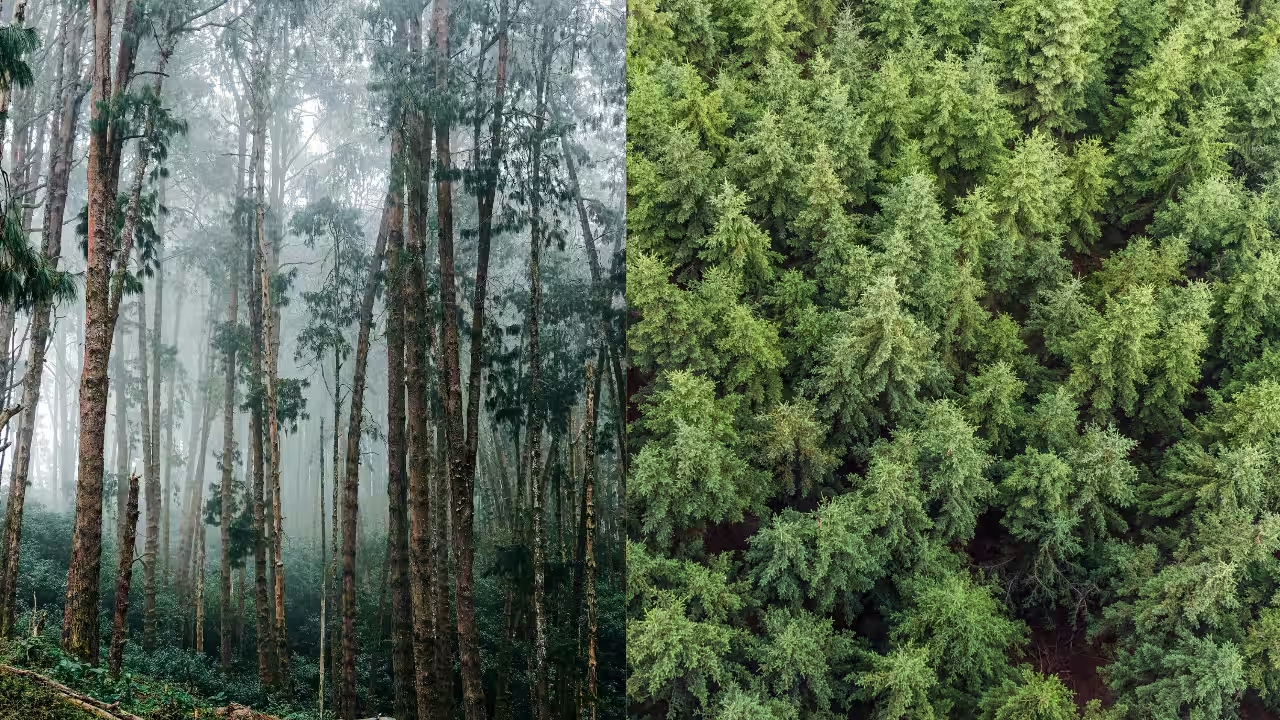
Across Uruguay, large areas of traditional grassland have been converted into managed forests, particularly plantations of fast-growing trees such as eucalyptus and pine. The change can bring economic benefits through timber production, but it also alters how water moves through the landscape. A 20-year paired-watershed study in northern Uruguay provides one of the clearest long-term measurements of that effect. According to the study ‘Hydrologic Impacts of Afforestation in Uruguay, A 20-Year Paired Watershed Study,’ researchers monitored two neighbouring watersheds beginning in 2000, one remained pasture while the other was planted with loblolly pine in 2003. By the end of the study, the forested watershed was producing substantially less water than it would have under grassland. The researchers found that cumulative water yield fell by 35% over the 17-year period after planting, with the difference becoming apparent several years after the trees were established.Uruguay's grasslands were gradually replaced by managed forestsUruguay has undergone substantial changes in land use as managed forestry expanded across areas historically dominated by grasslands. Pine and eucalyptus plantations are particularly important to the country's forestry sector, and the expansion has raised questions about how replacing grass with trees affects water availability. The researchers behind the 20-year study noted that substantial portions of Uruguay's grassland were being converted to managed forest, while relatively few long-term paired-watershed experiments had been conducted in South America. Their study was therefore designed to isolate the effects of changing vegetation rather than simply comparing unrelated catchments. At La Corona estancia in the Tacuarembó River basin, two neighbouring watersheds covering 69 and 108 hectares were monitored for rainfall, water-table depth and stream outflow. Both remained pasture during a three-year preparation period before one was planted with loblolly pine in July 2003.Scientists tracked the same watersheds for two decadesThe researchers used a paired-watershed approach, allowing them to compare a forested catchment with a nearby pasture catchment experiencing broadly similar weather. This is important because rainfall can vary substantially from year to year, making short-term comparisons difficult. Monitoring began in 2000, providing three years of measurements before planting established a baseline for the two watersheds. The treatment watershed was then converted from pasture to loblolly pine, while the neighbouring watershed remained under grassland management. Measurements continued through June 2020, creating a 20-year record that captured the trees' development from newly planted seedlings to a mature plantation. The study found that differences in water yield were not immediately obvious. The reduction only became detectable around four years after planting, but the gap between the forested and pasture watersheds subsequently became significant during the final 12 years of the study.The forested watershed eventually carried 35% less waterThe central finding was striking, cumulative water yield from the pine-planted watershed was 35% lower during the 17 years following afforestation than it would have been under the pasture conditions represented by the paired watershed. The reduction was not limited to unusually wet or dry periods. Daily flow analysis showed that high flows occurring less than 20% of the time were reduced by roughly 40% to 50%, while the remaining lower flows were reduced by approximately 50% to 70%. The researchers linked the change to the biology of the trees themselves. Pine roots penetrate deeper into the soil than the shallow-rooted grasses they replaced, allowing the trees to access more water from the soil profile. That additional water was then used through transpiration, reducing the amount ultimately available to leave the watershed as streamflow.The findings reveal a trade-off between forests and waterThe Uruguay experiment does not mean that planting trees universally reduces water supplies by the same amount everywhere. The researchers specifically studied a pine plantation replacing grassland under the conditions of northern Uruguay, and they noted that the magnitude of the effect varied with weather and tree growth. Other research has also found streamflow reductions associated with afforestation in Uruguay, although the scale of the effect can differ between watersheds. A 2024 study by Jimena Alonso, Luis Silveira and Rutger Willem Vervoort, for example, found significant streamflow declines in four highly afforested large basins in northern Uruguay, with changes becoming apparent when afforestation reached about 15% of basin area. More recent research has emphasised that forest density, landscape configuration, catchment characteristics and management all influence the hydrological response.The 20-year study ultimately highlights a less visible consequence of changing a landscape from grassland to forest. Trees can transform the appearance and economic use of an area while simultaneously changing its water cycle beneath the surface. At La Corona, the difference took several years to emerge, but became increasingly pronounced as the pine plantation developed. The researchers continue to study the site to understand how afforestation affects water through the full production cycle. Their findings provide an unusually long-term look at the trade-off involved when grasslands are converted into managed forests, the landscape gains trees, but a smaller share of rainfall ultimately leaves the watershed as water flowing downstream.Catch the latest World News and Live updates. Download the TOI app.
Topics in this story
- Uruguay afforestation study
- pine plantation water yield
- paired watershed study
- eucalyptus pine plantations Uruguay
- streamflow reduction forestry
- grassland to forest conversion
- forest hydrology research
- Tacuarembó River basin
- loblolly pine watershed
- water yield reduction afforestation
- World news
- World news today
Gathered from external sources. Rights to this text belong to whoever originally published it.